How to Journal Like Haruki Murakami
Summary
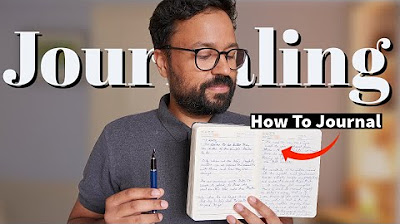
TLDRIn this video, Sam Mass explores a grounded approach to journaling, emphasizing the power of observation over introspection. Drawing on Haruki Murakami's memoir *What I Talk About When I Talk About Running*, Sam discusses how focusing on ordinary, external details—like the weather, daily routines, or simple activities—can lead to deeper, unforced insights. He suggests that starting with small, sensory-based observations removes pressure and allows natural reflection to emerge. This method makes journaling a less daunting practice and helps writers find meaning in the everyday.
Takeaways
- 😀 Many people struggle with journaling because they feel pressured to write something deep or profound, which often leads to paralysis in front of a blank page.
- 😀 Modern culture has turned journaling into a performance focused on self-improvement, rather than a simple practice of noticing and recording daily life.
- 😀 Historically, journaling was about documenting ordinary external details—weather, food, work, encounters—which often carried meaning without forcing introspection.
- 😀 Focusing on external observations can naturally lead to deeper insights, as illustrated in .
- 😀 uses running logs and everyday details as an entry point for reflections on aging, discipline, and creativity.
- 😀 Starting with small, concrete details makes writing easier than tackling large abstract questions like identity, happiness, or personal change.
- 😀 Narrowing focus can unlock creativity, as shown in , where writing about a single brick led to unexpected depth.
- 😀 Journaling works like conversation: beginning with neutral, everyday topics often leads to more honest emotional expression than direct self-interrogation.
- 😀 Writing indirectly around difficult topics can feel safer and result in greater honesty than confronting them head-on.
- 😀 Tying journaling to an existing habit or identity-based practice makes it more sustainable than pairing it with new, demanding routines.
- 😀 Practices rich in sensory details—like running, cooking, or observing from a window—provide strong anchors for meaningful journaling.
- 😀 Describing simple external details, a technique often used by , can be an effective way to overcome resistance and begin writing.
- 😀 The less you try to sound deep in your journaling, the deeper your insights tend to become through sustained attention to the real world.
Q & A
Why do many people struggle with journaling?
-Many people struggle with journaling because they often don't know what to write. They expect something profound and introspective to come to mind, but when it doesn't, they stop. The pressure to write something meaningful creates a barrier.
How has journaling become a cultural performance, and what impact does that have?
-Journaling has become a cultural performance, especially online, where influencers and writers frame it as a tool for self-discovery and emotional healing. This has shifted the focus from simply recording life to 'fixing' it, making it harder for people to approach journaling casually or organically.
What was the original purpose of journaling, historically?
-Historically, journaling was used to record everyday events and ordinary details of life, like the weather, meals, and interactions with others. The focus was more on observing and documenting life as it happened, rather than attempting to find deep meaning.
How does focusing on external details help with journaling?
-Focusing on external details—such as what happened during your day or your surroundings—helps you ease into journaling. This approach allows deeper reflections to emerge naturally without forcing yourself to confront big, abstract concepts immediately.
How does the book 'What I Talk About When I Talk About Running' by Haruki Murakami relate to journaling?
-In 'What I Talk About When I Talk About Running', Murakami blends memoir and diary by reflecting on ordinary aspects of his running practice, such as distance, weather, and music. These external details lead to deeper reflections on topics like aging, endurance, and the creative process, demonstrating how focusing on external life can reveal inner thoughts.
What is the benefit of starting with small, external details in journaling?
-Starting with small, external details allows you to avoid the pressure of trying to write something profound. By grounding your writing in simple, observable facts, you can naturally start exploring deeper, more meaningful topics.
How does Robert Pirsig’s story about writing about a brick relate to journaling?
-Pirsig’s story about a student struggling to write an assignment teaches that narrowing your focus to something small can help you get started. By focusing on a single brick rather than a vast topic like the United States, the student was able to write 5,000 words. This illustrates how journaling about small, detailed observations can help you dig deeper.
What is the connection between journaling and having a conversation with yourself?
-Journaling can be likened to having a conversation with yourself. If you start with a broad, introspective question, it may freeze you up. But by starting with something more casual or observational, like talking about the weather, you may naturally arrive at deeper reflections without forcing it.
Why can journaling about external details sometimes lead to more honest writing?
-Writing about external details creates a kind of emotional distance, reducing self-consciousness. This makes it easier to express honest thoughts and feelings without the pressure of analyzing them directly. It allows emotions and deeper thoughts to emerge organically.
How does the concept of 'writing around a topic' help with addressing difficult issues in journaling?
-Writing around a difficult topic—rather than directly confronting it—can make it easier to address. Just like having a conversation in a car while looking out the window, journaling about surrounding details can create emotional space, allowing deeper topics to emerge naturally without feeling forced or self-conscious.
What are some practical tips for starting a journaling practice based on this approach?
-Start with something you already do, something full of sensory details. This could be an activity like running, cooking, or simply observing what you see outside a window. The key is to choose something tied to your identity or routine, so journaling becomes an extension of your life, not an added pressure.
How does focusing on sensory details in daily activities make journaling easier?
-Focusing on sensory details, such as the sights, sounds, and smells of your surroundings, makes it easier to start journaling. These details provide concrete starting points for writing, which can lead to deeper reflections and insights as you go along.
How can looking at something like the weather help with writing, according to Hemingway?
-Hemingway often started his chapters by describing the weather, which served as a simple, concrete entry point into writing. Similarly, describing what you see outside can serve as a gentle way to ease into journaling, helping you bypass the pressure to create a complex or profound narrative immediately.
Outlines

このセクションは有料ユーザー限定です。 アクセスするには、アップグレードをお願いします。
今すぐアップグレードMindmap

このセクションは有料ユーザー限定です。 アクセスするには、アップグレードをお願いします。
今すぐアップグレードKeywords

このセクションは有料ユーザー限定です。 アクセスするには、アップグレードをお願いします。
今すぐアップグレードHighlights

このセクションは有料ユーザー限定です。 アクセスするには、アップグレードをお願いします。
今すぐアップグレードTranscripts

このセクションは有料ユーザー限定です。 アクセスするには、アップグレードをお願いします。
今すぐアップグレード関連動画をさらに表示

Cognitive Behavioral Therapy (CBT)

The #1 Journaling Method for Brain Health You Need to Know | Dr. Arif Khan

7 Ways Marcus Aurelius Will Help You Journal Like A Pro | Ryan Holiday | Stoicism

ICT 2026 Lecture: Trading ATH In The ICT PD Array Matrix \ April 20, 2026

20 Top Student Habits Tier List (Which Should You Build Next?)
How To Journal For Self Growth (And Make It A Habit !!)
5.0 / 5 (0 votes)

