Rangkuman Materi IPA Kelas 9 Bab 7 : Pewarisan Sifat pada Makhluk Hidup
Summary
TLDRThis educational video covers the inheritance of traits in living organisms, focusing on genetic material, DNA, and RNA. It explains Mendel's laws of inheritance through monohybrid and dihybrid crosses, illustrating dominant and recessive traits. The video also highlights human genetic disorders like color blindness, hemophilia, and albinism, and discusses the role of genetics in plant and animal breeding. Through Mendel's work, we learn how genetic traits are passed down and how they impact both humans and the environment, including applications in agriculture and animal husbandry.
Takeaways
- 😀 Genetic material is inherited from parents and carried through DNA and RNA molecules.
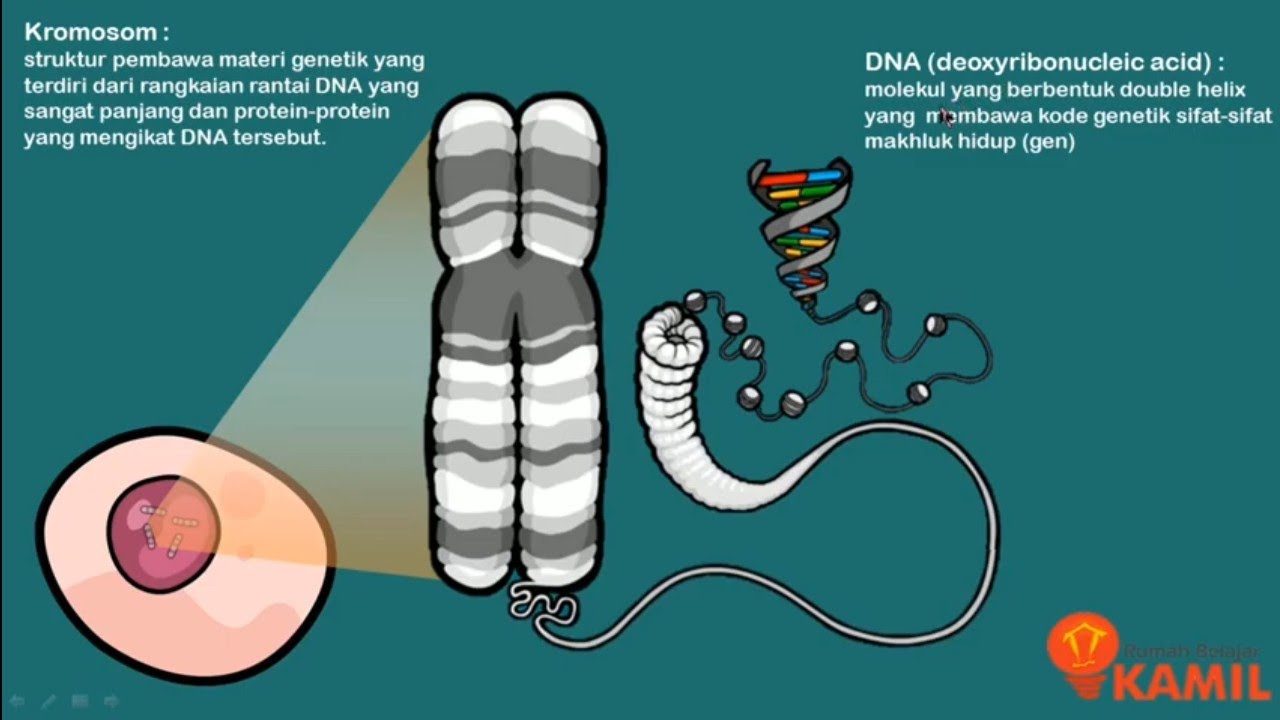
- 😀 DNA is located inside the cell nucleus and consists of long strands that coil around histone proteins to form chromatin and chromosomes.
- 😀 DNA and RNA are made up of nucleotides, which consist of sugar, phosphate, and nitrogenous bases. DNA uses deoxyribose sugar, while RNA uses ribose sugar.
- 😀 DNA consists of four nitrogenous bases: Adenine (A), Thymine (T), Guanine (G), and Cytosine (C), with A pairing with T, and G pairing with C.
- 😀 RNA contains Uracil (U) instead of Thymine (T), so the nitrogenous base pairs in RNA are A-U and G-C.
- 😀 Dominant genes are those that can overpower or mask recessive genes, while recessive genes are those that are overshadowed by dominant genes.
- 😀 The genotype refers to the genetic makeup of an individual, while the phenotype refers to the visible traits or characteristics.
- 😀 Humans have 23 pairs of chromosomes, where the paired chromosomes are diploid (2N) and the unpaired ones are haploid (N).
- 😀 Gregor Mendel’s work led to the development of Mendel's Laws of Heredity, including the Law of Segregation and the Law of Independent Assortment.
- 😀 Mendel’s experiments with pea plants demonstrated how traits are inherited, showing dominant and recessive patterns in monohybrid and dihybrid crosses.
- 😀 Human genetic conditions such as color blindness, hemophilia, and albinism can be inherited, with color blindness being linked to the X chromosome.
- 😀 Hybrid varieties in agriculture are created through crossbreeding plants or animals to combine desirable traits, such as the creation of broiler chickens.
Q & A
What is the role of genetic material in inheritance?
-Genetic material, such as DNA, is responsible for passing traits and characteristics from parents to offspring. These traits are inherited through genes, which are segments of DNA that carry specific instructions for each characteristic.
What is the structure of DNA and RNA?
-DNA has a double-stranded helix structure, while RNA is single-stranded. Both DNA and RNA are made up of nucleotides, which consist of a sugar, phosphate group, and nitrogenous base. DNA uses deoxyribose sugar, while RNA uses ribose sugar.
What are the four nitrogenous bases found in DNA?
-The four nitrogenous bases in DNA are adenine (A), thymine (T), guanine (G), and cytosine (C). Adenine pairs with thymine, and guanine pairs with cytosine.
What are dominant and recessive traits?
-Dominant traits are those that can mask or hide other traits, while recessive traits are masked by dominant traits. Dominant genes are typically represented by capital letters, and recessive genes are represented by lowercase letters.
What is the difference between genotype and phenotype?
-Genotype refers to the genetic makeup of an organism, which is inherited and cannot be seen directly. Phenotype refers to the observable traits or characteristics that result from the genotype and environmental factors.
How many chromosomes are found in a human body?
-Humans have 23 pairs of chromosomes, totaling 46 chromosomes. These chromosomes come in pairs, with one chromosome from each parent.
What are homozygous and heterozygous individuals?
-A homozygous individual has two identical alleles for a trait, while a heterozygous individual has two different alleles for a trait.
What is Gregor Mendel's contribution to genetics?
-Gregor Mendel is known as the father of genetics. He discovered the fundamental laws of inheritance, which include the Law of Segregation and the Law of Independent Assortment, through his experiments with pea plants.
What is the significance of Mendel's monohybrid and dihybrid crosses?
-Mendel's monohybrid cross studied inheritance involving a single trait, while his dihybrid cross studied the inheritance of two traits simultaneously. These experiments led to the discovery of the ratios of inheritance, such as the 3:1 ratio in monohybrid crosses and 9:3:3:1 in dihybrid crosses.
What are some examples of inherited traits and disorders in humans?
-Inherited traits in humans can include skin color, hair type, and ear lobe attachment. Some inherited disorders include albinism (lack of melanin), color blindness, hemophilia (difficulty with blood clotting), and certain types of cancer.
Outlines

このセクションは有料ユーザー限定です。 アクセスするには、アップグレードをお願いします。
今すぐアップグレードMindmap

このセクションは有料ユーザー限定です。 アクセスするには、アップグレードをお願いします。
今すぐアップグレードKeywords

このセクションは有料ユーザー限定です。 アクセスするには、アップグレードをお願いします。
今すぐアップグレードHighlights

このセクションは有料ユーザー限定です。 アクセスするには、アップグレードをお願いします。
今すぐアップグレードTranscripts

このセクションは有料ユーザー限定です。 アクセスするには、アップグレードをお願いします。
今すぐアップグレード関連動画をさらに表示
BIOLOGI SMA Kelas 12 - Materi Genetik | GIA Academy
Genetic Principles
Kamu unik, dan genmu adalah buktinya! Simak video ini....bagaimana DNA membentuk dirimu🧍🏻👋🏻

PEWARISAN SIFAT PADA MAHLUK HIDUP: IPA SMP KELAS 9

Biochemistry and Clinical pathology Chapter 1 | Cell and it's biochemical organization #biochemistry
IPA Kelas 9 : Pewarisan Sifat I (Materi Genetik : Kromosom, DNA dan RNA)
5.0 / 5 (0 votes)

