Heat Transfer - Chapter 9 - Conceptual Introduction to Natural (Free) Convection)
Summary
TLDRIn this video lecture, the concept of natural or free convection is introduced, explaining how heat transfer occurs in a fluid without forced flow. The process begins with a hot object in a still room, causing the surrounding air to warm and expand, creating buoyancy forces that induce circulation. The lecture compares free convection with forced convection, where external forces like a fan or pump drive fluid motion. It also discusses the role of thermal stratification and boundary layers in natural convection, demonstrating how temperature differences within the fluid lead to fluid movement and heat transfer.
Takeaways
- 🔥 Natural convection (also called free convection) occurs without externally forced fluid motion; buoyancy forces created by temperature differences drive the flow.
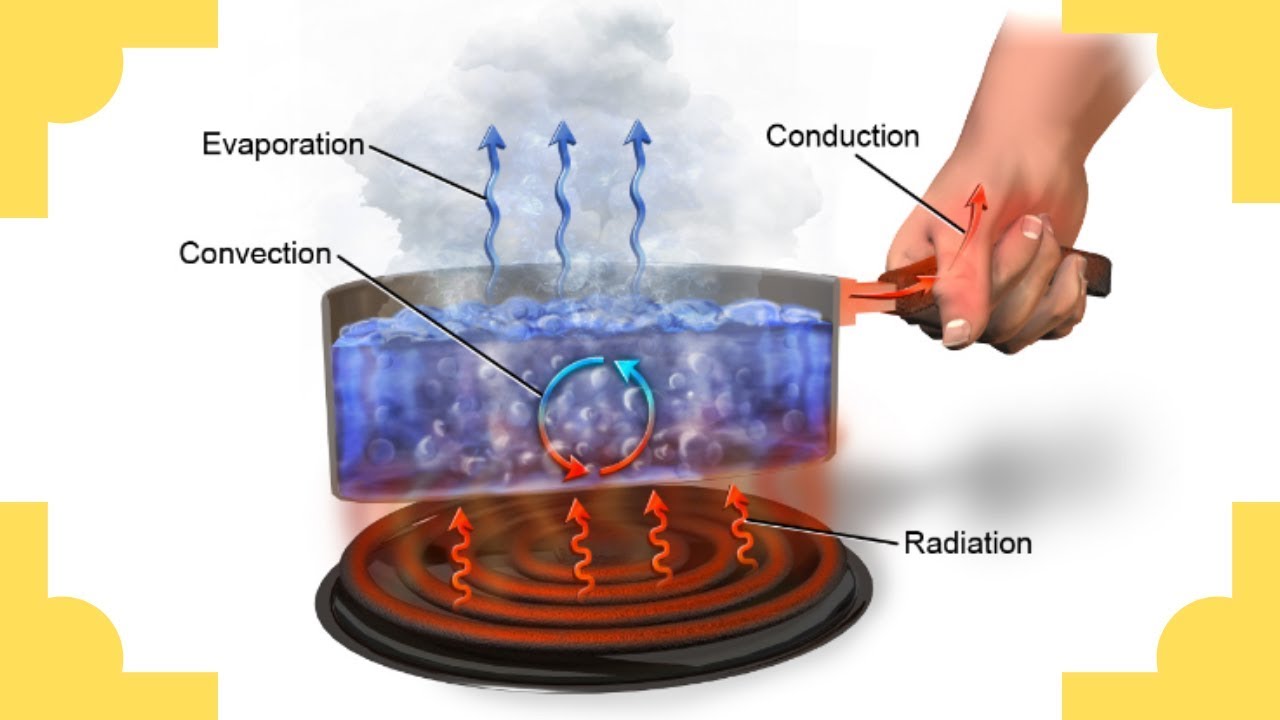
- 🌡️ Even in a perfectly still room, a hot object will transfer heat to the surrounding air due to conduction initially—and then convection as buoyancy-induced flow develops.
- 📈 As air near a hot surface warms, it expands, becomes less dense, and rises, creating circulation currents that enhance heat transfer.
- 💨 Convection is always a combination of conduction (microscopic energy transfer) and advection (energy carried by moving fluid). Natural convection includes both.
- ❄️ Natural convection also occurs during cooling: cold surfaces cool nearby air, making it denser so it sinks, producing downward flow.
- ⚡ Forced convection requires an external mechanism (e.g., fans, wind, pumps) to move the fluid, while natural convection relies solely on buoyancy forces.
- 🔀 Mixed convection occurs when both forced and natural convection mechanisms play significant roles.
- 📊 Temperature gradients create fluid stratification: hotter fluid below colder fluid creates an unstable condition that induces circulation; colder fluid below hotter fluid is stable.
- 🌀 Buoyancy-driven flow still forms velocity and thermal boundary layers similar to forced convection, but bounded by surrounding stationary fluid.
- 🧊 The thermal boundary layer develops as temperature transitions from surface temperature to ambient temperature, affecting natural convection heat transfer behavior.
- 📏 Velocity boundary layers in natural convection are shaped by no-slip conditions at the solid surface and the stationary fluid boundary above.
Q & A
What is the difference between forced convection and natural convection?
-Forced convection involves an active fluid flow created by external forces like a fan or pump, while natural convection, also known as free convection, occurs when fluid flow is induced by buoyancy forces due to temperature differences, without any external fluid movement.
Can heat transfer occur in a room with still air and a hot object?
-Yes, heat transfer will occur even if the air is still. This happens due to natural convection, where the air near the hot object gets heated, expands, becomes less dense, and rises, creating a circulation that transfers heat.
Why does fluid start to circulate around a hot object even when the air is initially still?
-When the fluid near the hot object gets heated, it expands, causing its density to decrease. This creates a buoyancy force that induces fluid movement, leading to circulation around the object.
What role does buoyancy play in natural convection?
-Buoyancy forces drive fluid movement in natural convection. When a fluid near a hot object heats up, its density decreases, causing it to rise, while the cooler, denser fluid sinks, creating a natural circulation pattern.
How does the temperature gradient in a fluid affect its circulation?
-A temperature gradient in a fluid, where hotter fluid is at the bottom and cooler fluid is at the top, causes the hotter, less dense fluid to rise and the cooler, denser fluid to sink. This uneven heating leads to natural fluid circulation, which is essential for convection.
What is the difference between stable and unstable fluid stratification?
-In unstable stratification, the hotter fluid rises, and the cooler fluid sinks, leading to circulation. In stable stratification, the colder, denser fluid remains at the bottom, and no fluid movement occurs unless disturbed.
Can natural convection occur during cooling as well as heating?
-Yes, natural convection can occur during both heating and cooling. In cooling, the colder surface causes the fluid around it to become denser and sink, while the warmer fluid moves upward.
What happens when a hot object is surrounded by stationary fluid?
-Initially, heat transfer will occur by conduction, where heat from the object is transferred to the fluid in contact with it. As the fluid warms up and becomes less dense, buoyancy forces cause it to circulate, leading to convection.
How does advection contribute to heat transfer in natural convection?
-Advection occurs when heated fluid moves and carries energy with it. In natural convection, as fluid rises due to heating, it advects heat away from the surface, contributing to the overall heat transfer process.
What is the role of boundary layers in natural convection?
-Boundary layers form at the surface of a hot or cold object, where the fluid near the surface has a slower velocity due to viscous effects. These layers play a crucial role in determining the efficiency of heat transfer in both natural and forced convection.
Outlines

このセクションは有料ユーザー限定です。 アクセスするには、アップグレードをお願いします。
今すぐアップグレードMindmap

このセクションは有料ユーザー限定です。 アクセスするには、アップグレードをお願いします。
今すぐアップグレードKeywords

このセクションは有料ユーザー限定です。 アクセスするには、アップグレードをお願いします。
今すぐアップグレードHighlights

このセクションは有料ユーザー限定です。 アクセスするには、アップグレードをお願いします。
今すぐアップグレードTranscripts

このセクションは有料ユーザー限定です。 アクセスするには、アップグレードをお願いします。
今すぐアップグレード関連動画をさらに表示

Heat Transfer - Chapter 8 - Internal Convection - Hydrodynamic Considerations

CONVECÇÃO TÉRMICA (Física - 2o ANO)

06 Pengenalan Konveksi Part1 PERPAN
Conduction -Convection- Radiation-Heat Transfer

Propagação de calor - CONDUÇÃO, CONVECÇÃO E IRRADIAÇÃO
Thermal Conductivity, Stefan Boltzmann Law, Heat Transfer, Conduction, Convecton, Radiation, Physics
5.0 / 5 (0 votes)

