Bu Anita sedang zoom ekonomi
Summary
TLDRThis video lecture explains the concept of market equilibrium, illustrating the interaction between demand and supply curves. The instructor defines equilibrium as the point where quantity demanded equals quantity supplied, resulting in a market-clearing price. The lesson explores scenarios when prices deviate from equilibrium: higher prices create excess supply, while lower prices lead to excess demand. Practical implications are discussed, emphasizing that in a perfectly competitive market, no single producer or consumer can influence prices. The lecture also includes visual demonstrations using colored curves to clarify shifts in demand and supply, helping viewers understand how prices naturally adjust to restore market balance.
Takeaways
- 😀 Market equilibrium occurs when the quantity demanded equals the quantity supplied at a particular price.
- 😀 The demand curve shows that as price decreases, consumers are willing to buy more, leading to an increase in demand.
- 😀 The supply curve illustrates that as price increases, producers are willing to supply more, leading to an increase in supply.
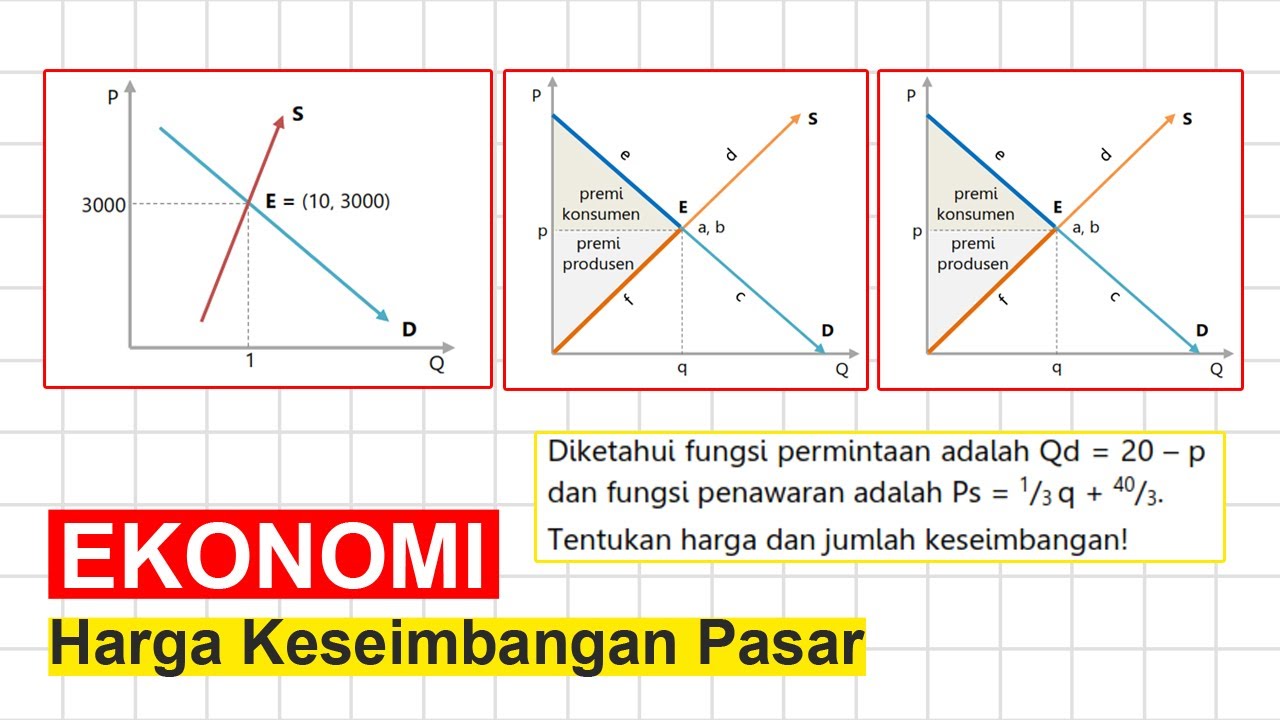
- 😀 The intersection of the demand and supply curves represents the equilibrium price and quantity in the market.
- 😀 At equilibrium, the amount produced equals the amount consumed, resulting in no surplus or shortage of goods.
- 😀 If the price is above the equilibrium price, excess supply occurs, leading to unsold goods and the need for price reduction.
- 😀 If the price is below the equilibrium price, excess demand occurs, leading to shortages, and price needs to be increased.
- 😀 In a perfectly competitive market, neither consumers nor producers have enough power to influence the market price significantly.
- 😀 Real-world markets may deviate from perfect competition, where some producers or consumers can influence prices.
- 😀 Prices adjust naturally over time to restore equilibrium, either by lowering prices in surplus situations or raising them in shortage situations.
Q & A
What is market equilibrium?
-Market equilibrium occurs when the quantity demanded by consumers equals the quantity supplied by producers, resulting in a balance where all produced goods are sold at a specific price called the equilibrium price.
How is the equilibrium price determined?
-The equilibrium price is determined at the point where the demand curve and the supply curve intersect. At this price, the quantity demanded equals the quantity supplied.
What does the demand curve represent?
-The demand curve, usually downward-sloping, represents consumers' behavior: as prices decrease, the quantity demanded increases.
What does the supply curve represent?
-The supply curve, usually upward-sloping, represents producers' behavior: as prices increase, producers are willing to supply more goods.
What happens when the market price is above the equilibrium price?
-If the market price is above equilibrium, there will be excess supply (surplus) because producers supply more than consumers are willing to buy. Prices then tend to fall to restore equilibrium.
What happens when the market price is below the equilibrium price?
-If the market price is below equilibrium, there will be excess demand (shortage) because consumers want to buy more than producers are willing to supply. Prices then tend to rise to restore equilibrium.
Why does market equilibrium assume a perfectly competitive market?
-Equilibrium analysis assumes a perfectly competitive market where no single producer or consumer can influence the market price. All participants are price takers and follow the market price.
How can equilibrium quantity be calculated mathematically?
-Equilibrium quantity can be calculated by setting the demand equation equal to the supply equation and solving for the price. Substituting this price into either the demand or supply equation gives the equilibrium quantity.
Why is it important for prices to adjust in response to surplus or shortage?
-Price adjustments ensure that the market clears, meaning goods are neither left unsold (surplus) nor in shortage. This self-correcting mechanism helps maintain market efficiency.
What is the effect of a price lower than equilibrium on consumers and producers?
-A price lower than equilibrium benefits consumers because they can buy more at a cheaper price, but it disadvantages producers because they supply less, leading to potential shortages.
What is the effect of a price higher than equilibrium on consumers and producers?
-A price higher than equilibrium benefits producers because they can sell at a higher price, but it disadvantages consumers who buy less due to the high price, creating surplus goods.
How does understanding market equilibrium help in real-life markets?
-Understanding market equilibrium helps predict how prices and quantities adjust in response to changes in supply or demand, enabling better decision-making for producers, consumers, and policymakers.
Outlines

Cette section est réservée aux utilisateurs payants. Améliorez votre compte pour accéder à cette section.
Améliorer maintenantMindmap

Cette section est réservée aux utilisateurs payants. Améliorez votre compte pour accéder à cette section.
Améliorer maintenantKeywords

Cette section est réservée aux utilisateurs payants. Améliorez votre compte pour accéder à cette section.
Améliorer maintenantHighlights

Cette section est réservée aux utilisateurs payants. Améliorez votre compte pour accéder à cette section.
Améliorer maintenantTranscripts

Cette section est réservée aux utilisateurs payants. Améliorez votre compte pour accéder à cette section.
Améliorer maintenantVoir Plus de Vidéos Connexes




5.0 / 5 (0 votes)

