Modul 01-01 PENGANTAR
Summary
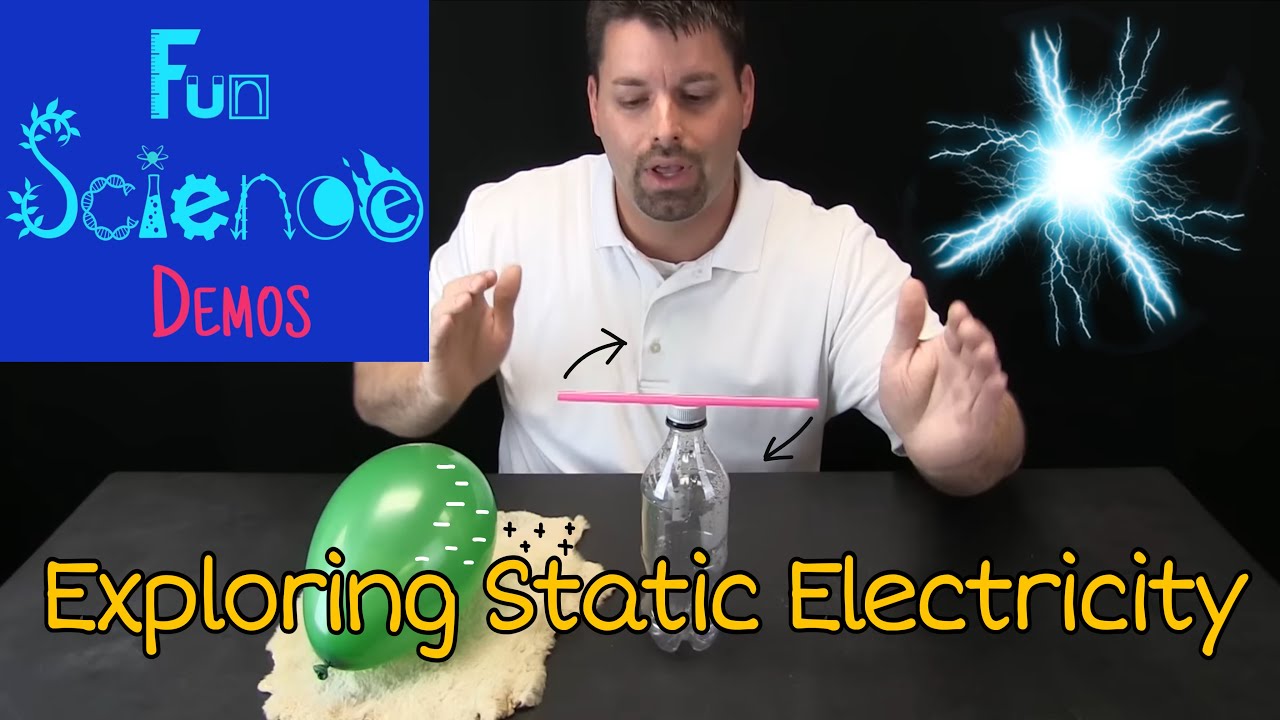
TLDRThis video explores the fascinating world of static electricity, illustrating everyday phenomena such as hair standing on end, a balloon attracting paper, and glass plates repelling or attracting depending on their charges. It introduces the concept of electric charge, explaining that like charges repel while opposite charges attract. The video then delves into Coulomb's Law, formulated by Charles Coulomb in the 18th century, which quantifies the force between two charges as proportional to the product of their charges and inversely proportional to the square of the distance between them. Finally, it compares electric forces with gravitational forces, highlighting similarities and key differences in their behavior and units.
Takeaways
- 😀 Static electricity is commonly observed in everyday phenomena like lightning, capacitors, and simple experiments with objects like combs and balloons.
- 😀 Objects can become electrically charged, leading to attractions or repulsions based on whether their charges are similar or opposite.
- 😀 When two objects have similar charges, they repel each other, while opposite charges attract.
- 😀 Coulomb's Law describes how electric charges interact with each other, particularly the force between them based on the magnitude of charges and the distance between them.
- 😀 The formula for Coulomb’s Law is: F = k × (Q1 × Q2) / r², where F is the force, Q1 and Q2 are the charges, and r is the distance between them.
- 😀 Coulomb’s constant (k) and the distance between charges (r) play a crucial role in determining the force between two charges.
- 😀 Electric force is directly proportional to the product of the two charges and inversely proportional to the square of the distance between them.
- 😀 Unlike gravitational force, which only attracts, the electric force can either attract or repel based on the type of charges involved.
- 😀 Gravitational force and Coulomb's force share similar mathematical forms, but they differ in their constants and the type of interaction (attraction vs. attraction/repulsion).
- 😀 The units of Coulomb’s constant (k) and the force are crucial for understanding how the forces behave in the context of electric charges, with units like Newtons, meters, and Coulombs being involved.
Q & A
What is static electricity, and where can we observe it in daily life?
-Static electricity refers to the accumulation of electric charge on the surface of objects. It can be observed in phenomena like lightning during thunderstorms, where electrical charges jump between clouds and the Earth. It is also noticeable in everyday activities such as when we brush dry hair and it causes small objects like paper scraps to be attracted to a comb or balloon.
How do capacitors in electronic devices use the principle of static electricity?
-Capacitors in electronic devices store and release electric charge, utilizing the principles of static electricity. They consist of two conductive plates separated by an insulating material, which can accumulate electric charge and then release it when needed to stabilize the power supply.
Why does a comb attract paper scraps when rubbed against dry hair?
-When a comb is rubbed against dry hair, it becomes electrically charged due to friction. This results in the comb having a negative or positive charge, which attracts the small paper scraps because the objects have an opposite charge, causing them to be pulled towards the comb.
What happens when two objects with different charges are brought together?
-When two objects with different charges (one positive and one negative) are brought close together, they will attract each other. This attraction occurs due to the electric force between the opposite charges.
What happens when two objects with the same charge are brought together?
-When two objects with the same charge (either both positive or both negative) are brought together, they will repel each other. Like charges repel due to the electric force between them.
What is Coulomb's Law, and what does it describe?
-Coulomb's Law describes the electric force between two charged objects. It states that the force is directly proportional to the product of the charges and inversely proportional to the square of the distance between them. In other words, the closer the charges are, the stronger the force between them, and the larger the charges, the stronger the force.
How does the force between charges change with distance according to Coulomb's Law?
-According to Coulomb's Law, the electric force between two charges is inversely proportional to the square of the distance between them. This means that as the distance between the charges increases, the force between them decreases significantly.
What is the mathematical formula for Coulomb's Law?
-The formula for Coulomb's Law is: F = k * (Q1 * Q2) / r². Here, F is the electric force, k is Coulomb's constant, Q1 and Q2 are the charges, and r is the distance between the charges.
How does Coulomb's Law compare to Newton's Law of Gravitation?
-Coulomb's Law and Newton's Law of Gravitation are similar in structure. Both describe a force between two objects based on their properties (charge for Coulomb's Law and mass for gravity) and the distance between them. However, Coulomb's Law deals with electric forces and can involve both attraction and repulsion, whereas gravitational forces are always attractive.
What is the significance of the constant 'k' in Coulomb's Law?
-The constant 'k' in Coulomb's Law is Coulomb's constant, which helps quantify the electric force between charges. Its value is approximately 8.99 × 10⁹ N·m²/C². It is crucial for calculating the force when you know the amount of charge and the distance between the charges.
Outlines

Cette section est réservée aux utilisateurs payants. Améliorez votre compte pour accéder à cette section.
Améliorer maintenantMindmap

Cette section est réservée aux utilisateurs payants. Améliorez votre compte pour accéder à cette section.
Améliorer maintenantKeywords

Cette section est réservée aux utilisateurs payants. Améliorez votre compte pour accéder à cette section.
Améliorer maintenantHighlights

Cette section est réservée aux utilisateurs payants. Améliorez votre compte pour accéder à cette section.
Améliorer maintenantTranscripts

Cette section est réservée aux utilisateurs payants. Améliorez votre compte pour accéder à cette section.
Améliorer maintenant




5.0 / 5 (0 votes)

