Apparato Escretore (Apparato Urinario) - Il Corpo Umano
Summary
TLDRThis educational video explains the human excretory system, focusing on the urinary apparatus. It covers the role of kidneys in filtering the blood, the formation of urine, and how waste is expelled from the body. The script explains the structure of the kidneys, the function of nephrons, and the processes of ultrafiltration, reabsorption, and secretion. It also highlights differences in the urinary systems of males and females, including urethra length and bladder capacity. The video concludes with a summary of how urine concentration is regulated and encourages viewers to support the channel.
Takeaways
- 💧 The excretory system, also called the urinary system, is primarily responsible for removing waste substances from the body, distinct from other organs that also perform excretion like the skin, lungs, liver, and digestive system.
- 🧬 The kidneys are the main organs of the urinary system, filtering blood to remove metabolic wastes, including nitrogenous compounds transformed into urea by the liver.
- 🩸 Each kidney has an outer cortex and an inner medulla, with nephrons as functional units that perform filtration, reabsorption, and secretion.
- ⚡ The filtration process occurs in the renal corpuscle, where the glomerulus and Bowman's capsule allow small molecules like water, glucose, salts, and urea to pass while retaining cells and large or negatively charged proteins.
- 🔄 Reabsorption and secretion in the nephron tubules return useful substances (glucose, amino acids, vitamins) to the blood and secrete additional wastes, including some drugs, into the filtrate.
- 💦 Urine concentration and pH regulation occur in the distal tubule and collecting duct, influenced by hormones such as antidiuretic hormone (ADH) and aldosterone to balance water and salt in the body.
- 🧪 Only about 1% of the plasma filtered by the kidneys ends up as urine; the rest is reabsorbed to maintain homeostasis.
- 🛢️ Urine is transported from the kidneys through the ureters to the bladder, which acts as a distensible storage reservoir with specialized layers to accommodate varying volumes.
- 🚪 The bladder has two sphincters: an involuntary internal sphincter and a voluntary external sphincter, allowing controlled urination, but only up to around half a liter before reflexes may cause urgency.
- ♂️♀️ Anatomical differences between sexes include the length of the urethra (shorter in females) and bladder size, influencing frequency and control of urination.
- 🧠 Stretch receptors in the bladder send signals to the spinal cord to coordinate urination reflexes, but conscious control can override this up to physiological limits.
Q & A
What is the primary function of the excretory system?
-The primary function of the excretory system is to remove waste substances from the body, maintain water and electrolyte balance, regulate blood pressure and pH, and secrete hormones.
Which organs contribute to excretion aside from the urinary system?
-Other organs contributing to excretion include the skin (through sweat), the lungs (through CO₂ elimination), the liver (by metabolizing substances and producing urea), and the digestive system (by expelling solid waste).
What are the main components of the urinary system?
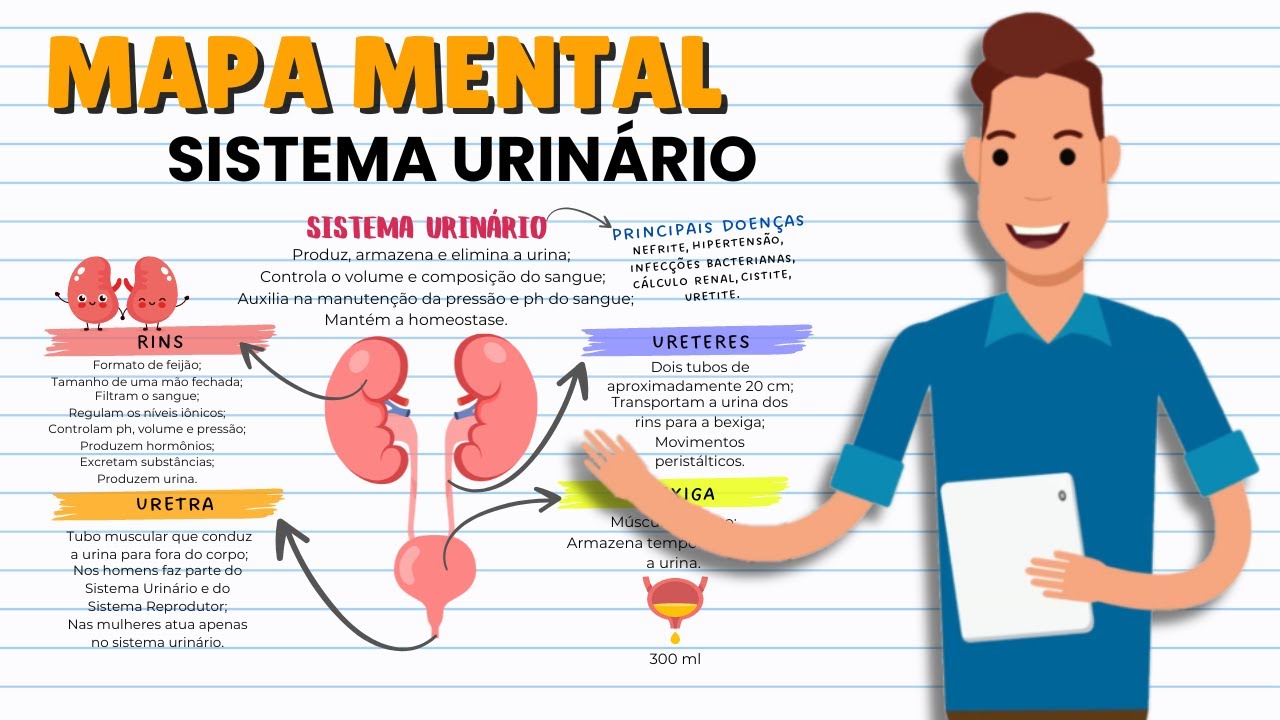
-The urinary system consists of the kidneys, ureters, bladder, and urethra. The kidneys filter blood, ureters transport urine to the bladder, the bladder stores urine, and the urethra expels it outside the body.
How is a nephron structured and what are its main parts?
-A nephron consists of the renal corpuscle (glomerulus and Bowman’s capsule), proximal convoluted tubule, loop of Henle, distal convoluted tubule, and collecting duct. Each part performs specific functions in filtration, reabsorption, secretion, and urine concentration.
What happens during glomerular ultrafiltration?
-During glomerular ultrafiltration, blood plasma passes from the glomerulus into Bowman’s capsule under high pressure, allowing water and small molecules like glucose, salts, and urea to pass while retaining cells and large or negatively charged proteins like albumin.
What is the role of reabsorption and secretion in the nephron?
-Reabsorption returns useful substances like water, glucose, amino acids, and vitamins back into the blood, while secretion removes additional waste substances, such as drug metabolites, from the blood into the tubule to become part of the urine.
How do ADH and aldosterone regulate urine concentration?
-ADH (antidiuretic hormone) increases water reabsorption in the collecting ducts by opening aquaporin channels, concentrating urine when water is scarce. Aldosterone promotes sodium reabsorption, which indirectly influences water retention and helps regulate blood pressure.
What is the structure and function of the bladder?
-The bladder is a hollow organ with three layers: transitional epithelium, smooth muscle, and connective tissue. It functions as a urine reservoir, can expand due to its folds, and signals the need for urination when stretched.
What are the differences in urethra and bladder anatomy between males and females?
-In females, the urethra is shorter (3–4 cm) and the bladder is slightly smaller, reducing storage capacity. In males, the urethra is longer (about 20 cm) and passes through the penis, resulting in a greater ability to retain urine.
How is urination controlled?
-Urination is controlled by two sphincters: the internal urethral sphincter (involuntary) and the external urethral sphincter (voluntary). Stretch receptors in the bladder send signals to the spinal cord to initiate urination, which can be voluntarily delayed until about half a liter of urine is accumulated.
Approximately what percentage of the plasma filtered by the kidneys is excreted as urine?
-Less than 1% of the plasma filtered by the kidneys is ultimately excreted as urine; the rest is reabsorbed into the bloodstream.
Outlines

Cette section est réservée aux utilisateurs payants. Améliorez votre compte pour accéder à cette section.
Améliorer maintenantMindmap

Cette section est réservée aux utilisateurs payants. Améliorez votre compte pour accéder à cette section.
Améliorer maintenantKeywords

Cette section est réservée aux utilisateurs payants. Améliorez votre compte pour accéder à cette section.
Améliorer maintenantHighlights

Cette section est réservée aux utilisateurs payants. Améliorez votre compte pour accéder à cette section.
Améliorer maintenantTranscripts

Cette section est réservée aux utilisateurs payants. Améliorez votre compte pour accéder à cette section.
Améliorer maintenant



5.0 / 5 (0 votes)

