Pendahuluan Statistika - Pertemuan 1
Summary
TLDRThis video provides an introduction to basic statistics (statistika), covering essential topics such as the difference between statistik and statistika, types of data, and methods for collecting and analyzing data. It explains qualitative and quantitative data, as well as various scales of measurement such as nominal, ordinal, interval, and ratio. The video also discusses data sources, including primary and secondary data, and the importance of statistics in research, government, and education. Finally, it outlines the steps for processing and presenting data through tables and graphs, with practical examples using Excel.
Takeaways
- 😀 Statistics represents the results of data processing, presented in tables, graphs, or diagrams, while statistika refers to the methods for collecting, analyzing, and presenting data.
- 😀 Qualitative data is categorical, such as gender, favorite color, or ethnicity, whereas quantitative data involves numbers, further divided into discrete (whole numbers) and continuous (measurable) types.
- 😀 Data sources can be external (primary or secondary) or internal (within the organization). Primary data is collected directly through methods like surveys, while secondary data is pre-existing.
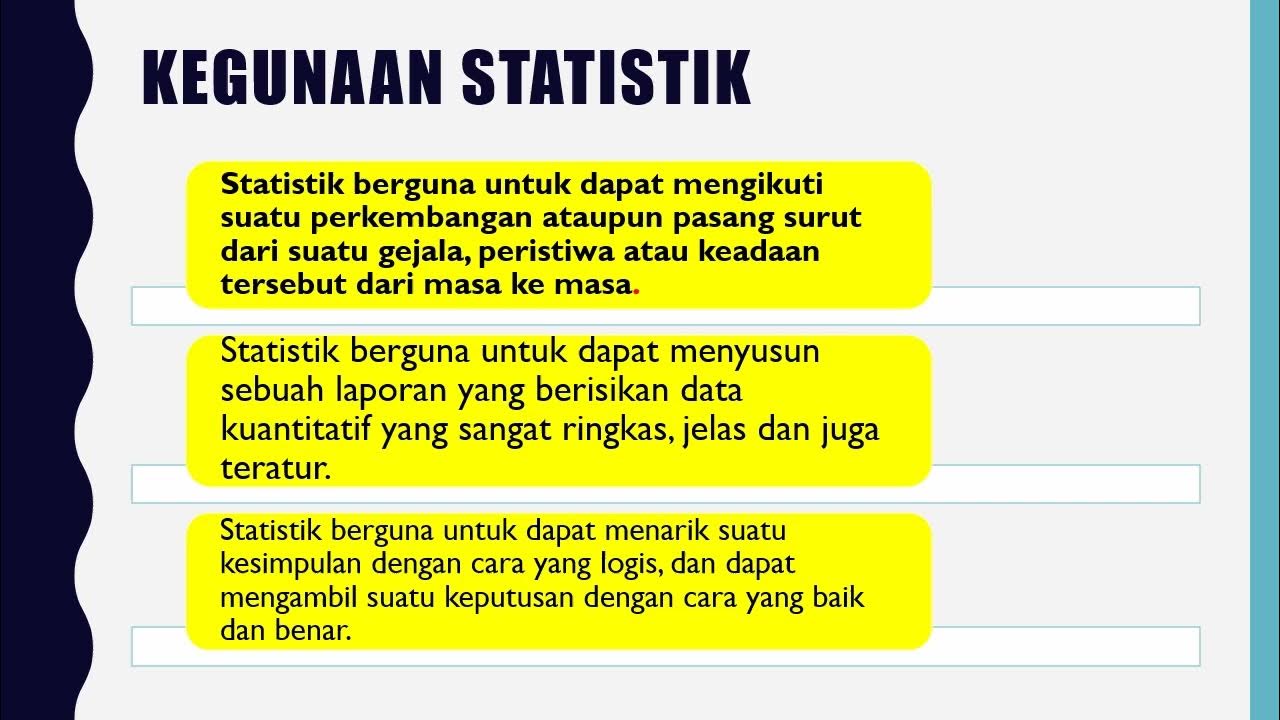
- 😀 Statistics is useful for various fields, including research, government policy-making, and psychology, as it helps in decision-making, prediction, and data interpretation.
- 😀 Measurement scales in statistics are nominal (categorical), ordinal (ranked), interval (equal distances, but no true zero), and ratio (equal distances with a true zero).
- 😀 Population refers to the entire group under study, while a sample is a subset of the population used for research or surveys.
- 😀 Data collection techniques include censuses (entire population) and surveys (sample), with methods like interviews, questionnaires, and field research.
- 😀 The steps in data processing include editing (ensuring accuracy), coding (simplifying responses into categories), and tabulation (organizing data into tables or charts).
- 😀 Data presentation can be in the form of tables (e.g., frequency distribution) or graphs (e.g., bar charts, pie charts, line graphs).
- 😀 Statistika involves not only data collection but also interpreting and presenting data through various statistical techniques to ensure accurate analysis.
Q & A
What is the difference between 'statistik' and 'statistika'?
-'Statistik' refers to the results of data processing presented in the form of tables, graphs, and diagrams. In contrast, 'statistika' is the science or methodology that involves collecting, managing, analyzing, interpreting, and presenting data through classification.
What are the two types of data mentioned in the script?
-The two types of data are 'qualitative' (kualitatif) and 'quantitative' (kuantitatif). Qualitative data consists of categories or attributes, while quantitative data consists of numbers, which can be further classified into discrete and continuous data.
What is the distinction between discrete and continuous quantitative data?
-Discrete data consists of whole numbers or integers, like the number of cars or students, while continuous data can be fractions or decimals, such as weight or distance.
What are primary and secondary sources of data?
-Primary data is collected and processed firsthand, such as through surveys or interviews. Secondary data has already been collected and is available from external sources, like government reports or databases from organizations like the World Bank.
How does statistika benefit researchers and various sectors?
-Statistika helps researchers make informed decisions by analyzing data. It also aids in predicting outcomes, assessing the effectiveness of past projects, and planning for the future. For governments, it is useful in evaluating development programs and making policy decisions.
What are the four levels of data measurement scales mentioned in the script?
-The four levels of data measurement scales are: nominal (categorical), ordinal (ranked), interval (equal distance between values, like temperature), and ratio (which includes a true zero point, like weight or height).
What is the difference between population and sample in data collection?
-A population refers to the entire group of subjects or units being studied, while a sample is a subset selected from the population for analysis. Data can be collected from the entire population (census) or from a sample (survey).
What are the two main methods of data collection mentioned in the script?
-The two main methods of data collection are 'direct research' (fieldwork) and 'collecting data from external institutions' (like through surveys or questionnaires).
What is the importance of data editing in the data processing process?
-Data editing ensures that the collected data is accurate and complete by checking the consistency of responses, correcting errors, and ensuring that all questions are answered correctly.
What types of data presentation methods are mentioned?
-The script discusses presenting data in tables (like row-column, contingency, and frequency distribution tables) and graphs (such as bar charts, pie charts, scatter plots, and line graphs).
Outlines

Cette section est réservée aux utilisateurs payants. Améliorez votre compte pour accéder à cette section.
Améliorer maintenantMindmap

Cette section est réservée aux utilisateurs payants. Améliorez votre compte pour accéder à cette section.
Améliorer maintenantKeywords

Cette section est réservée aux utilisateurs payants. Améliorez votre compte pour accéder à cette section.
Améliorer maintenantHighlights

Cette section est réservée aux utilisateurs payants. Améliorez votre compte pour accéder à cette section.
Améliorer maintenantTranscripts

Cette section est réservée aux utilisateurs payants. Améliorez votre compte pour accéder à cette section.
Améliorer maintenant


5.0 / 5 (0 votes)

