Hukum-hukum Newton Tentang Gerak: Dinamika Gerak 1 (Kelembaman, Gaya Aksi-reaksi)
Summary
TLDRThis video explains Newton’s three laws of motion through practical examples. It begins with the concept of inertia, highlighting how objects resist changes in motion. It then explores how forces cause objects to accelerate or decelerate, with a focus on friction and other forces acting on moving objects. The video concludes by demonstrating Newton's third law with examples such as action-reaction pairs and interactions between objects, like the forces between a boat's oar and the water. The lesson provides clear explanations of how these fundamental concepts applyinreal-worldscenarios.
Takeaways
- 😀 Newton's First Law: An object at rest will stay at rest, and an object in motion will stay in motion unless acted upon by an external force. This principle is known as inertia.
- 😀 Inertia can be understood as the resistance to changes in motion. If no external force is applied, objects will maintain their current state—either at rest or moving with constant velocity.
- 😀 Newton's Second Law: The acceleration of an object is directly proportional to the net force applied and inversely proportional to its mass. Mathematically: F = ma.
- 😀 The concept of friction is key in stopping motion. If a surface is too smooth and the friction is low, it may not be enough to stop an object.
- 😀 When multiple forces act on an object, the net force determines the object's motion, either accelerating or decelerating depending on the direction of the forces.
- 😀 Newton's Third Law: For every action, there is an equal and opposite reaction. This explains phenomena like a bouncing ball and the movement of a boat propelled by a paddle.
- 😀 Action and reaction forces always occur in pairs. For example, when you push on an object, the object pushes back with an equal and opposite force.
- 😀 Forces can cause objects to change direction, speed up, or slow down. The direction and magnitude of the net force determine the resulting acceleration.
- 😀 A common misconception is that normal and gravitational forces are action-reaction pairs. However, normal force and gravity act on the same object, so they are not an action-reaction pair.
- 😀 Electrostatic forces between charged objects also obey Newton's Third Law. The forces between two charges are equal in magnitude and opposite in direction, but they act on different objects.
Q & A
What is Newton's First Law of Motion?
-Newton's First Law of Motion states that an object will maintain its state of motion (either at rest or moving with constant velocity) unless acted upon by an external force. This is also known as the law of inertia.
How does the concept of inertia apply to objects in a moving train?
-Inertia explains that objects inside a moving train will initially stay at rest when the train suddenly starts moving, or will continue moving with the train if it is moving at constant speed. If the train stops suddenly, objects inside will tend to keep moving forward due to their inertia.
What is the relationship between force, mass, and acceleration as per Newton's Second Law?
-Newton's Second Law of Motion states that the acceleration of an object is directly proportional to the net force acting on it and inversely proportional to its mass. Mathematically, it is expressed as F = ma, where F is the net force, m is the mass, and a is the acceleration.
What is the role of friction in the motion of objects?
-Friction is the force that resists the relative motion of objects in contact. It acts in the opposite direction to the motion and can slow down or stop an object. For example, on a table, the friction between the object and the surface can eventually stop the object's motion if no external force is applied.
How does Newton's Second Law apply when two forces are acting on an object in opposite directions?
-When two forces act in opposite directions on an object, the resultant force is the difference between the two forces. This results in the object either accelerating or decelerating depending on the direction and magnitude of the forces.
What happens when the net force on an object is zero?
-When the net force on an object is zero, the object will either remain at rest or continue moving with constant velocity. This is consistent with Newton's First Law of Motion, as no unbalanced force is acting to change the object's state of motion.
Can you explain the concept of action and reaction forces as described by Newton's Third Law?
-Newton's Third Law states that for every action, there is an equal and opposite reaction. This means that if object A exerts a force on object B, object B exerts an equal but opposite force on object A. For example, when a ball bounces on the ground, the ball exerts a force on the ground, and the ground exerts an equal but opposite force on the ball.
How does the concept of action and reaction forces apply to the example of rowing a boat?
-When a rower pushes the water backward with an oar, the water pushes the oar forward with an equal and opposite force. This forward force on the oar propels the boat in the opposite direction, demonstrating Newton's Third Law.
What is the difference between static and dynamic friction?
-Static friction is the friction that resists the initiation of motion between two objects, while dynamic (or kinetic) friction occurs once the objects are already in motion relative to each other. Static friction is typically stronger than dynamic friction.
How can you calculate the acceleration of an object if the forces acting on it are known?
-You can calculate the acceleration of an object using Newton's Second Law, which is a = ΣF/m, where ΣF is the resultant force acting on the object, and m is its mass. This formula allows you to determine the acceleration based on the known forces and the mass of the object.
Outlines

Cette section est réservée aux utilisateurs payants. Améliorez votre compte pour accéder à cette section.
Améliorer maintenantMindmap

Cette section est réservée aux utilisateurs payants. Améliorez votre compte pour accéder à cette section.
Améliorer maintenantKeywords

Cette section est réservée aux utilisateurs payants. Améliorez votre compte pour accéder à cette section.
Améliorer maintenantHighlights

Cette section est réservée aux utilisateurs payants. Améliorez votre compte pour accéder à cette section.
Améliorer maintenantTranscripts

Cette section est réservée aux utilisateurs payants. Améliorez votre compte pour accéder à cette section.
Améliorer maintenantVoir Plus de Vidéos Connexes
🔌 FÍSICA NO COTIDIANO - Ciências da Natureza e suas Tecnologias - ENCCEJA - [Ensino Médio] - Aula 11

Biomekanika Olahraga : Tumpuan
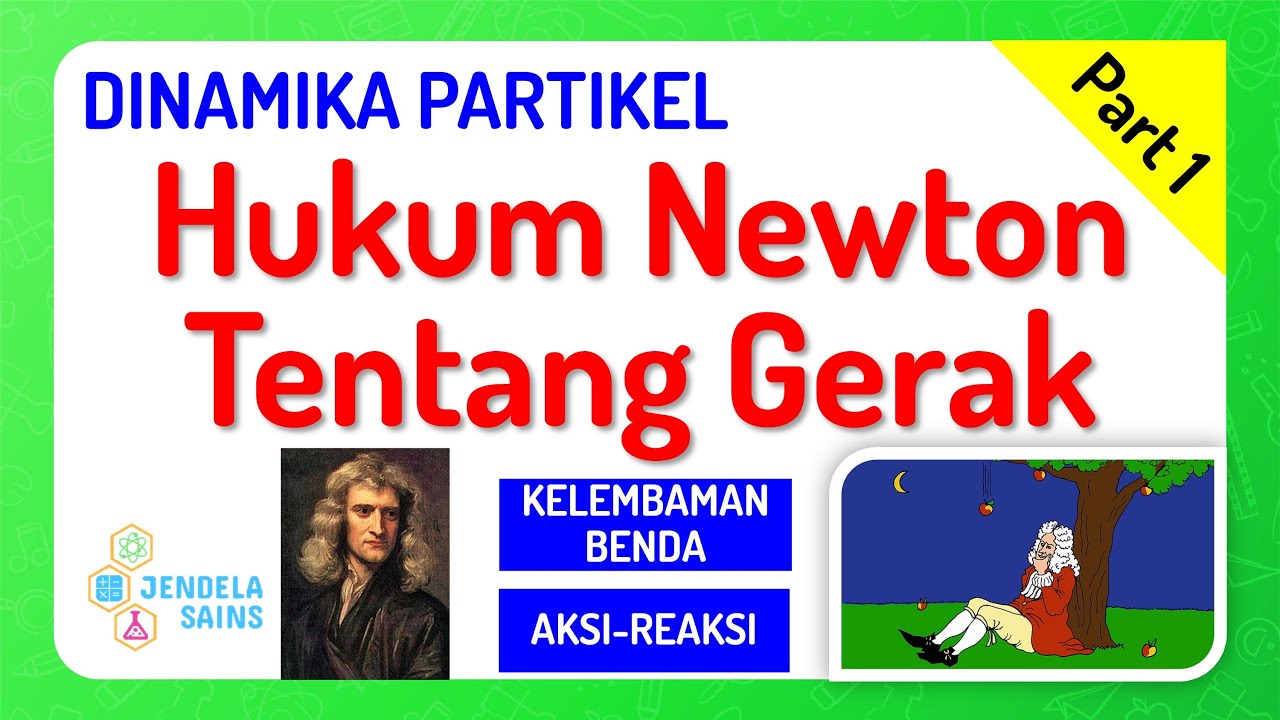
Dinamika Partikel • Part 1: Hukum Newton Tentang Gerak

Gerak Partikel Bermuatan dalam Medan Listrik Seragam

SOAL DAN PEMBAHASAN HUKUM NEWTON DAN GAYA NORMAL KELAS XI KURIKULUM MERDEKA

Las leyes de Kepler - Fer Fer González (La mejor explicación)
5.0 / 5 (0 votes)

