patterns and relationships
Summary
TLDRThe video explains three key mathematical relationships: constant (fixed) relationships, direct proportions, and inverse proportions, using the example of renting a bus for a school field trip. In a constant relationship, the cost remains fixed regardless of the number of children. In direct proportions, the cost increases with more children, with a fixed rate per child. In inverse proportions, as more children go on the trip, the cost per child decreases. The script offers practical examples and graphical representations to clarify these concepts.
Takeaways
- 😀 A constant or fixed relationship means that the dependent variable (cost) does not change regardless of the independent variable (number of children).
- 😀 In the case of renting a bus for a field trip, the cost of the bus remains fixed at 10,000 rand, no matter how many children go on the trip.
- 😀 A direct proportion relationship shows a constant increase between variables. For example, if the cost per child is 200 rand, the cost increases by 2,000 rand for every additional 10 children.
- 😀 In a direct proportion scenario, the total cost increases consistently with the number of children. For example, 10 children cost 2,000 rand, 20 children cost 4,000 rand, etc.
- 😀 The cost per child in a direct proportion relationship can be graphically represented with a linear upward trend as more children are added.
- 😀 In an inverse proportion relationship, the dependent variable decreases when the independent variable increases. For example, the cost per child decreases as the number of children increases.
- 😀 In the inverse proportion scenario, even though the total cost remains fixed at 10,000 rand, the cost per child decreases as the number of children increases.
- 😀 For example, if there is one child, the cost per child is 10,000 rand, but if there are 60 children, the cost per child drops to approximately 166.67 rand.
- 😀 The graphical representation of an inverse proportion relationship shows a downward curve as the number of children increases, resulting in a lower cost per child.
- 😀 The concept of break-even analysis is introduced, where it’s shown that if more than 60 children go on the trip, the 10,000 rand bus option becomes cheaper than the 200 rand per child option.
Q & A
What is meant by a constant relationship in the context of the bus rental example?
-A constant relationship refers to a situation where the cost of the bus rental remains fixed, no matter how many children attend the field trip. In the example, the cost is always 10,000 Rand, regardless of the number of children.
How does the direct proportion relationship work in the second example?
-In a direct proportion relationship, the cost increases in a fixed manner with the number of children. For example, if each child costs 200 Rand, the total cost increases by 2,000 Rand for every additional 10 children attending the field trip.
What is the break-even analysis used for in this lesson?
-The break-even analysis compares two different bus rental options. One option charges a fixed cost of 10,000 Rand regardless of the number of children, and the other charges 200 Rand per child. The break-even point occurs when there are exactly 50 children, as the total cost for both options is the same (10,000 Rand).
What does the inverse proportion relationship illustrate in the third example?
-The inverse proportion relationship shows that as the number of children increases, the cost per child decreases. For example, if only 1 child attends, the cost is 10,000 Rand per child, but with 60 children, the cost per child drops to 166.67 Rand.
What happens to the cost per child in an inverse proportion relationship when the number of children increases?
-In an inverse proportion relationship, the cost per child decreases as the number of children increases. For instance, with 10 children, the cost per child is 1,000 Rand, but with 60 children, it is reduced to 166.67 Rand per child.
How is the number of children represented in the graphs for constant, direct, and inverse proportion relationships?
-In all three types of relationships, the number of children is represented on the horizontal axis (independent variable). The cost, whether total or per child, is represented on the vertical axis (dependent variable).
Why is the graph for a constant relationship a horizontal line?
-The graph for a constant relationship is a horizontal line because the total cost remains the same regardless of the number of children. The cost does not change as the independent variable (the number of children) increases.
In the direct proportion example, how is the total cost calculated when the number of children increases?
-The total cost in the direct proportion example is calculated by multiplying the number of children by the cost per child (200 Rand). For example, 10 children will cost 2,000 Rand, 20 children will cost 4,000 Rand, and so on.
What is the shape of the graph for an inverse proportion relationship?
-The graph for an inverse proportion relationship is a curve that slopes downward. As the number of children increases, the cost per child decreases, resulting in this downward curve.
What is the key difference between a constant relationship and a direct proportion relationship in terms of cost?
-The key difference is that in a constant relationship, the total cost remains fixed no matter how many children attend, while in a direct proportion relationship, the total cost increases as the number of children increases.
Outlines

Cette section est réservée aux utilisateurs payants. Améliorez votre compte pour accéder à cette section.
Améliorer maintenantMindmap

Cette section est réservée aux utilisateurs payants. Améliorez votre compte pour accéder à cette section.
Améliorer maintenantKeywords

Cette section est réservée aux utilisateurs payants. Améliorez votre compte pour accéder à cette section.
Améliorer maintenantHighlights

Cette section est réservée aux utilisateurs payants. Améliorez votre compte pour accéder à cette section.
Améliorer maintenantTranscripts

Cette section est réservée aux utilisateurs payants. Améliorez votre compte pour accéder à cette section.
Améliorer maintenantVoir Plus de Vidéos Connexes

Perbandingan Senilai dan Berbalik Nilai [Part 3] - Perbandingan Berbalik Nilai
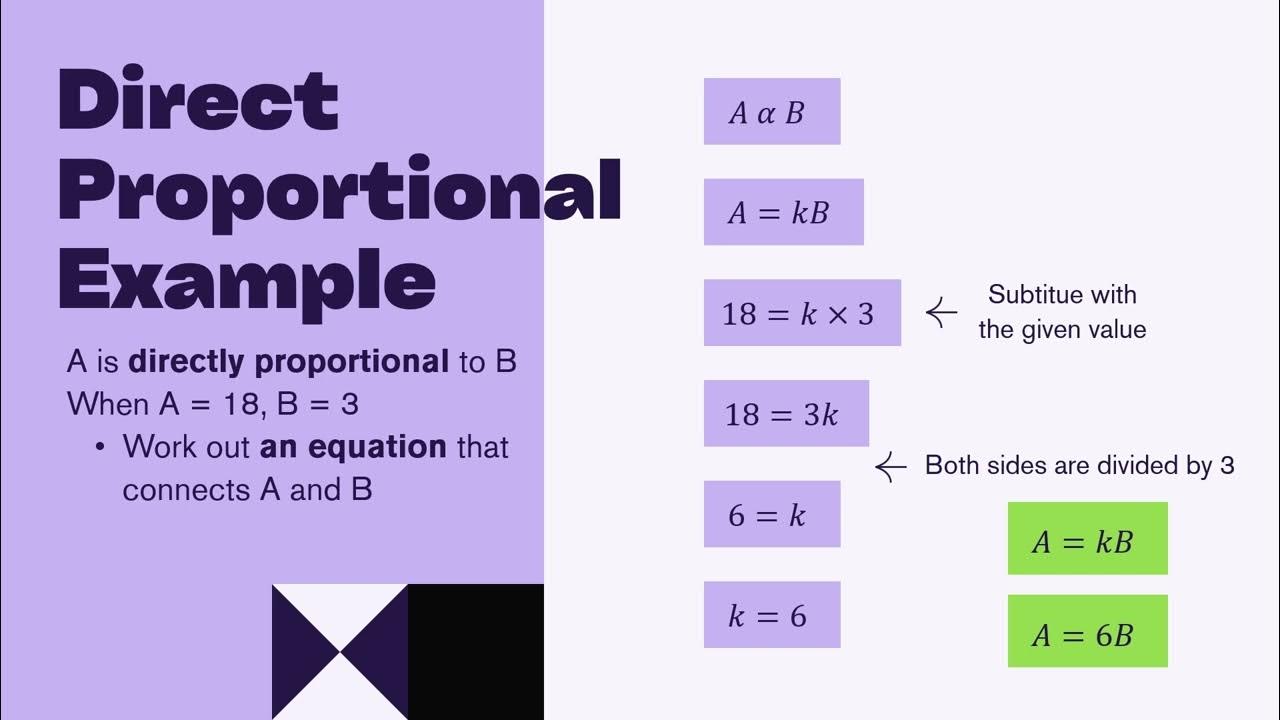
Direct & Inverse Proportions and Reccuring Decimals

3. Leis Ponderais: Lei de Proust - Aula 3/5 [Química Geral]

Hukum Dalton (Hukum Kelipatan Perbandingan) | Kimia SMA | Tetty Afianti

🔴HUKUM DASAR KIMIA DI SEKITAR KITA ‼️ ⚫HUKUM LAVOISIER 🟢HUKUM PROUST 🔵HUKUM DALTON (BAGIAN 1)

Matemática Básica para o ENEM | Parte 3 (Razão e Proporção)
5.0 / 5 (0 votes)

