Pertemuan 10 PPKn1
Summary
TLDRThis Pancasila course focuses on Pancasila as an ethical system, tracing its historical, sociological, and political roots in Indonesia. It explores how Pancasila was introduced and developed from the Old Order to the New Order and Reform eras, highlighting its role in shaping national identity and ethical norms. Key challenges include authoritarianism, corruption, and the euphoria of democracy. Pancasila's core values, such as divinity, humanity, unity, democracy, and social justice, are emphasized as guiding principles for moral actions, social harmony, and governance in contemporary Indonesia.
Takeaways
- 😀 Pancasila, as an ethical system, was initially introduced during the Old Order era but was not fully implemented until the New Order era.
- 😀 During the New Order era, Pancasila became a core ethical framework, emphasized through training programs like P4 to instill moral values in citizens.
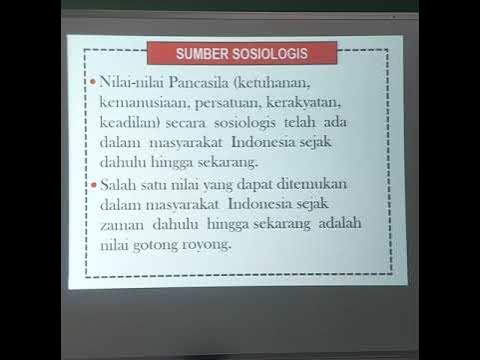
- 😀 The sociological sources of Pancasila as an ethical system can be found in the diverse ethnic groups of Indonesia, such as the Minangkabau people who practice consensus-based decision-making.
- 😀 Pancasila is positioned as the highest abstract moral norm, while legislation is a concrete and specific application of these values.
- 😀 Political ethics tied to Pancasila involves considering actors who play a role in the political system and ensuring policies serve the welfare of the people.
- 😀 One of the challenges to Pancasila's ethical system was the authoritarian tendencies during the Old and New Order eras, leading to issues like corruption, collusion, and nepotism.
- 😀 During the reform era, the values of Pancasila were overshadowed by the euphoria of newfound freedoms, leading to anarchic behavior and decentralized corruption.
- 😀 The essence of Pancasila's ethical system is found in its first principle: belief in God, which anchors moral behavior in religious values.
- 😀 The second principle focuses on humanity, emphasizing fair and just treatment of all people, ensuring the highest human values are upheld.
- 😀 The fifth principle of social justice for all Indonesian people stresses the importance of virtues in justice rather than just obligations or goals.
- 😀 The development of Pancasila as an ethical system includes using it as a moral source, a social guideline, a policy analysis tool, and a filter for global values impacting society.
Q & A
What is the main theme of this session of the Pancasila course?
-The main theme of this session is 'Pancasila as an ethical system.' The session is a continuation of the previous meeting, where the historical and sociological sources of Pancasila as an ethical system are explored.
What were the ethical views on Pancasila in the Old Order era?
-During the Old Order era, Indonesian society already had moral values that guided life, but these values were not emphasized as an ethical system. They were more theoretical and philosophical rather than being practiced as a system.
How did the New Order era influence the concept of Pancasila as an ethical system?
-In the New Order era, the concept of a 'complete Indonesian human' emerged, which reflected individuals who behave according to the noble values of Pancasila. The government at that time began to socialize Pancasila more formally, such as through P4 training for civil servants and students.
What is Pancasila's role in the Indonesian education system?
-Pancasila has been included in the university curriculum since 2012 as a required subject. This inclusion is part of efforts to reinforce its ethical values in academic and social contexts.
How do local cultures in Indonesia contribute to the ethical system of Pancasila?
-Local wisdom and traditions from various ethnic groups in Indonesia, such as the Minangkabau people’s practice of consensus through 'round water by round vessels,' contribute to the ethical principles of Pancasila. These local practices are viewed as valuable sociological sources that align with the values of Pancasila.
What are the political sources of Pancasila as an ethical system?
-The political sources of Pancasila as an ethical system can be found in basic norms or 'grunom,' which serve as a foundation for compiling laws and regulations in Indonesia. Pancasila itself is considered the highest abstract norm, while legislation serves as a concrete application of those principles.
How was Pancasila perceived during the Old Order and New Order eras in terms of political practice?
-During the Old Order era, the practice of Pancasila as an ethical system was weak, and accusations of too liberal elections under a guided democracy system arose. In contrast, the New Order era saw Pancasila placed into a more structured format with the P4 training, although challenges like corruption and authoritarianism also emerged.
What challenges did Pancasila face as an ethical system during the Reform era?
-During the Reform era, the euphoria of democracy led to challenges such as abuse of power, mass movements justifying any means for goals, and the decentralization of corruption. These issues reflected the need for a stronger foundation in Pancasila's ethical principles to prevent misuse of freedoms.
What is the essence of Pancasila as an ethical system?
-The essence of Pancasila as an ethical system is rooted in the five principles. These include belief in God (divinity), humanity, national unity, democracy, and social justice. These principles guide ethical behavior, justice, and the welfare of the community.
How does Pancasila contribute to the moral development and actions of citizens in Indonesia?
-Pancasila serves as a moral compass for citizens, guiding their attitudes, actions, and decisions in both local and international contexts. It also helps filter out divisive values from the plurality of ideas in society, ensuring that national policies align with the ethical system of Pancasila.
Outlines

Cette section est réservée aux utilisateurs payants. Améliorez votre compte pour accéder à cette section.
Améliorer maintenantMindmap

Cette section est réservée aux utilisateurs payants. Améliorez votre compte pour accéder à cette section.
Améliorer maintenantKeywords

Cette section est réservée aux utilisateurs payants. Améliorez votre compte pour accéder à cette section.
Améliorer maintenantHighlights

Cette section est réservée aux utilisateurs payants. Améliorez votre compte pour accéder à cette section.
Améliorer maintenantTranscripts

Cette section est réservée aux utilisateurs payants. Améliorez votre compte pour accéder à cette section.
Améliorer maintenantVoir Plus de Vidéos Connexes


5.0 / 5 (0 votes)

