Gregor Mendel
Summary
TLDRThis video explores Gregor Mendel's groundbreaking experiments with pea plants between 1856 and 1863, which laid the foundation for modern genetics. Mendel studied traits like seed color and plant height, discovering that some traits are dominant while others are recessive. Through careful breeding of purebred plants, he observed patterns across generations, introducing the concepts of alleles, heterozygous and homozygous genotypes, and how dominant traits can mask recessive ones. The video also explains gamete formation and inheritance, making complex genetic principles accessible and engaging, all while encouraging viewers to explore genetics with a touch of fun and curiosity.
Takeaways
- 🧬 Gregor Mendel, an Austrian monk, conducted experiments with pea plants between 1856 and 1863 that laid the foundation for modern genetics.
- 🌱 Mendel studied various traits in pea plants such as seed color, seed shape, and plant height.
- 🔬 By crossing purebred plants, Mendel observed that some traits could disappear in one generation and reappear in the next.
- 🟡 The yellow pea trait is dominant over the green pea trait, which is recessive.
- ⚖️ Dominant alleles mask recessive alleles, explaining why some traits do not appear in the first generation (F1) but can reappear in the second generation (F2).
- 🧩 A gene is a segment of DNA that controls a trait, and different forms of a gene are called alleles.
- ✍️ Individuals inherit two alleles for each gene, one from each parent, and allele combinations determine trait expression.
- 🔠 Genotypes can be homozygous dominant, homozygous recessive, or heterozygous, affecting the traits that appear in offspring.
- 🥚 Gametes carry only one allele from each gene, which explains how traits are passed to the next generation.
- 📊 Heterozygous individuals produce more variation in offspring because they carry different alleles for a trait.
Q & A
Who was Gregor Mendel and what was his main area of study?
-Gregor Mendel was an Austrian monk who studied genetics by experimenting with pea plants, investigating how traits are inherited across generations.
What types of traits did Mendel study in pea plants?
-Mendel studied traits such as seed color (green or yellow), seed shape (wrinkly or round), and plant height (tall or short), among others.
What did Mendel observe when he crossed two purebred pea plants with different traits?
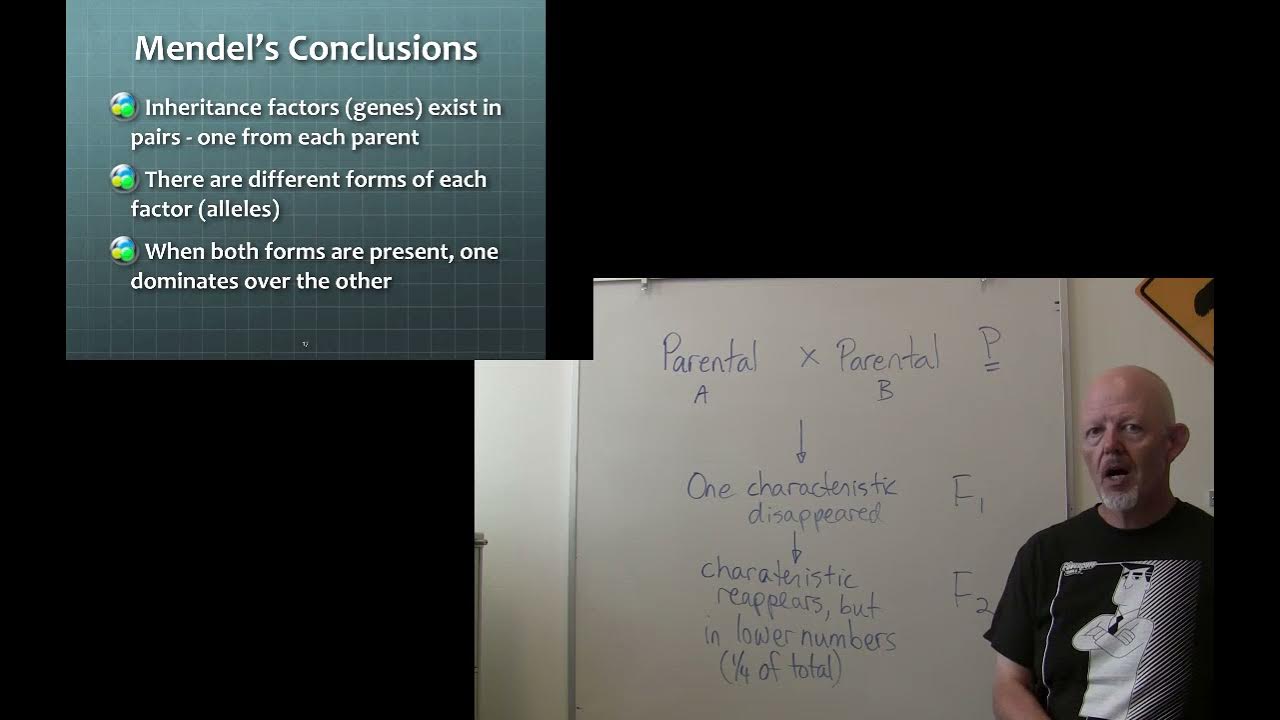
-When Mendel crossed two purebred plants, such as green and yellow peas, all offspring in the first generation (F1) showed only the dominant trait (yellow), and the recessive trait (green) disappeared.
How did the recessive trait reappear in the second generation (F2)?
-By breeding two F1 plants together, Mendel observed that 25% of the F2 generation exhibited the recessive trait, while 75% showed the dominant trait, demonstrating the presence of hidden alleles.
What conclusion did Mendel draw about how traits are inherited?
-Mendel concluded that traits are controlled by factors, now called genes, and that these genes can be dominant or recessive, with dominant alleles masking recessive ones.
What is the difference between a dominant and a recessive allele?
-A dominant allele expresses its trait even if only one copy is present, while a recessive allele only expresses its trait when two copies are present.
What do the terms homozygous and heterozygous mean?
-Homozygous means having two identical alleles for a trait (either dominant or recessive), while heterozygous means having two different alleles for a trait.
How are alleles represented in writing?
-Dominant alleles are represented with capital letters and recessive alleles with lowercase letters, such as 'T' for tall and 't' for short.
What is a gene and how does it relate to alleles?
-A gene is a section of DNA that controls a specific trait, and alleles are the different versions of a gene that determine the expression of that trait.
How do gametes contribute to inheritance?
-Gametes (sperm or eggs) carry only one allele for each gene, so when they combine during fertilization, the offspring receive one allele from each parent, determining their genotype.
What would be the gamete combinations for a homozygous dominant tall plant?
-A homozygous dominant tall plant (TT) would produce gametes containing only the dominant allele 'T'.
What would be the gamete combinations for a heterozygous tall plant?
-A heterozygous tall plant (Tt) would produce two types of gametes: one containing the dominant allele 'T' and one containing the recessive allele 't'.
Outlines

Esta sección está disponible solo para usuarios con suscripción. Por favor, mejora tu plan para acceder a esta parte.
Mejorar ahoraMindmap

Esta sección está disponible solo para usuarios con suscripción. Por favor, mejora tu plan para acceder a esta parte.
Mejorar ahoraKeywords

Esta sección está disponible solo para usuarios con suscripción. Por favor, mejora tu plan para acceder a esta parte.
Mejorar ahoraHighlights

Esta sección está disponible solo para usuarios con suscripción. Por favor, mejora tu plan para acceder a esta parte.
Mejorar ahoraTranscripts

Esta sección está disponible solo para usuarios con suscripción. Por favor, mejora tu plan para acceder a esta parte.
Mejorar ahoraVer Más Videos Relacionados

História de GREGOR MENDEL - GENÉTICA

Mendelian inheritance and Punnett squares | High school biology | Khan Academy

Ekperimen Mendel (Pola - pola Hereditas)
110 Mendel 1 Monohybrid Cross
Why Mendel chose peas | Heredity & Evolution | Biology | Khan Academy

028 Gregor Mendel & die klassische Genetik Meilensteine der Naturwissenschaft & Technik
5.0 / 5 (0 votes)

