Titrasi Pengendapan
Summary
TLDRThis lecture covers precipitation titration (argentometry) in pharmaceutical analysis, explaining the principles, methods, and practical applications. It introduces key methods: Mohr (direct titration with AgNO₃ and potassium chromate), Volhard (back titration with KSCN and Fe³⁺ indicator), and Fajans (adsorption indicators with fluorescence). Factors influencing precipitation, Ksp values, and titration endpoint determination are discussed, along with calculations for normality, mols, and substance content. Practical applications include quality control of NaCl infusions, KBr tablets, and sterile injections. Emphasis is placed on accuracy, safety procedures, proper use of indicators, and handling toxic reagents, ensuring precise and reliable analytical results in the lab.
Takeaways
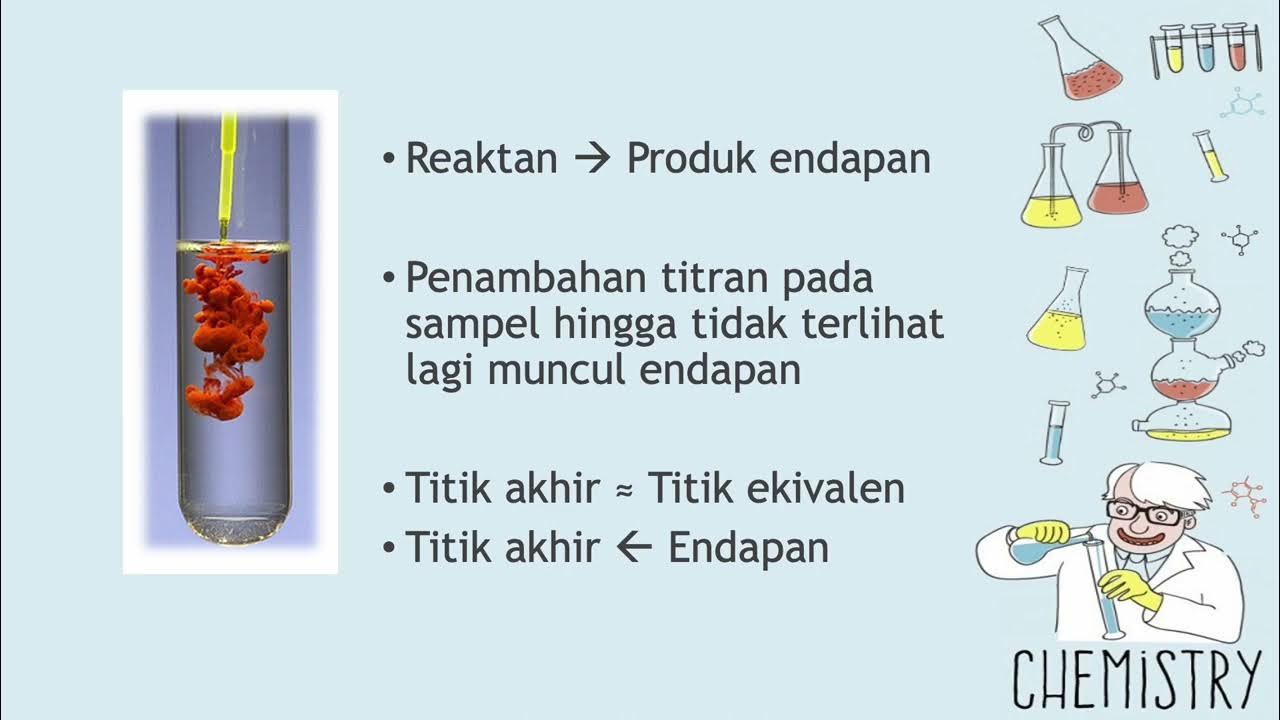
- 😀 Precipitation titration is a volumetric analysis method where an insoluble salt forms during the reaction between the analyte and titrant.
- 😀 The solubility product (Ksp) is essential in understanding the solubility of salts; lower Ksp values indicate less solubility.
- 😀 Factors such as temperature, pH, and ionic strength influence the solubility and precipitation process in titrations.
- 😀 Mohr method uses AgNO₃ and K₂CrO₄ as the indicator for halide ions, with a reddish-brown precipitate signaling the endpoint.
- 😀 Volhard method is a back titration technique that works well in acidic conditions, using KSCN as a titrant and Fe³⁺ as the indicator.
- 😀 Fajans method employs adsorption indicators that change color when they are adsorbed on the precipitate, and is effective in neutral to slightly basic conditions.
- 😀 Pharmaceutical applications of precipitation titration include determining chloride content in NaCl infusions, sedative syrups, and injections.
- 😀 Safety precautions are crucial when handling chemicals like silver nitrate, potassium chromate, and KSCN due to their toxicity and potential for causing skin stains or irritation.
- 😀 Titration calculations follow similar principles to other volumetric methods, where normality and molarity are used to determine the concentration of the analyte.
- 😀 Quality control in pharmaceutical production, such as testing chloride content in NaCl infusions, ensures that products meet regulatory standards before being released to the market.
Q & A
What is argentometric titration?
-Argentometric titration is a volumetric analysis method that involves the formation of an insoluble precipitate when an analyte reacts with a titrant, typically silver nitrate (AgNO3). The reaction endpoint is indicated by a color change from the chosen indicator.
What are the three main methods of argentometric titration discussed in the script?
-The three main methods of argentometric titration are: Mohr's method, Volhard's method, and Fajans' method. Each method varies in terms of the titrant used, pH conditions, and the type of indicator employed.
How does Mohr's method work in argentometric titration?
-Mohr's method uses silver nitrate (AgNO3) as the titrant and potassium chromate (K2CrO4) as the indicator. The titration occurs in a neutral to slightly basic solution. The endpoint is marked by the formation of a red-brown precipitate of silver chromate (Ag2CrO4).
What are the advantages and limitations of Mohr's method?
-The advantages of Mohr's method include its simplicity, rapid execution, and low cost. However, it is limited by its inability to detect iodides or cyanides in the sample, and it cannot be performed in acidic conditions.
What distinguishes Volhard's method from Mohr's method?
-Volhard's method is a back-titration process where excess silver nitrate is added to the sample, and the remaining silver ions are titrated with potassium thiocyanate (KSCN). It works in acidic conditions and is suitable for all halides, including cyanides.
What is Fajans' method and how does it differ from the other two methods?
-Fajans' method uses silver nitrate (AgNO3) as the titrant, with an indicator that adsorbs onto the surface of the precipitate. The method is performed in neutral to slightly basic conditions. It relies on changes in fluorescence or color at the surface of the precipitate to mark the endpoint.
How does the solubility product (Ksp) influence the results of argentometric titration?
-The solubility product (Ksp) is a measure of the solubility of a salt in water. A lower Ksp value indicates a less soluble salt, making it more likely to form a precipitate during argentometric titration. Thus, salts with lower Ksp values are easier to titrate.
What factors can affect the precipitation in argentometric titration?
-Factors affecting precipitation include temperature (which generally increases solubility), pH (which influences the solubility of salts), ionic strength (which can affect solubility), and the presence of interfering ions such as phosphate or arsenic.
What are the common applications of argentometric titration in pharmaceutical analysis?
-Argentometric titration is commonly used in pharmaceutical analysis to measure chloride content in saline solutions (e.g., NaCl in infusions), halides in sedatives and electrolytes, and in quality control of injection solutions, ensuring that chloride content does not exceed regulatory limits.
What safety precautions should be followed when performing argentometric titration?
-Safety precautions include wearing protective equipment such as gloves, lab coats, and goggles. Silver nitrate should be handled carefully to avoid staining, and proper disposal methods for silver waste should be followed. It is also important to handle other reagents like potassium chromate and potassium thiocyanate with caution, as they can be toxic or carcinogenic.
Outlines

Esta sección está disponible solo para usuarios con suscripción. Por favor, mejora tu plan para acceder a esta parte.
Mejorar ahoraMindmap

Esta sección está disponible solo para usuarios con suscripción. Por favor, mejora tu plan para acceder a esta parte.
Mejorar ahoraKeywords

Esta sección está disponible solo para usuarios con suscripción. Por favor, mejora tu plan para acceder a esta parte.
Mejorar ahoraHighlights

Esta sección está disponible solo para usuarios con suscripción. Por favor, mejora tu plan para acceder a esta parte.
Mejorar ahoraTranscripts

Esta sección está disponible solo para usuarios con suscripción. Por favor, mejora tu plan para acceder a esta parte.
Mejorar ahoraVer Más Videos Relacionados
Reaksi Kimia - Reaksi Pengendapan

Materi 1. Metode mohr argentometri part 1

Titration in Pharmaceutical Analysis l Titration in Pharma industry Interview Question and answers
Potentiometric titrations (Principle, Procedure, Types, Ion-selective electrodes, applications)
Analisa Gravimetri

KIMIA ANALITIK: PENGANTAR ANALISIS KUALITATIF
5.0 / 5 (0 votes)

