Fisika Kelas 10 - Dinamika Partikel Hukum Newton dan Contoh Soal
Summary
TLDRThis video lesson, led by physics teacher Aris Kurniawan, explores particle dynamics for high school students. It covers Newton's three laws of motion, explaining concepts of inertia, acceleration, and action-reaction forces. The lesson introduces various types of forces, including weight, normal, friction, and tension, with clear diagrams and examples. Practical applications are demonstrated through problem-solving, such as objects at rest, objects in motion, and pulley systems, emphasizing calculations for acceleration and tension. The session concludes with exercises for students to reinforce understanding, providing a comprehensive and interactive approach to mastering fundamental dynamics concepts in everyday physics scenarios.
Takeaways
- 😀 Newton's First Law states that an object at rest stays at rest, and an object in motion continues in a straight line at constant speed unless acted upon by a net external force (law of inertia).
- 😀 Newton's Second Law relates the acceleration of an object to the net force acting on it and its mass, expressed as ΣF = m × a.
- 😀 Newton's Third Law explains that every action has an equal and opposite reaction, meaning forces always occur in pairs.
- 😀 Mass is a scalar quantity representing the amount of matter in an object, while weight is a vector force due to gravity, calculated as W = m × g.
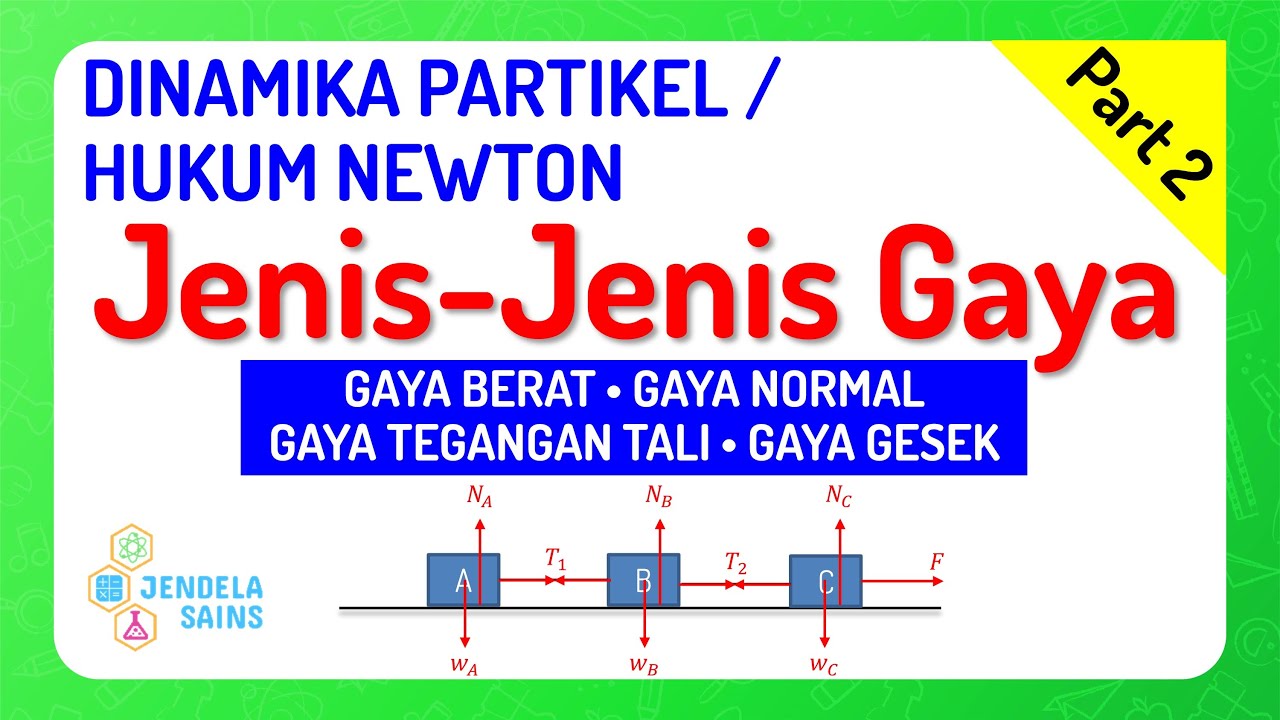
- 😀 The normal force is a contact force perpendicular to the surface supporting an object, always acting away from the surface.
- 😀 Friction is a contact force opposing the relative motion of surfaces, with static friction preventing motion and kinetic friction acting on moving objects (F = μ × N).
- 😀 Tension in a string transmits force between connected objects; for a massless and frictionless pulley, the tension is equal throughout the string.
- 😀 Key indicators for applying Newton's laws in problems include: objects at rest or in equilibrium (First Law), objects with constant acceleration (Second Law), and interacting pairs of objects (Third Law).
- 😀 To solve Newtonian mechanics problems, draw free-body diagrams to visualize forces and directions, which helps in calculating resultant forces and accelerations.
- 😀 Example applications include calculating the force required to keep a block at rest, determining acceleration when multiple forces act on a block, and solving tension in pulley systems.
Q & A
Who formulated the laws of motion discussed in this lesson?
-The laws of motion were formulated by Sir Isaac Newton, an English physicist who lived from 1643 to 1722.
What is the main idea of Newton's First Law of Motion?
-Newton's First Law, also known as the law of inertia, states that an object will remain at rest or move in a straight line with constant velocity unless acted upon by a net external force (ΣF = 0).
How does Newton's Second Law of Motion relate force, mass, and acceleration?
-Newton's Second Law states that the acceleration of an object is directly proportional to the net force acting on it and inversely proportional to its mass, expressed as ΣF = m × a.
Explain Newton's Third Law of Motion with an example.
-Newton's Third Law states that every action has an equal and opposite reaction. For example, when you push on a wall, the wall exerts an equal force in the opposite direction on you.
What is the difference between mass and weight?
-Mass is a scalar quantity measured in kilograms and represents the amount of matter in an object. Weight is a vector force (W = m × g) measured in newtons and represents the gravitational force acting on an object.
What is the direction of the normal force acting on an object?
-The normal force always acts perpendicular to the surface in contact with the object, supporting it against gravity or other forces.
How do static and kinetic friction differ?
-Static friction acts on objects at rest and opposes the initial motion, while kinetic friction acts on objects in motion and opposes their movement. Both are calculated as f = μ × N, where μ is the coefficient of friction.
What is the significance of tension in a string in mechanics problems?
-Tension is the pulling force transmitted through a string or rope, usually assumed to be uniform along a light, massless string, and plays a key role in analyzing systems like pulleys.
How do you calculate the acceleration of two masses connected by a massless string over a pulley?
-The acceleration of the system is calculated using a = (W₁ - W₂) / (m₁ + m₂), where W₁ and W₂ are the weights of the two masses, and m₁ and m₂ are their masses.
In which scenarios should Newton's First Law be applied when solving problems?
-Newton's First Law should be applied when an object is at rest or moving with constant velocity (equilibrium situations), identified by keywords like 'stationary,' 'balanced,' or 'constant speed.'
Why does a heavier mass require more force to accelerate compared to a lighter mass?
-According to Newton's Second Law, acceleration is inversely proportional to mass. Therefore, a heavier mass has greater inertia and requires a larger net force to achieve the same acceleration as a lighter mass.
How are forces resolved when an object rests on an inclined plane?
-The weight of the object is always directed vertically downward, while the normal force acts perpendicular to the plane. Forces along the plane and perpendicular to it are analyzed separately to apply Newton's laws.
Outlines

Esta sección está disponible solo para usuarios con suscripción. Por favor, mejora tu plan para acceder a esta parte.
Mejorar ahoraMindmap

Esta sección está disponible solo para usuarios con suscripción. Por favor, mejora tu plan para acceder a esta parte.
Mejorar ahoraKeywords

Esta sección está disponible solo para usuarios con suscripción. Por favor, mejora tu plan para acceder a esta parte.
Mejorar ahoraHighlights

Esta sección está disponible solo para usuarios con suscripción. Por favor, mejora tu plan para acceder a esta parte.
Mejorar ahoraTranscripts

Esta sección está disponible solo para usuarios con suscripción. Por favor, mejora tu plan para acceder a esta parte.
Mejorar ahoraVer Más Videos Relacionados
Fisika Kelas 11 | Konsep Pembiasan Cahaya pada Lensa Cembung
Dinamika Partikel • Part 2: Gaya Berat, Gaya Normal, Gaya Tegangan Tali, Gaya Gesek

14/07/25 - Devolutivas da Prova Paulista 2º Bimestre - Ensino Médio - Física
USAHA | Usaha dan Energi #1 - Fisika Kelas 10

Applied Economics - Intro - Part 1 - Senior High School and College Students

PRAKTIK PEMBELAJARAN MENDALAM MAPEL SEJARAH KEBUDAYAAN ISLAM || SERUUU DAN BERMAKNA
5.0 / 5 (0 votes)

