SOAL UTBK 2026 PENALARAN UMUM PART 2
Summary
TLDRThis video provides an in-depth guide for UTBK 2026 General Reasoning (Penalaran Umum) subtests, focusing on identifying correct statements through logical reasoning. The instructor explains key concepts such as statements, truth values, modus ponens, modus tollens, and syllogisms, demonstrating how to apply them in practice. Using step-by-step examples from actual tryouts, the video shows how to analyze cause-effect relationships, handle negations, and avoid common traps in answer choices. Viewers gain strategies for reading, symbolizing, and systematically eliminating incorrect options to draw valid conclusions, ensuring stronger preparation for the UTBK exam with practical insights and tips.
Takeaways
- 😀 Understanding 'true statements' is crucial in UTBK Penalaran Umum: a statement must be either true or false, not both.
- 😀 Logical reasoning in UTBK requires analyzing cause-effect relationships, conditions, and compound statements.
- 😀 Familiarity with formal logic methods like modus ponens, modus tollens, silogism, and contraposition is essential.
- 😀 Symbolizing statements using P, Q, R (or other symbols) simplifies complex cause-effect relationships.
- 😀 The systematic approach involves reading all information, identifying cause-effect, symbolizing, applying logic rules, eliminating wrong options, and drawing correct conclusions.
- 😀 Avoid adding assumptions not provided in the text; conclusions must be strictly based on the given information.
- 😀 UTBK questions often include logical traps, such as inversions, negations, or double negatives, requiring careful analysis.
- 😀 Practice helps in quickly recognizing patterns and correctly applying logical methods to diverse question types.
- 😀 Step-by-step problem-solving examples include analyzing environmental habits, market pricing effects, cybersecurity budgets, athletic competitions, and lab fermentation experiments.
- 😀 Consistency with given premises and factual information is key; every correct conclusion aligns logically with the text provided.
- 😀 Video emphasizes preparation, repeated practice, and using tryout materials to strengthen understanding and confidence for UTBK.
Q & A
What is the main focus of the UTBK 2026 subtest discussed in the video?
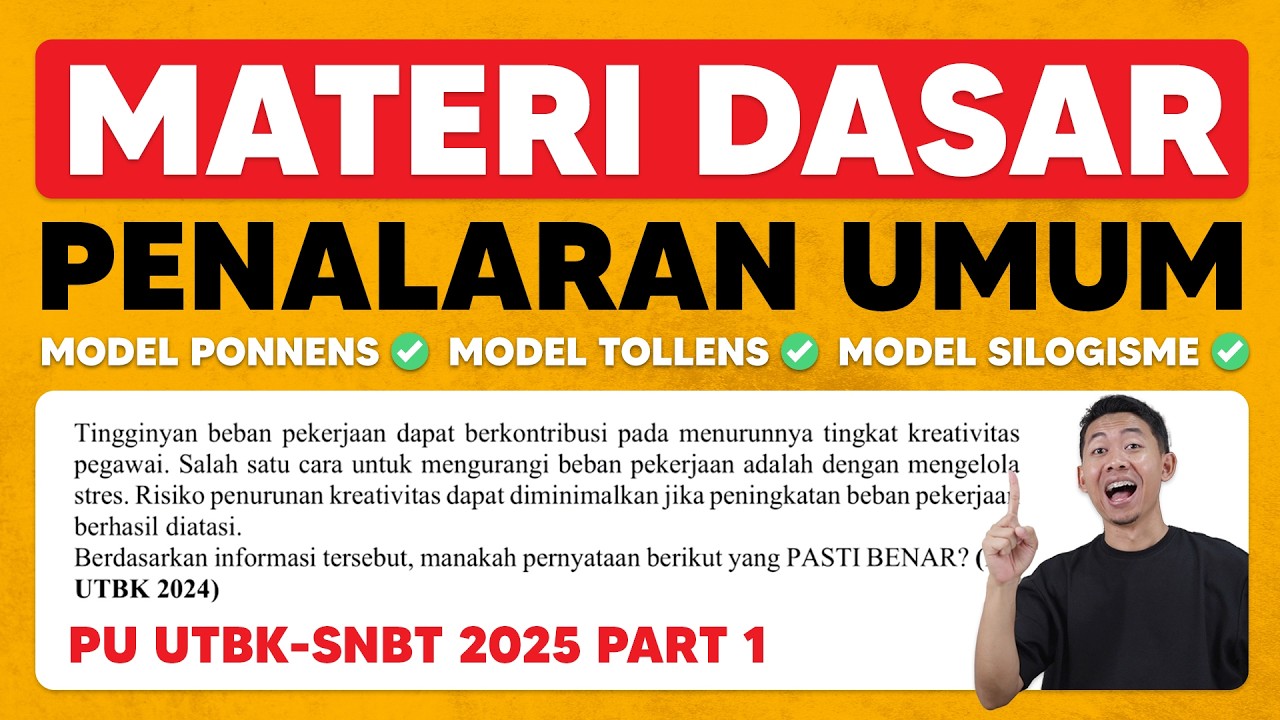
-The main focus is on 'General Reasoning' (Penalaran Umum), specifically on identifying correct statements and understanding logical relationships, cause-effect chains, and compound logic statements.
How does the video define a 'statement' in the context of logical reasoning?
-A statement is defined as a sentence that has a truth value: it is either true or false, but not both. Subjective opinions or statements that can be both true and false are not considered logical statements.
What are the key logical methods recommended for solving UTBK General Reasoning questions?
-The key methods are Modus Ponens (if P then Q; P is true, so Q is true), Modus Tollens (if P then Q; Q is false, so P is false), and Silogism (if P then Q and if Q then R, then if P then R).
What is the systematic approach suggested for tackling questions about correct statements?
-The approach involves reading all information, noting cause-effect relationships briefly, using symbolic notation like P, Q, R, applying logical rules, eliminating options that do not fit, and drawing conclusions strictly from the given premises without adding assumptions.
In the example about environmental habits, what logical conclusion is drawn?
-For a person who frequently litters, uses single-use plastics, and does not recycle, the logical conclusion is that they do not have good environmental habits.
How are cause-effect relationships represented symbolically in the video?
-Cause-effect relationships are represented with symbols like P → Q → R, where P causes Q, and Q causes R. This helps in systematically analyzing the logical chain of events.
What is the primary trick or 'jebakan' students should be aware of in UTBK reasoning questions?
-Tricks often involve negative statements, inverted cause-effect relationships, or introducing assumptions not stated in the text. Students must carefully map the logic without adding extra assumptions.
In the example of kue pukis sales, what is identified as the main factor for the decline in sales?
-The main factor for the decline in sales is the sharp increase in the price of raw materials, which leads to higher selling prices and consequently lower demand.
How should students handle questions involving negative premises or inverted logic, such as in the fermentation batch example?
-Students should use symbolic representation with negations (e.g., ¬P, ¬Q) to map the relationships correctly and then apply Modus Ponens or Modus Tollens to identify the logically correct conclusion.
What advice does the video give about preparing for UTBK General Reasoning questions?
-The video advises practicing frequently, becoming familiar with symbolic logic and patterns, focusing on premises without assumptions, using systematic methods, and learning to identify common tricks to maximize scores.
Outlines

Esta sección está disponible solo para usuarios con suscripción. Por favor, mejora tu plan para acceder a esta parte.
Mejorar ahoraMindmap

Esta sección está disponible solo para usuarios con suscripción. Por favor, mejora tu plan para acceder a esta parte.
Mejorar ahoraKeywords

Esta sección está disponible solo para usuarios con suscripción. Por favor, mejora tu plan para acceder a esta parte.
Mejorar ahoraHighlights

Esta sección está disponible solo para usuarios con suscripción. Por favor, mejora tu plan para acceder a esta parte.
Mejorar ahoraTranscripts

Esta sección está disponible solo para usuarios con suscripción. Por favor, mejora tu plan para acceder a esta parte.
Mejorar ahora


5.0 / 5 (0 votes)

