EP. 007 (Termodinamika) | Pembelajaran Termodinamika | Syaiful Karim
Summary
TLDRThis lecture introduces the fundamentals of thermodynamics, focusing on work and heat as essential concepts for understanding the first and second laws. It explains quasi-static processes, where systems change infinitesimally to maintain equilibrium, and distinguishes between work (energy transfer via force) and heat (energy transfer due to temperature differences). The instructor covers conventions for positive and negative work, diagrams of pressure-volume (PV) relationships, and isotermal heat transfer using large reservoirs. Practical examples like pistons, gas expansion, and heating demonstrate these concepts. The session lays the groundwork for studying cycles, Carnot engines, entropy, and thermodynamic potentials, providing a clear, quantitative, and conceptual understanding of energy transfer processes.
Takeaways
- 😀 Quasistatic processes occur very slowly, allowing the system to remain in thermodynamic equilibrium throughout the process.
- 😀 Work (W) in thermodynamics is energy transferred through force, often calculated as δW = P dV for infinitesimal volume changes.
- 😀 Positive work occurs when the system does work on the environment (expansion), while negative work occurs when the environment does work on the system (compression).
- 😀 Work is not a state function, meaning it depends on the path taken, not just the initial and final states.
- 😀 Heat (Q) is energy transferred due to temperature differences between a system and its surroundings.
- 😀 For controlled, quasistatic heat transfer, the process should ideally be isothermal or use a large thermal reservoir to avoid disturbing the system's temperature.
- 😀 Thermodynamic equilibrium requires mechanical, thermal, chemical, and phase balance in the system.
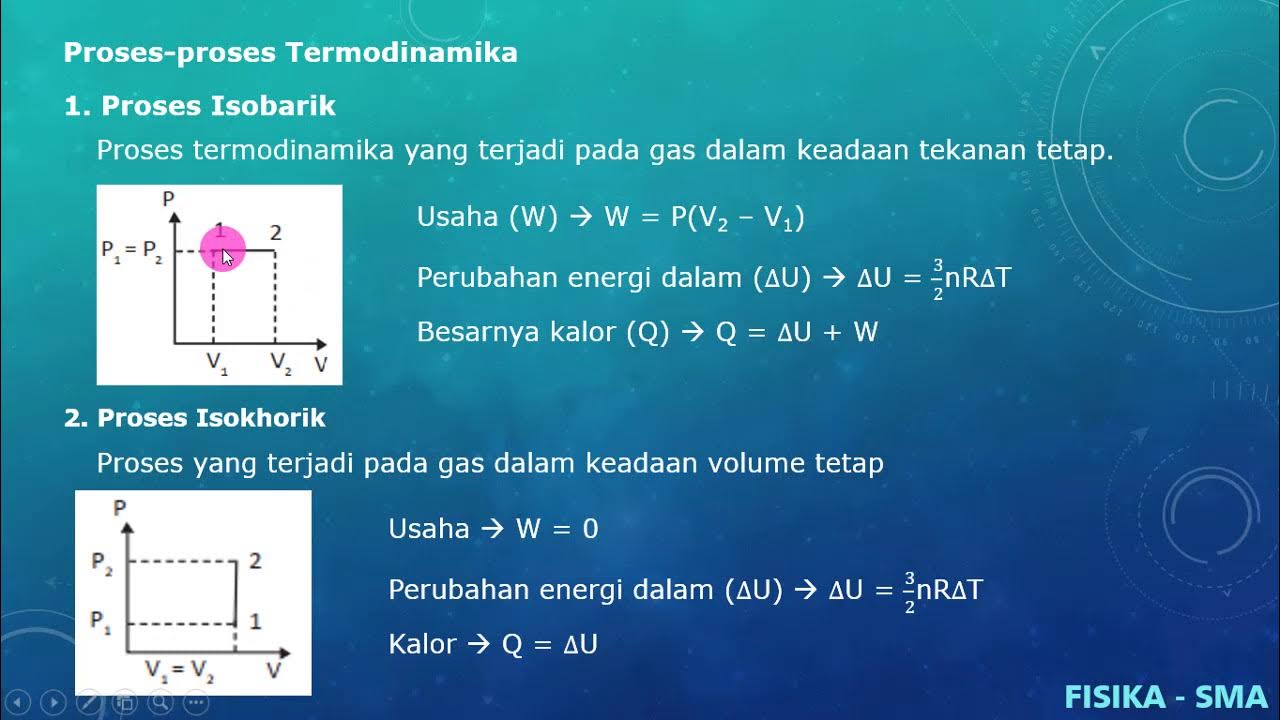
- 😀 Diagram PV (Pressure-Volume) visually represents work done by the system; the area under the curve corresponds to the work performed.
- 😀 Thermodynamic cycles are series of processes that return the system to its initial state; total work in a cycle equals the area enclosed in the PV diagram.
- 😀 Understanding the fundamentals of work, heat, and quasistatic processes is essential for studying entropy, Carnot cycles, and thermodynamic potentials.
Q & A
What is the difference between the First and Second Laws of Thermodynamics?
-The First Law of Thermodynamics focuses on the conservation of energy, stating that energy cannot be created or destroyed, only transformed. The Second Law, while still about energy conservation, emphasizes the qualitative aspect, specifically the efficiency of energy transfer and the increase in entropy in a system.
What is a quasi-static process, and why is it important in thermodynamics?
-A quasi-static process is one that happens slowly enough that the system remains in equilibrium throughout the process. This means that even though the system changes, it remains infinitesimally close to equilibrium at all times. This is important in thermodynamics because it ensures the system can be accurately modeled and analyzed at every stage.
Can you explain the role of work in thermodynamics?
-In thermodynamics, work refers to the transfer of energy through a force. A common example is when gas inside a closed container expands and moves a piston. The energy used to move the piston is considered work, and it transfers energy from the system to the surroundings.
How does heat transfer differ from work in thermodynamics?
-While both heat and work are forms of energy transfer, the key difference is that work is transferred through force, whereas heat is transferred due to a temperature difference. Heat moves from areas of higher temperature to areas of lower temperature, typically until thermal equilibrium is reached.
What is the significance of quasi-static heat transfer?
-Quasi-static heat transfer refers to the transfer of heat that occurs slowly and steadily enough to maintain equilibrium throughout the system. This ensures that the system’s temperature and other properties remain well-defined during the process, which is crucial for accurate analysis in thermodynamics.
What happens during an isothermal process?
-An isothermal process is one where the temperature of the system remains constant. This means that even though the system might undergo expansion or compression, the temperature does not change. In an ideal gas, the work done during such a process can be calculated by integrating pressure and volume changes.
How does a PV diagram relate to work in thermodynamics?
-A Pressure-Volume (PV) diagram represents the relationship between the pressure and volume of a system during a thermodynamic process. The area under the curve on a PV diagram represents the work done by the system, which can be calculated as the integral of pressure over volume changes.
What is the difference between expansion and compression in thermodynamics?
-Expansion refers to when the volume of a system increases, and the system does work on the surroundings (negative work). Compression occurs when the volume of a system decreases, and the surroundings do work on the system (positive work).
What is a thermodynamic cycle?
-A thermodynamic cycle is a series of processes that returns a system to its initial state. Each process in the cycle transforms the system in some way, but after completing the cycle, the system returns to its original condition. An example of a thermodynamic cycle is the Carnot cycle.
How does the concept of system and surroundings apply in thermodynamics?
-In thermodynamics, the system refers to the part of the universe being studied, while the surroundings are everything else. The system exchanges energy with the surroundings, typically through work or heat transfer. For example, when a gas expands and pushes a piston, it performs work on the surroundings.
Outlines

Esta sección está disponible solo para usuarios con suscripción. Por favor, mejora tu plan para acceder a esta parte.
Mejorar ahoraMindmap

Esta sección está disponible solo para usuarios con suscripción. Por favor, mejora tu plan para acceder a esta parte.
Mejorar ahoraKeywords

Esta sección está disponible solo para usuarios con suscripción. Por favor, mejora tu plan para acceder a esta parte.
Mejorar ahoraHighlights

Esta sección está disponible solo para usuarios con suscripción. Por favor, mejora tu plan para acceder a esta parte.
Mejorar ahoraTranscripts

Esta sección está disponible solo para usuarios con suscripción. Por favor, mejora tu plan para acceder a esta parte.
Mejorar ahoraVer Más Videos Relacionados



5.0 / 5 (0 votes)

