Affinity Propagation Clustering
Summary
TLDRAffinity Propagation clustering is an Exemplar Clustering algorithm that assigns data points to exemplars without needing to pre-define the number of clusters. It works by passing responsibility and availability messages between data points and potential exemplars based on pairwise similarities. This process is iterated to determine the best exemplars for each point. Affinity Propagation offers advantages such as handling asymmetric similarities, being deterministic, and not requiring multiple runs. Unlike other methods like k-means, it determines its own number of exemplars and can be parallelized for efficiency.
Takeaways
- 😀 Affinity Propagation (AP) is an exemplar-based clustering algorithm that assigns data points to exemplars (cluster centers), with no need for predefining the number of clusters.
- 😀 Exemplar clustering differs from methods like k-means, where the number of clusters must be specified in advance.
- 😀 AP uses two key types of messages: responsibility (ρnk) and availability (αnk), which are passed iteratively between data points and potential exemplars to form clusters.
- 😀 The responsibility message indicates how suitable a potential exemplar is for a point, while the availability message shows how suitable a point is for being an exemplar for others.
- 😀 Affinity Propagation operates on a similarity matrix, which contains pairwise similarities between all data points, where higher similarities indicate better potential exemplars.
- 😀 The objective of AP is to maximize the total similarity between points and their respective exemplars, with the goal of selecting the exemplars that best represent clusters.
- 😀 The algorithm terminates when the responsibility and availability messages converge, signaling that the clustering is complete.
- 😀 Unlike k-means, AP does not require the number of clusters to be known in advance and can automatically determine it based on the data.
- 😀 AP is deterministic, meaning it does not require multiple initializations like k-means, and produces consistent results every time.
- 😀 The message-passing process in Affinity Propagation can be parallelized, allowing for more efficient execution on large datasets.
- 😀 Affinity Propagation allows for message passing within local neighborhoods, limiting communication to neighboring points, which can improve computational efficiency.
Q & A
What is Exemplar Clustering and how does it differ from other clustering methods?
-Exemplar Clustering is a method where data points are assigned to exemplars, which are representative points in the dataset. Unlike methods like k-means, where the number of clusters must be pre-defined, Exemplar Clustering allows the algorithm to determine its own number of exemplars. Each point is associated with one exemplar, and the exemplars themselves are also treated as data points.
How does Affinity Propagation clustering differ from k-means?
-Affinity Propagation clustering differs from k-means in that it does not require pre-defining the number of clusters. It automatically determines the number of exemplars based on the data and the similarity matrix. In contrast, k-means requires the user to specify the number of clusters beforehand.
What is the role of the similarity matrix in Affinity Propagation?
-The similarity matrix in Affinity Propagation stores the pairwise similarities between data points. These similarities help determine how closely related points are to each other and influence the assignment of exemplars. The values in the matrix can be the negative of the Euclidean distance or other measures of divergence between points.
What are the two types of messages exchanged in Affinity Propagation and what do they represent?
-The two types of messages exchanged in Affinity Propagation are 'responsibility' (ρnk) and 'availability' (αnk). Responsibility indicates how suitable a potential exemplar **k** is for data point **n**, while availability shows how suitable **n** is for **k**. Both messages are updated iteratively during the algorithm's execution.
How is the responsibility message (ρnk) computed?
-The responsibility message (ρnk) is computed by subtracting from the similarity between data point **n** and potential exemplar **k** the maximum similarity between **n** and any other potential exemplar **l**, along with the corresponding availability. This reflects how well **k** serves as an exemplar compared to other potential candidates.
How is the availability message (αnk) computed in Affinity Propagation?
-The availability message (αnk) is computed by taking the self-responsibility of exemplar **k** and adding the sum of responsibilities from all other data points **m**. The message is bounded to ensure it cannot exceed certain limits, ensuring that the algorithm remains stable and doesn't produce extreme values.
What condition must be satisfied for a point **k** to be selected as an exemplar in Affinity Propagation?
-A point **k** is selected as an exemplar if the sum of its responsibility and availability (ρkk + αkk) is greater than zero. This ensures that the exemplar is suitably representative of the data point.
Can the Affinity Propagation algorithm be parallelized?
-Yes, the Affinity Propagation algorithm can be parallelized. The responsibilities can be computed for each data point in parallel, and the availability computations can be done for each potential exemplar in parallel, making the algorithm more efficient.
What is the advantage of using local neighborhoods for message passing in Affinity Propagation?
-Using local neighborhoods for message passing reduces the communication overhead by restricting message exchanges to only those points that are close to each other. This improves efficiency, especially in large datasets, and helps to maintain the focus on the most relevant relationships between points.
What are the main advantages of Affinity Propagation over other clustering methods like k-means?
-Affinity Propagation has several advantages over methods like k-means. It does not require the number of exemplars (clusters) to be pre-defined, it can handle asymmetric similarities, and it operates deterministically, meaning it doesn't require multiple runs with different initializations. Additionally, it can be implemented with localized message passing for efficiency.
Outlines

Esta sección está disponible solo para usuarios con suscripción. Por favor, mejora tu plan para acceder a esta parte.
Mejorar ahoraMindmap

Esta sección está disponible solo para usuarios con suscripción. Por favor, mejora tu plan para acceder a esta parte.
Mejorar ahoraKeywords

Esta sección está disponible solo para usuarios con suscripción. Por favor, mejora tu plan para acceder a esta parte.
Mejorar ahoraHighlights

Esta sección está disponible solo para usuarios con suscripción. Por favor, mejora tu plan para acceder a esta parte.
Mejorar ahoraTranscripts

Esta sección está disponible solo para usuarios con suscripción. Por favor, mejora tu plan para acceder a esta parte.
Mejorar ahora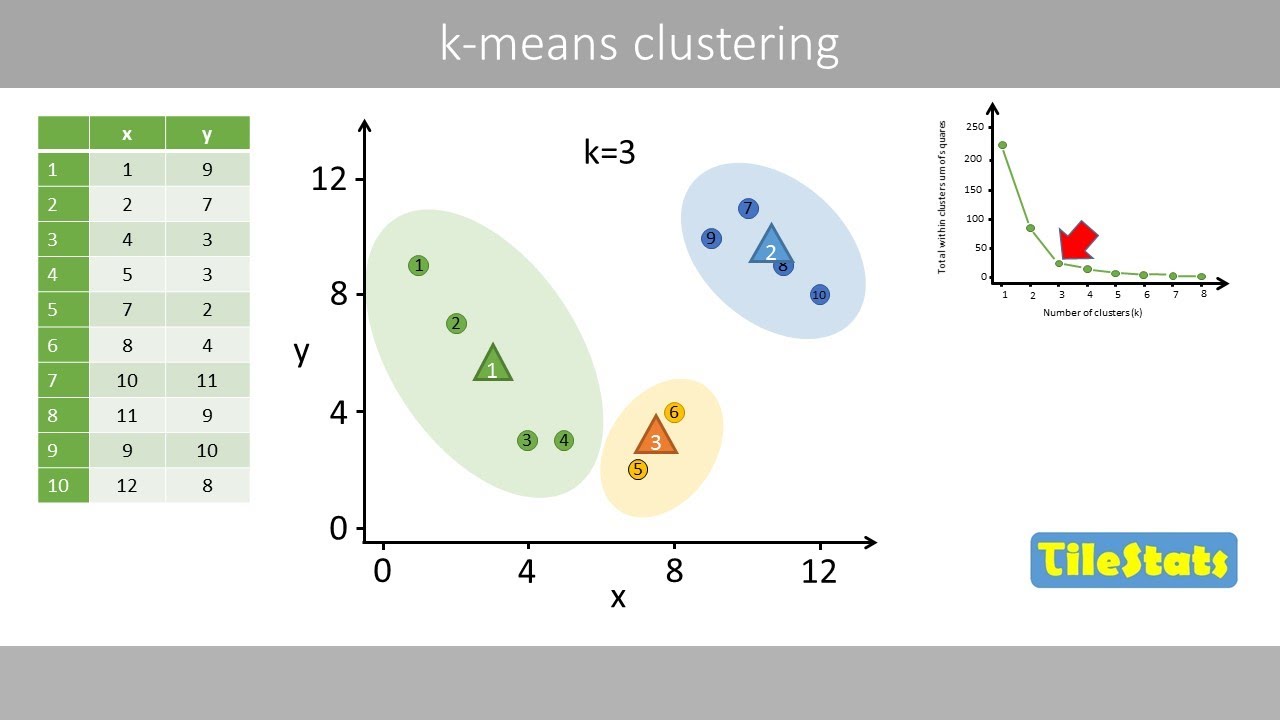



5.0 / 5 (0 votes)

