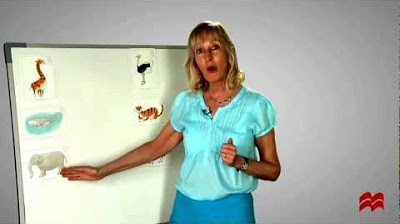
Carol Read - Ten great ideas for using flashcards
Summary
TLDRThis video offers creative ways to use flashcards for teaching vocabulary to primary children. It highlights various activities such as quick identification games, memory-building exercises, lip-reading tasks, and action games to engage kids and reinforce word retention. Strategies like 'What's Missing?' and 'Flashcard Chains' encourage interaction, while games like 'Kim's Game' provide opportunities for revising vocabulary from different lexical sets. The emphasis is on keeping the pace lively and varied, making vocabulary learning both fun and effective for young learners.
Takeaways
- 😀 Flashcards are a practical and versatile tool for teaching vocabulary to primary children.
- 😀 The 'Flash' technique involves showing a flashcard quickly to help children identify and name the image.
- 😀 The 'Slowly, slowly' technique gradually reveals the flashcard to assist recognition and encourage engagement.
- 😀 Repetition with flashcards, such as saying words in a rhythmic pattern, helps children memorize and retain vocabulary.
- 😀 Activities like 'What's missing?' and 'Magic eyes' develop children's visual memory and attention skills.
- 😀 Lip reading activities with flashcards can support comprehension of foreign language pronunciation.
- 😀 Creating riddles with flashcards encourages children to apply vocabulary in familiar contexts and enhances language understanding.
- 😀 Action games like 'Flashcard groups' and 'Hands-on-heads' combine movement with learning, improving listening and response skills.
- 😀 'Flashcard chains' promote interaction among children and provide multiple opportunities to practice language questions and answers.
- 😀 'Kim's game' and classification activities allow children to revise, categorize, and recall vocabulary from multiple lexical sets.
- 😀 Maintaining a good pace and varying flashcard activities keeps children engaged and ensures effective vocabulary learning.
Q & A
Why are flashcards considered useful for teaching vocabulary to primary children?
-Flashcards are practical, flexible, and engaging tools that help children associate images with words, making vocabulary learning more visual, interactive, and memorable.
What is the 'flash' technique in flashcard teaching?
-The 'flash' technique involves quickly showing a flashcard to students so they identify the image instantly, helping improve recognition speed and recall.
How does the 'slowly slowly' technique differ from the 'flash' technique?
-In the 'slowly slowly' technique, the teacher gradually reveals the flashcard image, allowing children to guess the word as soon as they recognize it, promoting anticipation and engagement.
What is the purpose of the 'What's missing?' activity?
-This activity develops memory and observation skills by asking children to identify which flashcard has been removed from a set.
How does the 'Magic Eyes' activity help children learn vocabulary?
-It strengthens memory and visualization skills by gradually removing flashcards while students continue recalling the sequence from memory.
What skill does the lip-reading activity aim to develop?
-It helps children improve listening and comprehension skills by paying attention to mouth movements, which is especially useful in learning a foreign language.
Why are flashcard riddles effective in language learning?
-They place vocabulary in context using familiar language, helping children connect new words with descriptions and existing knowledge.
What is the key instruction strategy used in the 'flashcard groups' activity?
-The teacher gives the action first and the flashcard group second, ensuring that children listen carefully to determine whether the instruction applies to them.
How does the 'Hands on Heads' game engage students physically?
-Students respond to hearing their assigned words by placing their hands on their heads, encouraging movement and active listening.
What is the goal of the 'flashcard chains' activity?
-It provides repeated practice of language structures through a question-and-answer chain, helping reinforce speaking and interaction skills.
How does Kim's game support vocabulary revision?
-It challenges students to remember and recall multiple flashcards after viewing them briefly, improving memory and recall abilities.
Why is it important to keep flashcard activities short and varied?
-Short and varied activities maintain children's attention, keep them engaged, and make learning more enjoyable and effective.
Outlines

Dieser Bereich ist nur für Premium-Benutzer verfügbar. Bitte führen Sie ein Upgrade durch, um auf diesen Abschnitt zuzugreifen.
Upgrade durchführenMindmap

Dieser Bereich ist nur für Premium-Benutzer verfügbar. Bitte führen Sie ein Upgrade durch, um auf diesen Abschnitt zuzugreifen.
Upgrade durchführenKeywords

Dieser Bereich ist nur für Premium-Benutzer verfügbar. Bitte führen Sie ein Upgrade durch, um auf diesen Abschnitt zuzugreifen.
Upgrade durchführenHighlights

Dieser Bereich ist nur für Premium-Benutzer verfügbar. Bitte führen Sie ein Upgrade durch, um auf diesen Abschnitt zuzugreifen.
Upgrade durchführenTranscripts

Dieser Bereich ist nur für Premium-Benutzer verfügbar. Bitte führen Sie ein Upgrade durch, um auf diesen Abschnitt zuzugreifen.
Upgrade durchführenWeitere ähnliche Videos ansehen
Ideas for using flashcards

Learn Phonemes & Blending Basics

Self Help Skills (and Potty Training) - Dr Day Care Toddler training video (part 3)
Revised - A1 - Lesson 7 | jemanden kennenlernen | Getting to know someone | Learn German

ESL Games For Young Learners | I Have She Has

How To Learn ANY Language With These ChatGPT Prompts
5.0 / 5 (0 votes)

