Management Support System
Summary
TLDRThis video explores Management Support Systems (MSS) and Decision Support Systems (DSS), highlighting their role in aiding managerial decision-making through technology. It discusses the essential roles of managers, categorized into interpersonal, informational, and decisional types, and emphasizes how technology aids in processing data, improving communication, and overcoming cognitive limitations in decision-making. The video also explores the complexities of modern decision-making, driven by abundant data and the need for quick, informed choices. By utilizing DSS technologies, managers can enhance productivity, make informed decisions, and address challenges in dynamic, fast-paced environments.
Takeaways
- 😀 Management Support Systems (MSS) refer to applications of technology, either independently or integrated with other information systems, to assist with management tasks and decision-making.
- 😀 The main objective of the video is to help viewers understand how computer technology supports managers in their roles, particularly in decision-making processes.
- 😀 A manager's roles are divided into three categories: interpersonal, informational, and decisional. These roles are crucial for efficient management and decision-making.
- 😀 Interpersonal roles include leader, figurehead, and liaison, which focus on communication and relationship-building with both internal and external stakeholders.
- 😀 Informational roles involve monitoring, disseminating, and representing information, ensuring that managers are updated with the latest organizational and environmental developments.
- 😀 Decisional roles are divided into entrepreneur, disturbance handler, resource allocator, and negotiator, where managers make critical decisions related to opportunities, resources, and negotiations.
- 😀 Managers need efficient tools, such as computers, laptops, and smartphones, to carry out their roles effectively, especially when it comes to gathering and analyzing information.
- 😀 Productivity in an organization is crucial, and it depends on effective management processes such as planning, organizing, directing, and controlling.
- 😀 Decision-making has become more complex due to factors such as a larger number of alternatives, the increasing availability of data, time pressures, and the cost of mistakes.
- 😀 Computer systems support decision-making by speeding up computation, improving communication, increasing productivity, and offering quality support through data analysis and simulations.
- 😀 Technologies like Expert Systems (ES) and Enterprise Resource Management (ERM) enhance decision-making by providing tools for faster, data-driven choices, even for managers with less expertise.
Q & A
What is a Management Support System (MSS)?
-A Management Support System (MSS) refers to any technology application, either as a standalone tool or combined with other information technologies, that helps managers perform their tasks and especially supports decision-making processes.
What are other terms often used interchangeably with Management Support Systems?
-Management Support Systems are often used interchangeably with Decision Support Systems (DSS) and Business Intelligence (BI) systems.
What are the main learning objectives of the material discussed in the video?
-The objectives include understanding how computer technology helps managers in their work, learning the basic concepts of decision-making, understanding Decision Support Systems, identifying different types of DSS used in practice, recognizing when specific DSS should be applied, and understanding how technology influences decision support systems.
According to classic management studies, how many major managerial roles exist and how are they categorized?
-Managers perform 10 major roles that are categorized into three groups: interpersonal roles, informational roles, and decisional roles.
What are interpersonal roles in management and what do they include?
-Interpersonal roles involve interaction and relationship-building with others. They include the roles of figurehead (symbolic leader performing formal duties), leader (motivating and managing employees), and liaison (maintaining networks and external contacts).
What are informational roles in management?
-Informational roles involve managing information within and outside the organization. These roles include monitor (collecting information), disseminator (sharing information within the organization), and spokesperson (communicating information to external parties).
What are decisional roles performed by managers?
-Decisional roles include entrepreneur (initiating improvements and innovations), disturbance handler (addressing unexpected problems), resource allocator (distributing organizational resources), and negotiator (representing the organization in negotiations).
How is management defined in the context of the script?
-Management is defined as a process in which organizational goals are achieved by effectively utilizing resources as inputs and producing desired outputs.
Why is productivity important for organizations and nations?
-Productivity reflects the ratio of outputs to inputs and determines the efficiency of organizations. At the national level, productivity influences economic stability, employment levels, and the overall standard of living.
Why has decision-making become more complex in modern organizations?
-Decision-making has become more complex due to the increase in available alternatives, the high cost of making mistakes, rapidly changing environments, uncertainty, and the need to respond quickly to market and technological changes.
What is the role of computers in supporting managerial decision-making?
-Computers help managers by enabling fast computations, improving communication and collaboration, increasing productivity, managing large amounts of data, and providing tools such as simulations and analytics to evaluate different decision alternatives.
What are some benefits of Decision Support Systems (DSS)?
-DSS improves decision quality, enables faster analysis, supports collaboration, allows access to large data warehouses, facilitates complex simulations, and helps organizations remain competitive in dynamic environments.
What is meant by cognitive limits in human information processing?
-Cognitive limits refer to the limited ability of humans to process, store, and recall large amounts of information, which can make complex decision-making difficult without technological assistance.
How do computerized systems help overcome cognitive limitations?
-Computerized systems can store and process large volumes of data, improve communication and coordination among teams, and provide analytical tools that help individuals make better and faster decisions.
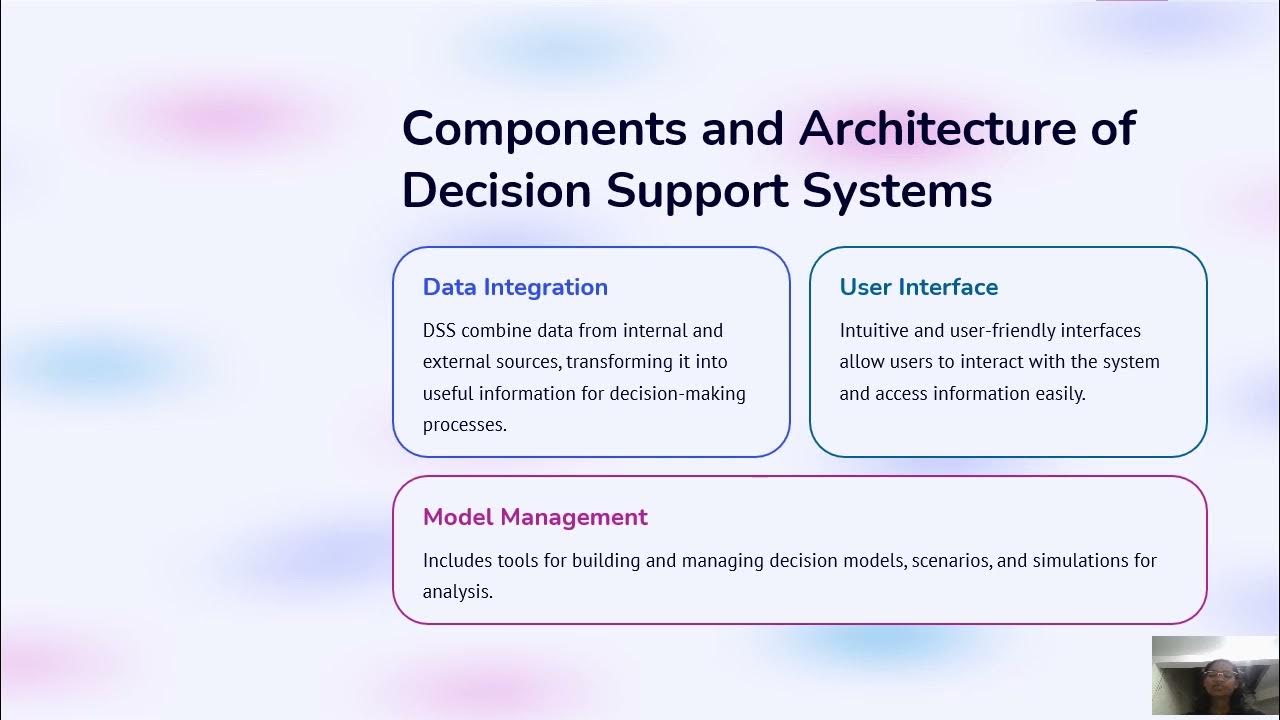
How is a Decision Support System (DSS) defined?
-A Decision Support System is an interactive computer-based system that helps decision-makers use data and models to solve semi-structured or unstructured problems and improve the quality of decisions.
Outlines

Dieser Bereich ist nur für Premium-Benutzer verfügbar. Bitte führen Sie ein Upgrade durch, um auf diesen Abschnitt zuzugreifen.
Upgrade durchführenMindmap

Dieser Bereich ist nur für Premium-Benutzer verfügbar. Bitte führen Sie ein Upgrade durch, um auf diesen Abschnitt zuzugreifen.
Upgrade durchführenKeywords

Dieser Bereich ist nur für Premium-Benutzer verfügbar. Bitte führen Sie ein Upgrade durch, um auf diesen Abschnitt zuzugreifen.
Upgrade durchführenHighlights

Dieser Bereich ist nur für Premium-Benutzer verfügbar. Bitte führen Sie ein Upgrade durch, um auf diesen Abschnitt zuzugreifen.
Upgrade durchführenTranscripts

Dieser Bereich ist nur für Premium-Benutzer verfügbar. Bitte führen Sie ein Upgrade durch, um auf diesen Abschnitt zuzugreifen.
Upgrade durchführenWeitere ähnliche Videos ansehen

Types of Information Systems (TPS, MIS, and DSS)

Decision Support Systems Video Lecture - Business Intelligence Concepts, Tools, and Applications

Topik 3 : Karakteristik dan Arsitektur Sistem Pengambilan Keputusan

Desicion-Making Systems, Modelling and Support

Pertemuan10 SIM-SPK
Introduction to Decision Support Systems in Business intelligence
5.0 / 5 (0 votes)

