Notasi Fungsi, Rumus Fungsi, dan Nilai Fungsi
Summary
TLDRThis video script explains the concept of function notation, formulas, and function values in mathematics. It begins by showing how to convert between function notation (e.g., f(x) = 2x - 1) and formulas, then demonstrates how to find function values by substituting specific x-values. The script provides multiple examples, such as determining f(2) and f(-2), and explores concepts like mapping and the relationship between 'pre-image' (input) and 'image' (output). It concludes with solving more complex problems using algebraic manipulations, helping learners grasp these essential mathematical principles.
Takeaways
- 😀 Function notation is written as f: x → 2x - 1, where 'f' is the function, 'x' is the input, and the formula after the arrow represents how the input is mapped.
- 😀 Different letters can be used to represent functions, such as 'g' or 'y', but 'f' is most commonly used in function notation.
- 😀 To convert function notation into a function formula, replace the arrow with an equation: f(x) = 2x - 1 becomes f(x) = 2x - 1.
- 😀 The notation 'f(x)' represents a function rule applied to an input value 'x', whereas the notation 'f: x → 2x - 1' is the definition of the function.
- 😀 The function value can be calculated by substituting a specific value of 'x' into the function formula, such as f(3) = 2(3) - 1 = 5.
- 😀 To find the value of a function at a specific point (like f(2) or f(-2)), substitute the given 'x' value into the function formula and simplify the result.
- 😀 The terms 'preimage' (pra-peta) and 'image' (peta) are used to describe the input value (preimage) and the resulting output value (image) in function mapping.
- 😀 Function notation and formulas are essential for determining the output (image) for any given input value (preimage).
- 😀 When calculating function values for a range of inputs, be sure to perform operations like multiplication and addition/subtraction in the correct order.
- 😀 In some cases, you may be asked to find the 'image' or 'preimage' of a value, such as determining the image (output) for a given input (x).
- 😀 Solving equations with function notation involves using algebraic operations to isolate and solve for unknown variables, such as finding 'b' when f(b) = 1.
Q & A
What is function notation and how is it written?
-Function notation is a way to represent functions, where the function name (usually denoted as 'f' or 'g') is followed by a variable (commonly 'x'), and then the formula describing the function. For example, 'f(x) = 2x - 1'. It shows how a function maps the variable 'x' to its result.
How do you convert function notation to a formula?
-To convert function notation into a formula, you take the notation, such as 'f: x -> 2x - 1', and rewrite it as 'f(x) = 2x - 1'. The arrow '->' is replaced with an equal sign, and the expression after the arrow becomes the right-hand side of the equation.
How do you evaluate the value of a function?
-To evaluate a function, you substitute the value of 'x' into the function's formula. For example, to find 'f(3)' when 'f(x) = 2x - 1', substitute 'x' with 3: 'f(3) = 2(3) - 1 = 6 - 1 = 5'.
What is the significance of the function 'g(x)' in the script?
-In the script, 'g(x)' is used as another example of a function. The function 'g(x)' maps 'x' to a formula, such as 'g(x) = 5x + 2'. It's similar to 'f(x)' but uses a different formula and is used to show how the function works with another variable.
What does the term 'peta' mean in the context of functions?
-'Peta' refers to the output or result of a function. It is the value that the function maps to based on a given input, or 'x'. In the script, for example, 'peta' of '2' means the value that results when 'x = 2' is substituted into the function.
How do you solve for the value of 'f(x)' when the input 'x' is given?
-To solve for 'f(x)', you substitute the given value of 'x' into the formula of the function. For example, if the function is 'f(x) = 2x - 4' and you need to find 'f(2)', you substitute 'x = 2' into the formula: 'f(2) = 2(2) - 4 = 4 - 4 = 0'.
What is the process to solve for 'x' when the output of the function is known?
-To solve for 'x' when the output is known, you set the function equal to the given value and solve for 'x'. For example, if 'f(x) = 2x - 3' and 'f(b) = 1', you set '2b - 3 = 1'. Solving for 'b' gives 'b = 2'.
What does the term 'bayangan' refer to in the context of functions?
-'Bayangan' refers to the output or result of a function when a specific input is substituted. It is synonymous with 'peta', meaning the value produced by the function for a given input.
What is the difference between 'notasi fungsi' and 'rumus fungsi'?
-'Notasi fungsi' refers to the symbolic representation of a function, such as 'f: x -> 2x - 1'. 'Rumus fungsi', on the other hand, is the formula that defines the function, such as 'f(x) = 2x - 1'. The 'notasi' shows the mapping, while the 'rumus' is the algebraic expression.
How do you determine the value of a function for negative inputs, like 'f(-2)'?
-To determine the value of a function for negative inputs, substitute the negative value into the function formula. For example, if 'f(x) = 2x - 4', to find 'f(-2)', substitute 'x = -2': 'f(-2) = 2(-2) - 4 = -4 - 4 = -8'.
Outlines

Dieser Bereich ist nur für Premium-Benutzer verfügbar. Bitte führen Sie ein Upgrade durch, um auf diesen Abschnitt zuzugreifen.
Upgrade durchführenMindmap

Dieser Bereich ist nur für Premium-Benutzer verfügbar. Bitte führen Sie ein Upgrade durch, um auf diesen Abschnitt zuzugreifen.
Upgrade durchführenKeywords

Dieser Bereich ist nur für Premium-Benutzer verfügbar. Bitte führen Sie ein Upgrade durch, um auf diesen Abschnitt zuzugreifen.
Upgrade durchführenHighlights

Dieser Bereich ist nur für Premium-Benutzer verfügbar. Bitte führen Sie ein Upgrade durch, um auf diesen Abschnitt zuzugreifen.
Upgrade durchführenTranscripts

Dieser Bereich ist nur für Premium-Benutzer verfügbar. Bitte führen Sie ein Upgrade durch, um auf diesen Abschnitt zuzugreifen.
Upgrade durchführenWeitere ähnliche Videos ansehen
Relasi dan Fungsi [Part 4] - Notasi, Rumus, dan Nilai Fungsi
Functions
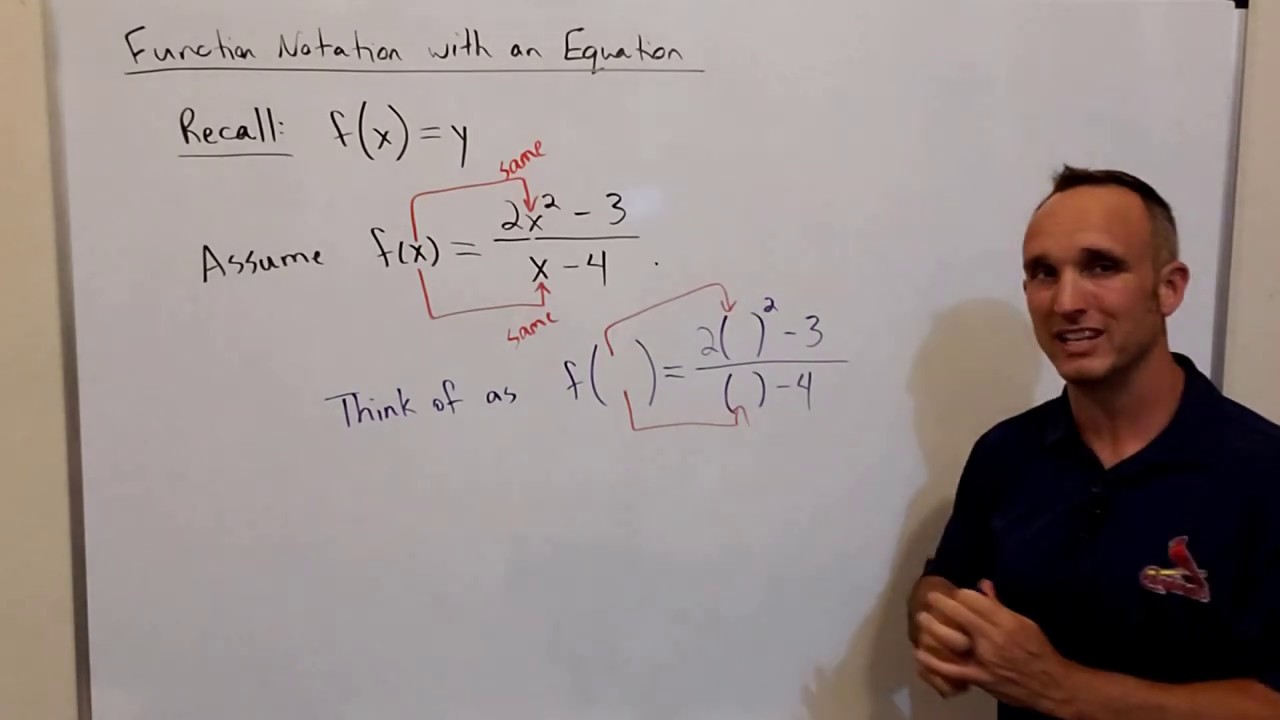
Function Notation with an Equation

Relasi dan Fungsi Part 2 ~ Fungsi (Pemetaan) dan Korespondensi Satu-Satu (Materi Kelas VIII / 8 SMP)

Pembahasan materi FUNGSI (Domain & Range, Komposisi, Invers) KELAS 10 | #MatematikAsik
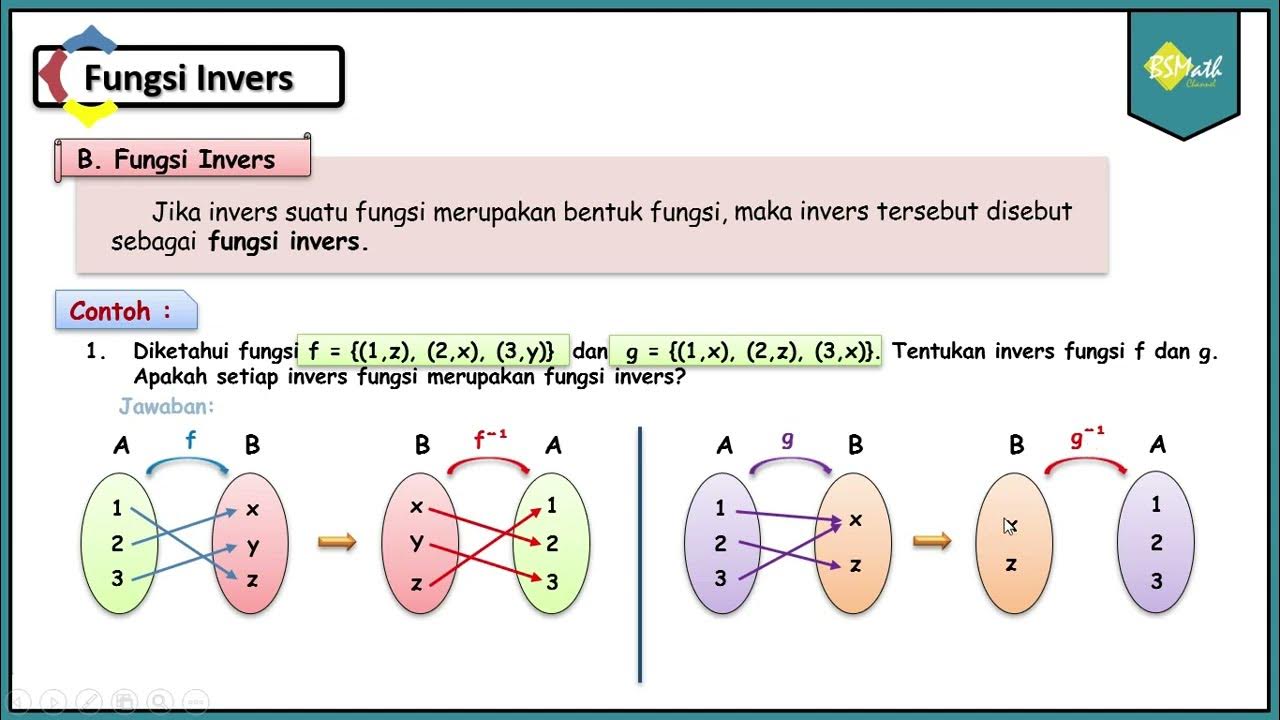
Fungsi Invers - Matematika SMA Kelas XI Kurikulum Merdeka
5.0 / 5 (0 votes)

