teori pembentukan benua Alfred Wegener
Summary
TLDRThis video explains the formation of continents based on Alfred Wegener’s Continental Drift Theory. Wegener proposed that around 225 million years ago, Earth had a single supercontinent called Pangaea. Over millions of years, Pangaea split into Laurasia in the north and Gondwana in the south, which later fragmented into the continents we recognize today. The script traces this process through geological eras, including the Triassic, Jurassic, Cretaceous, and the present. It also presents evidence supporting the theory, such as matching coastlines, similar rock structures, shared fossils across continents, mid-ocean ridges, magnetic shifts, and ancient glacial deposits.
Takeaways
- 😀 Alfred Wegener, a German climatologist and geologist, proposed the theory of Continental Drift in his book 'The Origin of Continents and Oceans'.
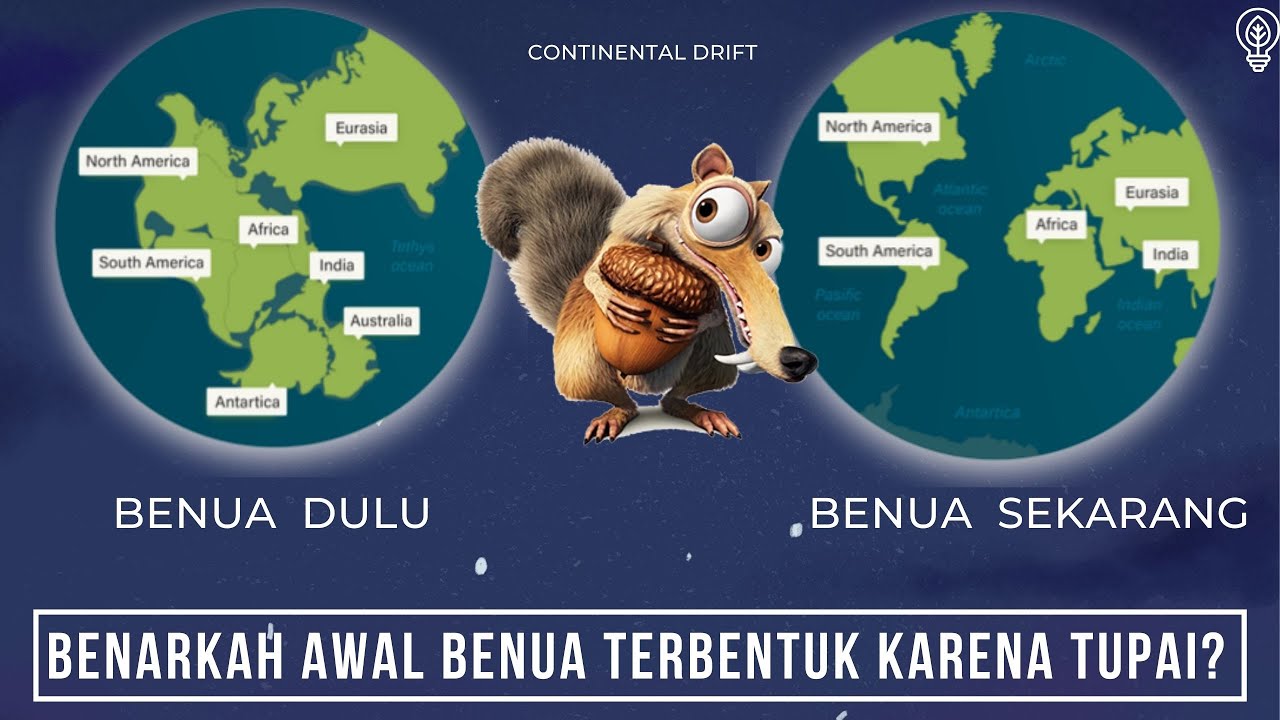
- 🌍 Around 225 million years ago, Earth had a single supercontinent called Pangea during the Permian period.
- 🌎 Approximately 200 million years ago, during the Triassic period, Pangea split into two parts: Laurasia in the north and Gondwana in the south.
- ⏳ By 150 million years ago, in the Jurassic period, North America began to separate from Eurasia, and India moved towards the northeast.
- 🌏 In the Cretaceous period, 60 million years ago, North and South America moved further apart from Eurasia and Africa, while India continued moving towards Asia.
- 🏔️ The collision between India and Eurasia led to the formation of the Himalayas.
- 🦘 Australia separated from Antarctica during this time.
- 🗺️ Wegener’s theory identified five key stages in continental formation: Pangea, Laurasia, Gondwana, the Jurassic period, the Cretaceous period, and the present day.
- 🌍 Evidence supporting Wegener’s theory includes the matching coastlines of South America and Africa, similarities in rock structures, and shared fossil findings like Glossopteris and Lystrosaurus.
- 🌊 The discovery of the Mid-Atlantic Ridge and Earth's magnetic shifts further validated the theory of Continental Drift.
Q & A
What is the theory proposed by Alfred Wegener regarding the formation of continents?
-Alfred Wegener proposed the 'Continental Drift' theory, which suggests that continents were once part of a single supercontinent called Pangea. Over time, Pangea split into smaller continents that drifted to their current positions.
What was Pangea, according to Alfred Wegener's theory?
-Pangea was a single supercontinent that existed around 225 million years ago during the Permian era, where all the continents were joined together as one large landmass.
What happened to Pangea around 200 million years ago?
-Around 200 million years ago, during the Triassic period, Pangea began to break apart into two main landmasses: Laurasia in the north and Gondwana in the south.
What are Laurasia and Gondwana?
-Laurasia was the northern landmass formed after Pangea's breakup, and Gondwana was the southern landmass. Laurasia later became North America, Eurasia, and other regions, while Gondwana became South America, Africa, and parts of Asia.
What geological changes occurred during the Jurassic period, according to Wegener's theory?
-During the Jurassic period (about 150 million years ago), the northern continent, North America, moved away from Eurasia, while in the south, India moved northeastward.
How did the separation of continents continue during the Cretaceous period?
-During the Cretaceous period (about 60 million years ago), North and South America continued to drift apart from Eurasia and Africa, while India continued moving toward Asia, which led to the formation of the Himalayas.
What evidence supports Alfred Wegener's theory of continental drift?
-Evidence supporting the theory includes the similar coastlines of South America and Africa, similar rock structures across continents, the discovery of the same fossils (such as Glossopteris and Lystrosaurus) on different continents, and the presence of mid-ocean ridges in the Atlantic Ocean.
What role do mid-ocean ridges play in Wegener's theory?
-Mid-ocean ridges, like the ones found in the Atlantic Ocean, are evidence of sea-floor spreading, which suggests that the ocean floor is expanding and continents are drifting apart.
How do magnetic reversals support the theory of continental drift?
-Magnetic reversals, found in rock formations on the ocean floor, show alternating bands of normal and reversed magnetic fields, which indicate that the sea floor is spreading, pushing the continents apart over time.
What was the significance of the glacial deposits found on different continents?
-The discovery of glacial deposits on continents like Africa, India, and South America, dating back to the Permian period, suggests that these continents were once located near the South Pole, which supports the idea that they were once part of a single landmass.
Outlines

Dieser Bereich ist nur für Premium-Benutzer verfügbar. Bitte führen Sie ein Upgrade durch, um auf diesen Abschnitt zuzugreifen.
Upgrade durchführenMindmap

Dieser Bereich ist nur für Premium-Benutzer verfügbar. Bitte führen Sie ein Upgrade durch, um auf diesen Abschnitt zuzugreifen.
Upgrade durchführenKeywords

Dieser Bereich ist nur für Premium-Benutzer verfügbar. Bitte führen Sie ein Upgrade durch, um auf diesen Abschnitt zuzugreifen.
Upgrade durchführenHighlights

Dieser Bereich ist nur für Premium-Benutzer verfügbar. Bitte führen Sie ein Upgrade durch, um auf diesen Abschnitt zuzugreifen.
Upgrade durchführenTranscripts

Dieser Bereich ist nur für Premium-Benutzer verfügbar. Bitte führen Sie ein Upgrade durch, um auf diesen Abschnitt zuzugreifen.
Upgrade durchführenWeitere ähnliche Videos ansehen

Alfred Wegener dan Teori Pergeseran Benua
Asal Mula Terbentuknya Benua dan Samudra || Continental Drift

Evidences Of Plate Tectonics,Continental Drift,Seafloor Spreading,Magnetic Reversal,Grade 10 Science
Pangeia | A Grande Catástrofe #9

Araling Panlipunan 8 MATATAG Q1 Week 1-2 Mga Teorya sa Pagkakabuo ng mga Kontinente with PPT and DLL
IPS KELAS 9 MATERI TEORI TERBENTUKNYA BENUA
5.0 / 5 (0 votes)

