Design of fixed-bed adsorption columns: breakthrough concentration curve and example 12.3-1 scale-up
Summary
TLDRThis transcript explores the intricacies of adsorption processes, focusing on breakthrough concentration, column capacity, and the design of adsorption systems. The speaker details methods for calculating capacity, understanding the dynamics of concentration profiles, and optimizing processes using fixed beds. Various techniques and assumptions are discussed to help in scaling up designs, determining the efficiency of materials like activated carbon, and predicting mass transfer zones. The transcript provides an in-depth look at adsorption principles, breakthrough points, and how they are crucial for effective industrial applications, all aimed at improving system performance and reducing energy costs.
Takeaways
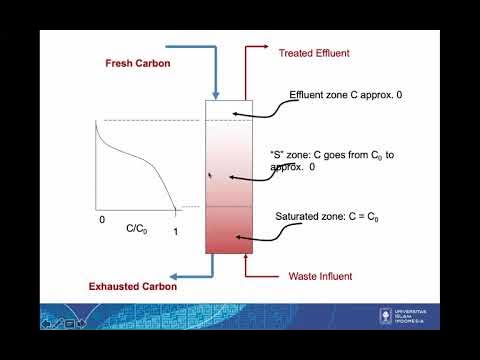
- 😀 The adsorption process involves understanding the relationship between the concentration gradient and mass transfer resistance in a fixed bed system.
- 😀 A key principle in adsorption is that concentration differences drive the mass transfer process, which is the primary mechanism for adsorption to occur.
- 😀 The breakthrough concentration is an important point in the adsorption process, where concentration starts to increase rapidly after reaching a certain threshold.
- 😀 The design of the adsorption column should account for both the breakthrough curve and the saturation loading capacity of the adsorbent material.
- 😀 Assumptions made in adsorption process modeling include that the adsorption occurs through the bed and that the concentration of the gas or liquid stream is uniform at the inlet.
- 😀 Concentration profiles in the column can be mapped using a mathematical model, and these profiles help to predict the performance of the adsorption system.
- 😀 The capacity of the column is often defined in terms of usable capacity, which is related to the time the adsorbent material can operate effectively before reaching the breakpoint.
- 😀 Particle size and adsorbent material play crucial roles in the efficiency of the adsorption process. For example, activated carbon is commonly used for adsorption.
- 😀 The calculation of saturation loading capacity helps to determine the maximum amount of material the adsorbent can hold before it becomes ineffective.
- 😀 For scaling up an adsorption process, factors such as superficial velocity, column diameter, and fluid dynamics must be considered to maintain efficiency at larger scales.
Q & A
What is the main focus of the discussed process in the script?
-The main focus is on adsorption processes, specifically the concentration profiles, breakthrough concentration, mass transfer resistance, and fixed bed design in chemical engineering.
What is the significance of breakthrough concentration in adsorption processes?
-Breakthrough concentration refers to the point at which the adsorbent's capacity is nearly exhausted, and contaminants begin to appear in the outlet stream. It is an important parameter for determining the effectiveness and duration of the adsorption process.
What role does mass transfer resistance play in the fixed bed adsorption process?
-Mass transfer resistance refers to the difficulty with which molecules move through the adsorbent bed. Higher resistance can lead to slower adsorption and less efficient removal of contaminants, affecting the overall performance of the system.
Why is the assumption of a fixed bed important in this context?
-Assuming a fixed bed simplifies the modeling of the adsorption process, as it allows for the prediction of concentration profiles and the analysis of mass transfer in a steady-state condition, making it easier to design and scale up the system.
What are the key factors influencing adsorption capacity?
-Key factors influencing adsorption capacity include the type of adsorbent, particle size, temperature, flow rate, and the concentration of the adsorbate. The breakthrough concentration and the system's operational conditions also play critical roles.
How do you calculate the saturation capacity of an adsorbent?
-Saturation capacity is calculated by determining the total amount of the substance adsorbed at equilibrium, typically measured in grams of adsorbate per gram of adsorbent. This value is used to evaluate the efficiency and effectiveness of the adsorbent.
What is the importance of the concentration profile in the adsorption process?
-The concentration profile helps visualize how the concentration of the adsorbate changes along the length of the fixed bed over time. It is crucial for understanding the distribution of adsorbate, the efficiency of the process, and the timing of breakthrough.
What is the relationship between particle size and adsorption efficiency?
-Smaller particles generally offer higher surface area for adsorption, leading to more efficient adsorption. However, very small particles may also cause increased mass transfer resistance due to slower diffusion rates within the bed.
What is meant by the term 'equivalent time for usable capacity'?
-The equivalent time for usable capacity refers to the duration during which the adsorbent bed effectively removes contaminants before reaching the breakthrough point. It is a measure of the efficiency of the bed in its active phase.
How does fluid velocity affect the adsorption process in a fixed bed?
-The fluid velocity impacts the rate of contact between the adsorbate and the adsorbent. Higher velocities may reduce the residence time of the fluid in the bed, leading to incomplete adsorption. On the other hand, lower velocities increase residence time and can enhance adsorption efficiency, but may lead to greater pressure drop.
Outlines

Dieser Bereich ist nur für Premium-Benutzer verfügbar. Bitte führen Sie ein Upgrade durch, um auf diesen Abschnitt zuzugreifen.
Upgrade durchführenMindmap

Dieser Bereich ist nur für Premium-Benutzer verfügbar. Bitte führen Sie ein Upgrade durch, um auf diesen Abschnitt zuzugreifen.
Upgrade durchführenKeywords

Dieser Bereich ist nur für Premium-Benutzer verfügbar. Bitte führen Sie ein Upgrade durch, um auf diesen Abschnitt zuzugreifen.
Upgrade durchführenHighlights

Dieser Bereich ist nur für Premium-Benutzer verfügbar. Bitte führen Sie ein Upgrade durch, um auf diesen Abschnitt zuzugreifen.
Upgrade durchführenTranscripts

Dieser Bereich ist nur für Premium-Benutzer verfügbar. Bitte führen Sie ein Upgrade durch, um auf diesen Abschnitt zuzugreifen.
Upgrade durchführenWeitere ähnliche Videos ansehen

Pressure Swing Adsorption Process For Air Purification|| PSA Cycle|| Aspen Adsorption

Video Animasi: Penjelasan Kromatografi Kolom
Pertemuan 18 Adsorpsi Bagian 2, SOSP TL, Prodi TL UII, 2020-2021

Adsorption Columns & Equipment - How do they Work? (Lec127)

ADSORPSI _ Pengertian Adsorpsi _ Adsorpsi adalah _ Perbedaan Adsorpsi dan Absorpsi _ Adsorpsi

Column Chromatography
5.0 / 5 (0 votes)

