Pembahasan Soal Titrasi Asam Basa Kelas 11
Summary
TLDRIn this educational chemistry video, the instructor walks viewers through four detailed acid-base titration problems, tailored for 11th-grade students. The tutorial covers calculating molarity of NaOH, determining iron content in a sample, finding the concentration of acetic acid, and evaluating the percentage of vinegar in everyday cooking. Each problem is solved step-by-step using clear explanations of molarity, valence, reaction stoichiometry, and dilution principles. The instructor also demonstrates multiple solving methods for better understanding, ensuring students grasp both conceptual and practical aspects of titration. The video emphasizes accuracy, practical application, and problem-solving strategies in real lab scenarios.
Takeaways
- 😀 The video discusses acid-base titration problems for 11th-grade chemistry, focusing on both conceptual understanding and calculation methods.
- 😀 Titration is used to determine the concentration of a solution using a solution of known concentration.
- 😀 In Problem 1, the molarity of NaOH is determined by titration with 0.1 M HCl using phenolphthalein as an indicator, resulting in 0.086 M NaOH.
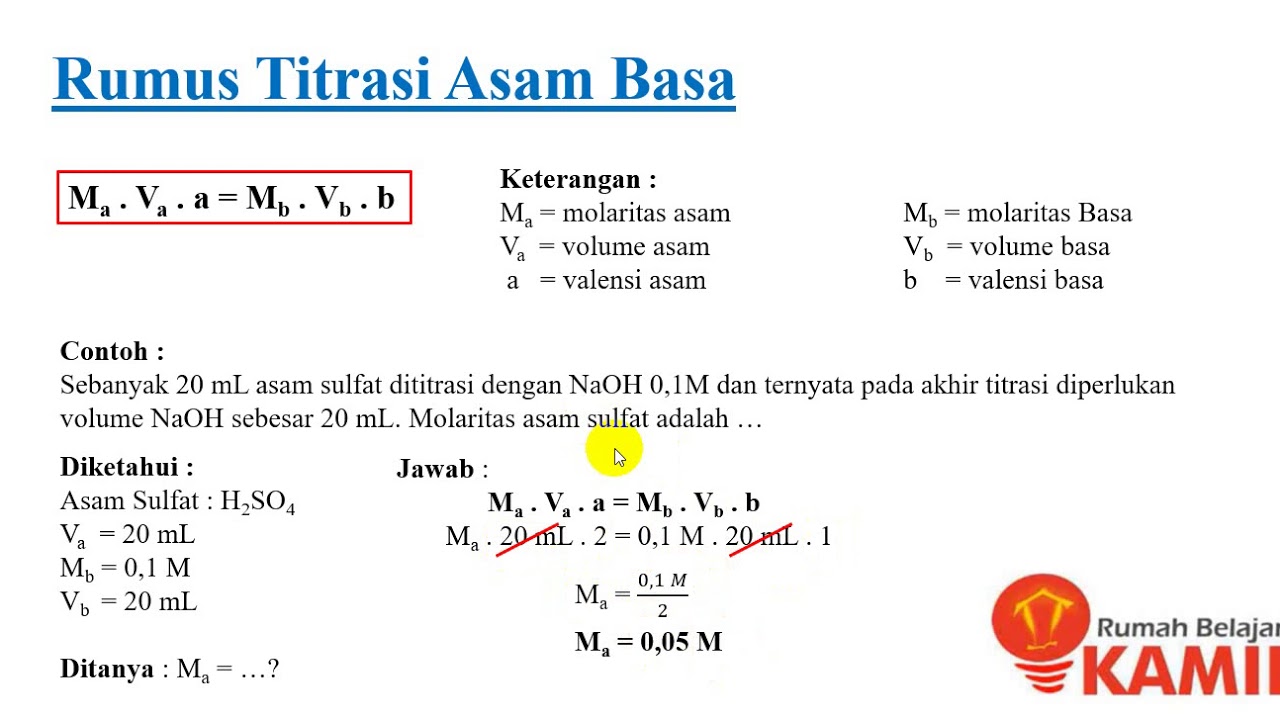
- 😀 Two calculation approaches are highlighted: using equivalent grams (molarity × volume × valence) and using reaction stoichiometry.
- 😀 Problem 2 involves determining the iron (Fe) content in a 2 g sample using excess HCl and titration of leftover acid with NaOH, resulting in 8.4% Fe content.
- 😀 Problem 3 calculates the molarity of acetic acid (CH3COOH) titrated with 0.1 M NaOH, yielding 0.12 M using both equivalent and reaction-based methods.
- 😀 Problem 4 focuses on determining the concentration and percentage of vinegar (acetic acid) after dilution and titration with NaOH, resulting in 2 M and 11.49% concentration, respectively.
- 😀 The video emphasizes careful attention to units (mL, molarity) and the importance of step-by-step calculation to avoid errors.
- 😀 The concept of neutralization is central: acids and bases react in a 1:1 or stoichiometrically defined ratio, which is essential for accurate titration calculations.
- 😀 Dilution calculations are used to backtrack from titration data to the original concentration of solutions, applying the M1V1 = M2V2 formula.
- 😀 The instructor encourages understanding multiple solution methods for titration problems, including both conceptual reaction reasoning and direct formula application.
- 😀 The video provides practical examples linking lab procedures (like titration) to chemical calculations and real-world applications, such as determining vinegar acidity.
Q & A
What is the primary topic discussed in the video?
-The video discusses acid-base titration problems in high school chemistry, specifically for grade 11, semester 2.
How is the molarity of NaOH determined in the first example?
-The molarity of NaOH is determined by titrating it with 0.1 M HCl using a phenolphthalein indicator. Using the formula M1V1 = M2V2 (since both have valence 1), the molarity of NaOH is calculated to be 0.086 M.
What alternative method is suggested to calculate the molarity of NaOH?
-An alternative method uses the reaction approach. By setting up the equation based on the neutralization reaction (NaOH + HCl → NaCl + H2O), and considering that both react completely, the molarity of NaOH is derived from 29x = 2.5, giving x = 0.086 M.
In the second problem, how is the percentage of iron in the sample determined?
-The sample containing iron is reacted with excess HCl, and the leftover HCl is titrated with NaOH. By calculating the reacted HCl, the number of moles of Fe is determined, converted to grams, and then divided by the sample mass to get the percentage. The final percentage of iron in the sample is 8.4%.
What is the chemical reaction used for iron in HCl?
-The reaction is Fe + 2HCl → FeCl2 + H2.
How is the molarity of acetic acid (CH3COOH) calculated in the third problem?
-The molarity is determined by titration with 0.1 M NaOH. Using the formula M_acid × V_acid = M_base × V_base and substituting the known values (V_acid = 25 mL, M_base = 0.1 M, V_base = 30 mL), the molarity of CH3COOH is calculated to be 0.12 M.
Explain the stepwise approach used in the fourth problem to determine the concentration of vinegar.
-First, a diluted vinegar sample (10 mL diluted to 50 mL) is titrated using NaOH to determine the molarity of the diluted portion. Using M1V1 = M2V2 for the dilution step, the molarity of the original vinegar is calculated. Finally, the concentration is expressed as a percentage of pure acetic acid relative to the standard 17.4 M pure acetic acid, resulting in 11.49%.
Why is it important to consider the dilution step in the vinegar titration problem?
-Because the titration is performed on a small portion of the diluted sample, the actual molarity of the original solution can only be determined by accounting for the dilution using M1V1 = M2V2, ensuring accurate calculation of the original vinegar concentration.
What role does the phenolphthalein indicator play in these titrations?
-Phenolphthalein acts as an acid-base indicator that changes color at the endpoint of the titration, signaling when the reaction between acid and base is complete.
How is the molar amount of a substance calculated in titration problems?
-The molar amount is calculated using the formula n = M × V, where n is the number of moles, M is the molarity, and V is the volume in liters. For reactions with known stoichiometry, this helps determine the quantity of the other reactant or product.
What general concept is emphasized across all titration problems in the video?
-The video emphasizes that titration is used to determine the concentration of an unknown solution by reacting it with a solution of known concentration and using stoichiometric relationships, while carefully considering dilution, volume, and valence factors.
Outlines

هذا القسم متوفر فقط للمشتركين. يرجى الترقية للوصول إلى هذه الميزة.
قم بالترقية الآنMindmap

هذا القسم متوفر فقط للمشتركين. يرجى الترقية للوصول إلى هذه الميزة.
قم بالترقية الآنKeywords

هذا القسم متوفر فقط للمشتركين. يرجى الترقية للوصول إلى هذه الميزة.
قم بالترقية الآنHighlights

هذا القسم متوفر فقط للمشتركين. يرجى الترقية للوصول إلى هذه الميزة.
قم بالترقية الآنTranscripts

هذا القسم متوفر فقط للمشتركين. يرجى الترقية للوصول إلى هذه الميزة.
قم بالترقية الآنتصفح المزيد من مقاطع الفيديو ذات الصلة



5.0 / 5 (0 votes)

