06 Pengenalan Konveksi Part1 PERPAN
Summary
TLDRThis lecture introduces Chapter 6 on convection, covering boundary layers, local and average convection coefficients, and flow types. It explains that convection involves energy transfer between a surface and a contacting fluid through both fluid motion (advection) and molecular diffusion (conduction). Key boundary layers—velocity, thermal, and concentration—are described, highlighting their role in determining heat and mass transfer rates. The video details formulas for local and average convection coefficients, including applications to flat surfaces, and demonstrates how gradients in velocity, temperature, and concentration affect transfer rates. Practical examples and experimental data illustrate these concepts, making them accessible for fluid mechanics studies.
Takeaways
- 😀 Convection is the heat transfer between a surface and the fluid in direct contact, involving both advection (bulk fluid motion) and diffusion (molecular motion).
- 😀 Advection refers to energy transfer due to macroscopic fluid motion, while diffusion is similar to conduction and occurs at the molecular level.
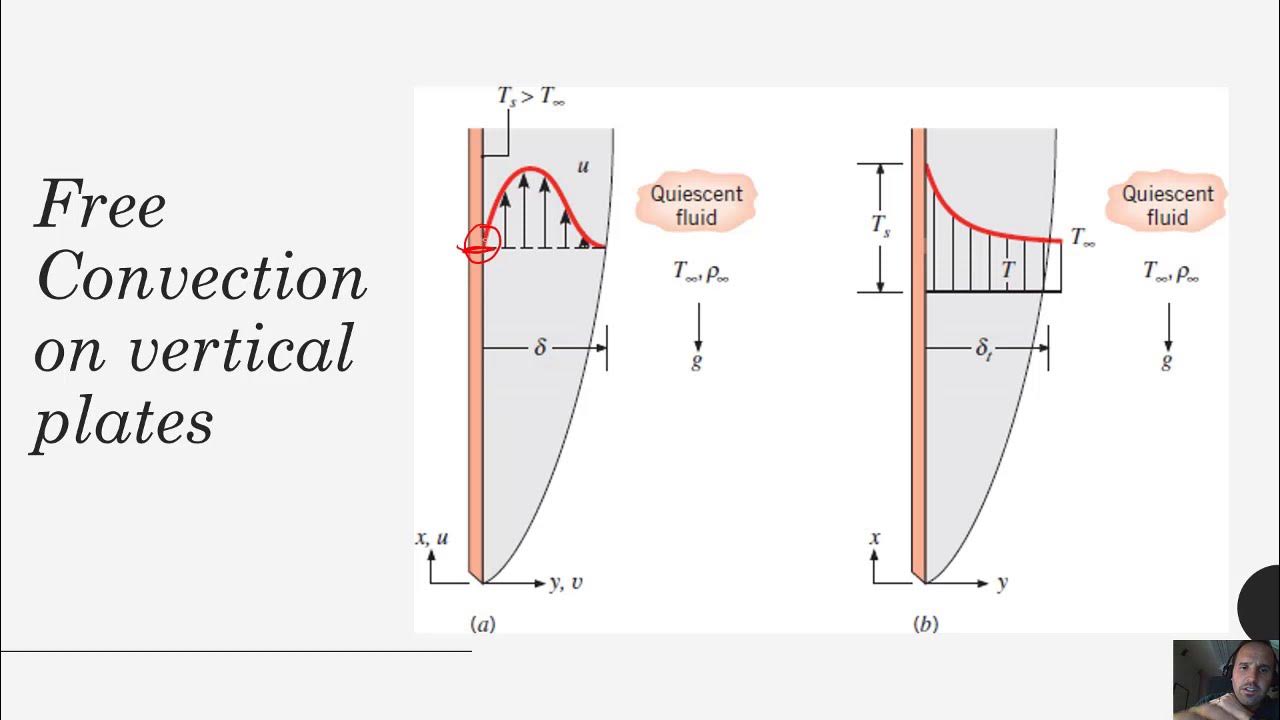
- 😀 There are three types of boundary layers in convection: velocity boundary layer, thermal boundary layer, and concentration boundary layer.
- 😀 The velocity boundary layer forms near a solid surface where fluid velocity gradually changes from zero (at the surface) to the free stream velocity away from the surface.
- 😀 The thermal boundary layer arises due to temperature differences between the surface and the fluid, with fluid temperature approaching the surface temperature near the wall.
- 😀 The concentration boundary layer involves mass transfer, such as the diffusion of vapor from a liquid surface into the air, with thickness ΔC representing the distance over which concentration changes.
- 😀 The thickness of each boundary layer (velocity, thermal, and concentration) may differ and affects local rates of heat and mass transfer.
- 😀 The local convective heat transfer coefficient (h_x) varies along the surface, and the average convective coefficient (h̄) is calculated by integrating h_x over the surface area.
- 😀 For a flat plate, if the local convective coefficient follows h_x = a * x^(-0.1), the average coefficient h̄ is slightly higher than h_x at the plate end, with h̄ ≈ 1.11 * h_x.
- 😀 Understanding boundary layers and convective coefficients is essential for analyzing heat and mass transfer in both internal and external flows, and for predicting transfer rates accurately.
- 😀 The study of convection in this script lays the foundation for more detailed topics in future chapters, including external flow, internal flow, free convection, and phase-change processes like boiling and condensation.
Q & A
What is convective heat transfer and what mechanisms contribute to it?
-Convective heat transfer is the energy transfer between a surface and the fluid in contact with it. It occurs through two mechanisms: advection (energy transfer due to bulk fluid motion) and diffusion (random molecular motion similar to conduction). Both mechanisms often act simultaneously.
What is the difference between pure advection and convection?
-Pure advection refers to heat transfer solely due to the bulk movement of the fluid, while convection includes both advection and diffusion, combining the effects of fluid motion and molecular energy transfer.
What are the main types of boundary layers in convective heat transfer?
-The main types of boundary layers are: 1) Velocity boundary layer, 2) Thermal boundary layer, and 3) Concentration boundary layer. Each represents a region where the influence of the surface affects fluid velocity, temperature, or species concentration, respectively.
How does the velocity boundary layer develop over a flat surface?
-The velocity boundary layer develops as the fluid flows over a surface. Fluid at the surface has zero velocity due to the no-slip condition, and velocity gradually increases with distance from the surface until it reaches the free-stream velocity. Its thickness, δ, grows downstream from the leading edge.
What is the thermal boundary layer and how is its thickness defined?
-The thermal boundary layer is the region near a surface where the fluid temperature is influenced by the surface temperature. Its thickness, δ_t, is typically defined as the distance from the surface where the fluid temperature reaches 99% of the free-stream temperature.
What is the role of the concentration boundary layer?
-The concentration boundary layer governs mass transfer, such as the diffusion of a species from a surface into a flowing fluid. Its thickness, δ_c, defines the distance over which the species concentration approaches the bulk value, and it is used to calculate convective mass transfer rates.
How is the local convective heat transfer coefficient (h_x) determined?
-The local convective heat transfer coefficient, h_x, is determined from the temperature gradient at the surface: h_x = -k (∂T/∂y)|_y=0, where k is the thermal conductivity of the fluid and y is the direction normal to the surface.
How is the average convective heat transfer coefficient (h̄) calculated?
-The average convective heat transfer coefficient over a surface area A_s is calculated as: h̄ = (1/A_s) ∫_A_s h_x dA. For a flat plate of length L, it simplifies to h̄ = (1/L) ∫_0^L h_x dx.
What is the relationship between local and average heat transfer coefficients for a flat plate where h_x = a * x^-0.1?
-For h_x = a * x^-0.1, integrating over the plate length L gives h̄ = 1.11 * a * L^-0.1. The ratio h̄/h_x is approximately 1.1, showing that the average coefficient is slightly higher than the local value at the end of the plate.
Why is understanding boundary layers important in convective heat transfer?
-Boundary layers are crucial because they determine the gradients of velocity, temperature, and concentration near the surface, which directly influence the rates of friction, heat transfer, and mass transfer. Accurate prediction of boundary layer thickness is essential for calculating convective transfer rates.
How does boundary layer thickness affect the convective heat transfer rate?
-Thicker boundary layers reduce the gradient of temperature at the surface, decreasing the local convective heat transfer rate. Conversely, thinner boundary layers increase the gradient and enhance heat transfer.
Can velocity, thermal, and concentration boundary layers exist simultaneously?
-Yes, all three types of boundary layers can coexist. However, their thicknesses typically differ because momentum, heat, and mass diffuse at different rates depending on fluid properties like viscosity, thermal conductivity, and diffusivity.
Outlines

هذا القسم متوفر فقط للمشتركين. يرجى الترقية للوصول إلى هذه الميزة.
قم بالترقية الآنMindmap

هذا القسم متوفر فقط للمشتركين. يرجى الترقية للوصول إلى هذه الميزة.
قم بالترقية الآنKeywords

هذا القسم متوفر فقط للمشتركين. يرجى الترقية للوصول إلى هذه الميزة.
قم بالترقية الآنHighlights

هذا القسم متوفر فقط للمشتركين. يرجى الترقية للوصول إلى هذه الميزة.
قم بالترقية الآنTranscripts

هذا القسم متوفر فقط للمشتركين. يرجى الترقية للوصول إلى هذه الميزة.
قم بالترقية الآنتصفح المزيد من مقاطع الفيديو ذات الصلة

Heat Transfer - Chapter 8 - Internal Convection - Hydrodynamic Considerations
Heat Transfer - Chapter 9 - Conceptual Introduction to Natural (Free) Convection)

Analysis of Temperature Distribution profile of pin fin | Practical No.8 | GTU | 3151909

Heat | Full Chapter Revision under 30 mins | Class 7 Science

Boundary Layer dan Pengaruhnya pada Objek Bergerak

Suhu, Kalor, dan Pemuaian | IPA Kelas 7 Bab 3 Kurikulum Merdeka - Lengkap
5.0 / 5 (0 votes)

