MENGANALISIS CP, TP DAN ATP JENJANG SD DALAM KURILUM MERDEKA
Summary
TLDRThis video discusses the analysis of CP (Competency Standards) and ATP (Achievement Targets) in the context of the Indonesian Merdeka Curriculum, focusing on the primary school level. The content covers the structure and elements of CP, explaining how these competencies are developed from early childhood to secondary education. The video also highlights the role of the constructivist theory in shaping learning outcomes, the importance of linking CP to teaching methods, and the process of formulating clear learning objectives. The goal is to equip educators with the knowledge to effectively design and assess learning in line with the curriculum.
Takeaways
- 😀 Competency Standards (CP) are learning competencies that students must achieve in each phase of the Merdeka Curriculum, from early childhood education (PAUD) to secondary school.
- 😀 CP is the minimum competency that teachers must teach their students, with the curriculum divided into different phases, such as Phase A to Phase C in elementary school.
- 😀 CP consists of five key components: rationales, subject goals, subject characteristics, phase achievements, and achievements based on each element of the CP.
- 😀 Each subject’s CP includes essential competency groups, which may vary between subjects, and each element should be interconnected to achieve the desired learning outcomes.
- 😀 The CP is built on constructivist theory, emphasizing that knowledge is constructed based on real, contextual experiences, and understanding is the highest competency level.
- 😀 Understanding within CP should not be equated to Bloom's Taxonomy's C2 level but rather viewed as a higher-level competency, such as creating or applying knowledge.
- 😀 In formulating learning objectives, the curriculum allows for different frameworks, such as revising Bloom’s Taxonomy or using other theories like Marzano’s Taxonomy.
- 😀 Learning objectives can be simply formulated as a combination of competencies and content (CP + content), which can also integrate communication, collaboration, creativity, and critical thinking.
- 😀 Teachers can formulate learning objectives in three ways: directly from CP, by analyzing and separating competencies from content, or through cross-element integration between CP elements.
- 😀 In the Merdeka Curriculum, unlike the rigid structure in the K-13 curriculum, teachers are encouraged to focus on competencies and content rather than following a strict ABCD pattern, allowing more flexibility in teaching approaches.
Q & A
What is CP in the context of the Indonesian Merdeka Curriculum?
-CP, or Capaian Pembelajaran, refers to the learning competencies that students must achieve at each educational phase, from early childhood (PAUD) to secondary education. It represents the minimum competencies that teachers are required to teach their students.
How is CP structured for primary school (SD) phases?
-For primary schools, CP is organized into phases from A to C. Each phase has specific CPs and elements, which are further broken down into learning objectives and competencies that need to be achieved by students.
What are the five main components of CP?
-The five components are: 1) Rational, explaining why a subject is taught; 2) Subject objectives, outlining required student capabilities; 3) Characteristics of the subject, providing general descriptions for teaching methods and media; 4) Learning outcomes for each phase; 5) Outcomes by element, which are detailed competencies for each subject component.
What are examples of elements in CP for different subjects?
-Examples include: Mathematics (Numbers, Algebra, Measurement, Geometry, Data Analysis and Probability), Science (Understanding science concepts and process skills), and Language (Listening, Reading, Speaking, Writing, Presenting).
How does the Merdeka Curriculum view the competency 'understanding'?
-In the Merdeka Curriculum, 'understanding' is seen as a higher-order competency, above C2 in Bloom's Taxonomy. It aligns with constructivist theory, where knowledge is built based on real and contextual experiences.
What are the three methods to formulate learning objectives (TP) from CP?
-The three methods are: 1) Directly deriving from CP; 2) Separating competencies and content before formulating objectives; 3) Integrating multiple CP elements to create cross-element learning objectives.
What is ATP, and how is it used in teaching?
-ATP (Analisis Tujuan Pembelajaran) is the sequence of learning objectives arranged according to phase and difficulty. It guides teachers in ordering lessons from concrete to abstract, easy to complex, or general to specific, ensuring scaffolded learning for students.
How are competencies and content distinguished in formulating learning objectives?
-Competencies are identified through action verbs (e.g., measure, describe, compare) that indicate what students can do. Content refers to the subject matter or scope of material that accompanies the competency.
What considerations are recommended for sequencing learning objectives in ATP?
-Sequencing can be based on: 1) From concrete to abstract concepts; 2) From easier to more challenging tasks; 3) From general concepts to more specific ones. This helps in scaffolding student learning progressively.
Why is it important to create indicators and assessment for each learning objective?
-Indicators and assessments show whether students have achieved the competency. They provide measurable evidence of learning, guiding teachers on whether students can apply the knowledge or skills, such as using a measurement tool correctly or performing calculations.
How does cross-element learning help in achieving broader competencies?
-Cross-element learning integrates competencies from different elements, allowing students to apply multiple skills simultaneously, such as measuring objects and then representing them in geometric shapes. This approach promotes deeper understanding and practical application.
What is the role of constructivist theory in formulating CP and TP?
-Constructivist theory emphasizes that knowledge is built from real and contextual experiences. CP and TP are designed to promote active learning where students construct understanding through hands-on and meaningful activities, making learning more effective and relevant.
Outlines

هذا القسم متوفر فقط للمشتركين. يرجى الترقية للوصول إلى هذه الميزة.
قم بالترقية الآنMindmap

هذا القسم متوفر فقط للمشتركين. يرجى الترقية للوصول إلى هذه الميزة.
قم بالترقية الآنKeywords

هذا القسم متوفر فقط للمشتركين. يرجى الترقية للوصول إلى هذه الميزة.
قم بالترقية الآنHighlights

هذا القسم متوفر فقط للمشتركين. يرجى الترقية للوصول إلى هذه الميزة.
قم بالترقية الآنTranscripts

هذا القسم متوفر فقط للمشتركين. يرجى الترقية للوصول إلى هذه الميزة.
قم بالترقية الآنتصفح المزيد من مقاطع الفيديو ذات الصلة

Telaah Kurikulum KBK dan KTSP

4 Point Pokok Kurikulum Merdeka di Jenjang SD (LENGKAP)

Elemen dan Sub Elemen Standar Kompetensi Lulusan Sekolah Islam Terpadu
PRESENTASI KURIKULUM DAN PEMBELAJARAN KELOMPOK 1
Pesan Mas Menteri tentang Kurikulum Merdeka
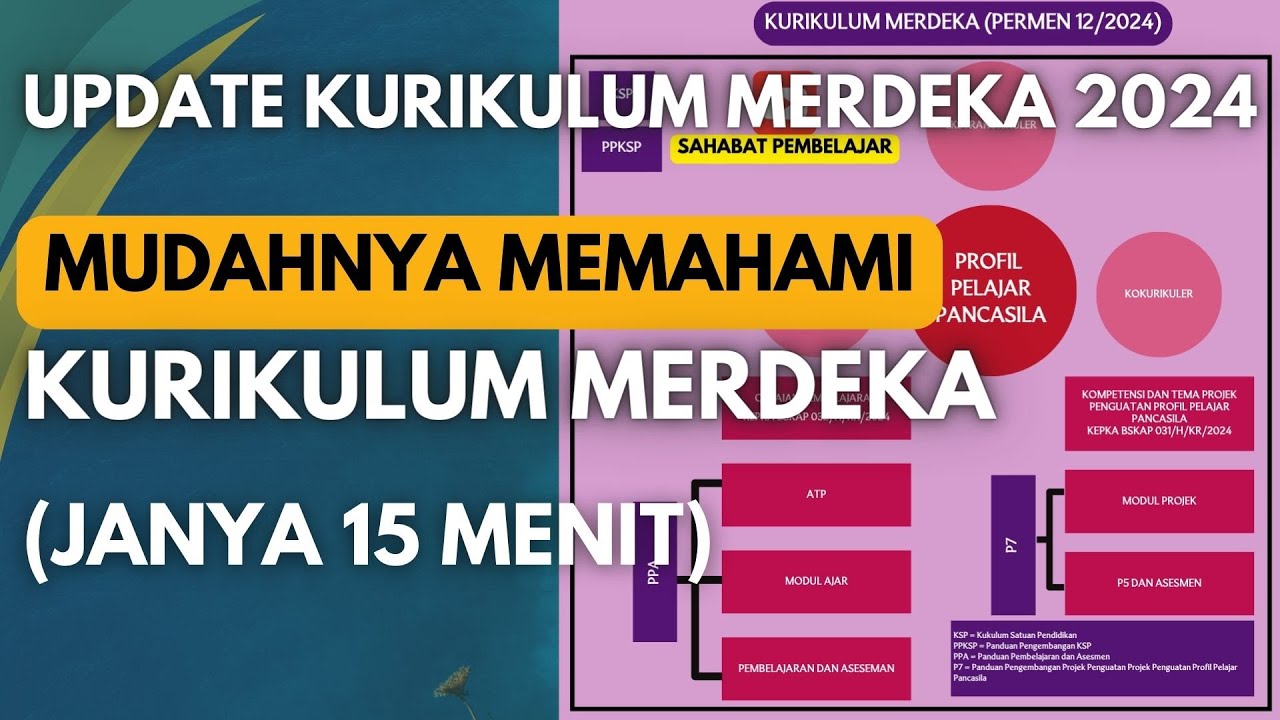
MUDAHNYA MEMAHAMI KURIKULUM MERDEKA. CUKUP 15 MENIT. UPDATE KURIKULUM MERDEKA 2024
5.0 / 5 (0 votes)

