11 DESIGN PROTOTYPING and CONSTRUCTION
Summary
TLDRThis lesson explores the importance of prototyping in design, covering different types such as low-fidelity and high-fidelity prototypes. It highlights the need for compromises in prototyping—whether horizontal or vertical—and how these affect functionality and design choices. Key concepts like conceptual and concrete design are discussed, with an emphasis on interface metaphors, interaction types, and the role of scenarios and storyboards in the design process. The video also touches on the use of physical computing kits and SDKs for transitioning from design to construction, and the value of feedback and evaluation in creating successful products.
Takeaways
- 😀 Prototyping is essential in design to test and validate ideas before final product development.
- 😀 A prototype is a preliminary version of a product that helps explore design concepts and functionality.
- 😀 Low-fidelity prototypes (e.g., paper, cardboard) are cheap, quick to create, and allow for easy changes.
- 😀 High-fidelity prototypes closely resemble the final product and help test realistic user interactions.
- 😀 Compromises are inevitable in prototyping—horizontal prototypes offer wide functionality but little detail, while vertical prototypes provide detailed functionality for only a few features.
- 😀 Prototypes support evaluation and feedback, which are key to refining product design and functionality.
- 😀 A conceptual design involves transforming user needs into a model that outlines what the product will do and how users will interact with it.
- 😀 The choice of interface metaphors plays a crucial role in helping users understand and relate to the product.
- 😀 Scenarios and use cases can be used to generate storyboards, card-based prototypes, and experience maps to better understand user interaction and design flow.
- 😀 Physical computing kits and SDKs (like Arduino and Makey Makey) enable the transition from design to actual product construction with physical computing elements.
- 😀 Design phases include both conceptual design (defining functions and tasks) and concrete design (refining the details such as color, icons, and interaction devices).
Q & A
What is a prototype and why is it used in design?
-A prototype is a preliminary model of a product, system, or concept created to test and validate ideas, design concepts, and functionalities before the final version is developed. It is used to evaluate design choices, gather feedback, communicate ideas, and explore alternatives effectively.
What are the main differences between low-fidelity and high-fidelity prototypes?
-Low-fidelity prototypes are quick, inexpensive, and easy to change, often using paper, cardboard, sketches, or storyboards. High-fidelity prototypes use materials and components closer to the final product, providing more realistic interactions but may give users the false impression of a finished system.
What are the filtering dimensions of prototyping according to Helen Sharp?
-The filtering dimensions are Appearance (size, color, shape, texture), Data (size, type, privacy), Functionality (system functions and user needs), Interactivity (input/output/feedback behaviors), and Spatial Structure (arrangement of interface or information elements).
What does it mean when a prototype is described as horizontal or vertical?
-A horizontal prototype provides a broad range of functions but with little detail, while a vertical prototype provides detailed functionality but only for a few aspects. Both types involve compromises that must be acknowledged.
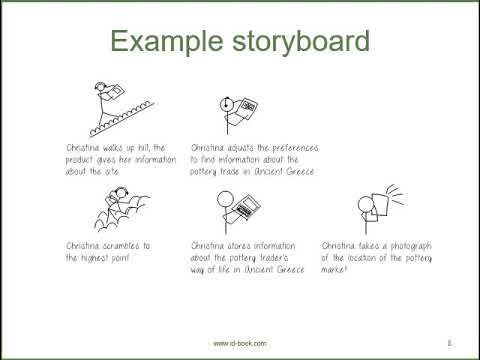
How do storyboards contribute to the prototyping process?
-Storyboards visually represent a sequence of user interactions with a system through sketches or cartoons. They help explore scenarios, enable roleplay, and allow designers to test ideas early in the design process.
What is a conceptual design and what role does it play in prototyping?
-Conceptual design transforms user requirements into a conceptual model, outlining what users can do with a product and the concepts they need to interact with it. It helps define interface metaphors, interaction types, and potential problem areas before creating concrete designs.
What are interface metaphors and why are they important?
-Interface metaphors use familiar knowledge to help users understand a product. They provide structure, improve comprehension, and make interactions more intuitive, especially for complex systems.
How are scenarios and personas used in the design process?
-Scenarios describe proposed or imagined situations, guiding design decisions and user evaluation. Personas represent typical users, helping designers model experiences and test prototypes against realistic user needs and behaviors.
What tools and kits are mentioned for constructing physical and software prototypes?
-Physical computing kits include Arduino, LilyPad, and Makey Makey, which allow rapid prototyping of interactive devices. Software development kits (SDKs) such as iOS SDK or Microsoft Connect SDK provide programming tools, documentation, and APIs to create software prototypes efficiently.
Why must prototypes eventually be engineered into a final product?
-Prototypes are meant to answer questions, test ideas, and explore alternatives, but they often involve compromises in functionality, appearance, or performance. To become a usable product, prototypes must be carefully engineered to meet final specifications, quality, and reliability standards.
How do experience maps and design maps aid in prototyping?
-Experience maps and design maps visually capture the user journey, interactions, and task flows. They help designers identify pain points, optimize workflows, and ensure the product addresses user needs effectively across scenarios.
What is the Wizard of Oz prototyping technique and its purpose?
-In Wizard of Oz prototyping, users interact with a system they believe to be autonomous, but a developer manually responds to inputs behind the scenes. This technique helps understand user expectations early without building full system functionality.
Outlines

هذا القسم متوفر فقط للمشتركين. يرجى الترقية للوصول إلى هذه الميزة.
قم بالترقية الآنMindmap

هذا القسم متوفر فقط للمشتركين. يرجى الترقية للوصول إلى هذه الميزة.
قم بالترقية الآنKeywords

هذا القسم متوفر فقط للمشتركين. يرجى الترقية للوصول إلى هذه الميزة.
قم بالترقية الآنHighlights

هذا القسم متوفر فقط للمشتركين. يرجى الترقية للوصول إلى هذه الميزة.
قم بالترقية الآنTranscripts

هذا القسم متوفر فقط للمشتركين. يرجى الترقية للوصول إلى هذه الميزة.
قم بالترقية الآنتصفح المزيد من مقاطع الفيديو ذات الصلة
Lecture 08 Part 1 Low Fidelity Prototyping

Lecture 1.4 The Power of Prototyping

Wireframing for UX: What it is and how to get better at it

Config 2025: Influencing via prototyping with Cheechee Lin
What Is Wireframing? (A UI Design Tutorial)
Low fidelity design: A guide to making your design process inclusive - Daniel Sauble (Config 2021)
5.0 / 5 (0 votes)

