PRESENT CONTINUOUS TENSE in English: 7 ways to use it!
Summary
TLDRIn this video, Aga explains the present continuous tense in English, covering seven key uses, such as talking about actions happening now, temporary situations, and future arrangements. She compares it with the present simple tense, illustrating the differences through examples like 'I am reading' versus 'I read'. The video also explores how the present continuous expresses temporary habits, annoyance, and ongoing thoughts. Viewers can practice identifying the correct usage of the tense, and there’s an invitation to subscribe for more resources, including a free grammar booklet.
Takeaways
- 😀 The present continuous tense (also known as the present progressive) is used to describe actions happening right now.
- 😀 Example: 'I am reading a book' refers to an action happening in the present moment, unlike the present simple, 'I read a lot of books,' which indicates a regular habit.
- 😀 The present continuous can also describe temporary situations, like 'I am living in Paris at the moment,' which contrasts with a permanent habit like 'I live in Paris.'
- 😀 It's used for temporary habits or actions, such as 'I am eating a lot of sugar this month,' unlike a permanent habit, 'I eat a lot of vegetables.'
- 😀 The present continuous expresses frustration or annoyance with repeated actions, like 'You're always wearing shoes inside!'
- 😀 With the verb 'think,' the present continuous expresses a current process of thinking, e.g., 'I am thinking we should go for lunch.'
- 😀 'I am being' can describe temporary behavior or attitude, like 'I am being horrible right now,' in contrast to 'I am horrible,' which describes a permanent characteristic.
- 😀 The present continuous can be used to discuss future plans and arrangements, such as 'I am playing football with my friends on Saturday.'
- 😀 To practice, differentiate between the present continuous ('I am drinking coffee at the moment') and the present simple ('I play tennis every weekend').
- 😀 The video encourages viewers to subscribe for more English tips and get a free grammar booklet, with an interactive exercise to reinforce understanding of the present continuous tense.
Q & A
What is the main use of the present continuous tense in English?
-The present continuous tense is used to talk about actions happening right now, in the specific moment of speaking. For example, 'I am reading a book right now.'
How is the present continuous tense different from the present simple tense?
-The present continuous describes actions happening right now (e.g., 'I am eating'), while the present simple describes regular, habitual actions (e.g., 'I eat every day').
Can you use the present continuous for temporary actions?
-Yes, the present continuous is used to describe temporary actions or states. For instance, 'I am living in Paris at the moment' refers to a temporary situation.
What does it mean if something is described using the present simple tense, like 'I live in Paris'?
-The present simple tense in this case suggests a permanent or habitual action. 'I live in Paris' means it is a fixed or long-term situation, not a temporary one.
What is an example of a temporary habit expressed in the present continuous tense?
-A temporary habit could be 'I am eating a lot of sugar this month,' as it's a short-term change in behavior.
How do you use the present continuous tense to express annoyance?
-You use the present continuous to express annoyance about repeated actions, such as 'You're always wearing shoes inside.' It emphasizes irritation about the behavior.
Why do we say 'I'm thinking about my friend right now' instead of 'I think about my friend'?
-The present continuous is used here to emphasize that the thinking process is happening right now, not as a general, ongoing thought.
What is the difference between 'I am horrible' and 'I am being horrible'?
-'I am horrible' describes a general, permanent characteristic, whereas 'I am being horrible' refers to temporary behavior at that moment.
Can the present continuous tense be used to talk about future plans?
-Yes, the present continuous is often used to describe future arrangements or plans made with others, like 'I am playing football on Saturday.'
What is the purpose of the practice exercise in the video?
-The practice exercise aims to help learners distinguish between the present continuous and present simple tenses in different contexts, enhancing their understanding and usage.
Outlines

هذا القسم متوفر فقط للمشتركين. يرجى الترقية للوصول إلى هذه الميزة.
قم بالترقية الآنMindmap

هذا القسم متوفر فقط للمشتركين. يرجى الترقية للوصول إلى هذه الميزة.
قم بالترقية الآنKeywords

هذا القسم متوفر فقط للمشتركين. يرجى الترقية للوصول إلى هذه الميزة.
قم بالترقية الآنHighlights

هذا القسم متوفر فقط للمشتركين. يرجى الترقية للوصول إلى هذه الميزة.
قم بالترقية الآنTranscripts

هذا القسم متوفر فقط للمشتركين. يرجى الترقية للوصول إلى هذه الميزة.
قم بالترقية الآنتصفح المزيد من مقاطع الفيديو ذات الصلة

How to Use the Present Continuous - English Verb Tenses Grammar Lesson

Let's Learn: Present Continuous Tense | With Ms. Rindi

English Grammar: All 4 Present Tenses

PRESENT CONTINUOUS TENSE ~ Video Pembelajaran Bahasa Inggris
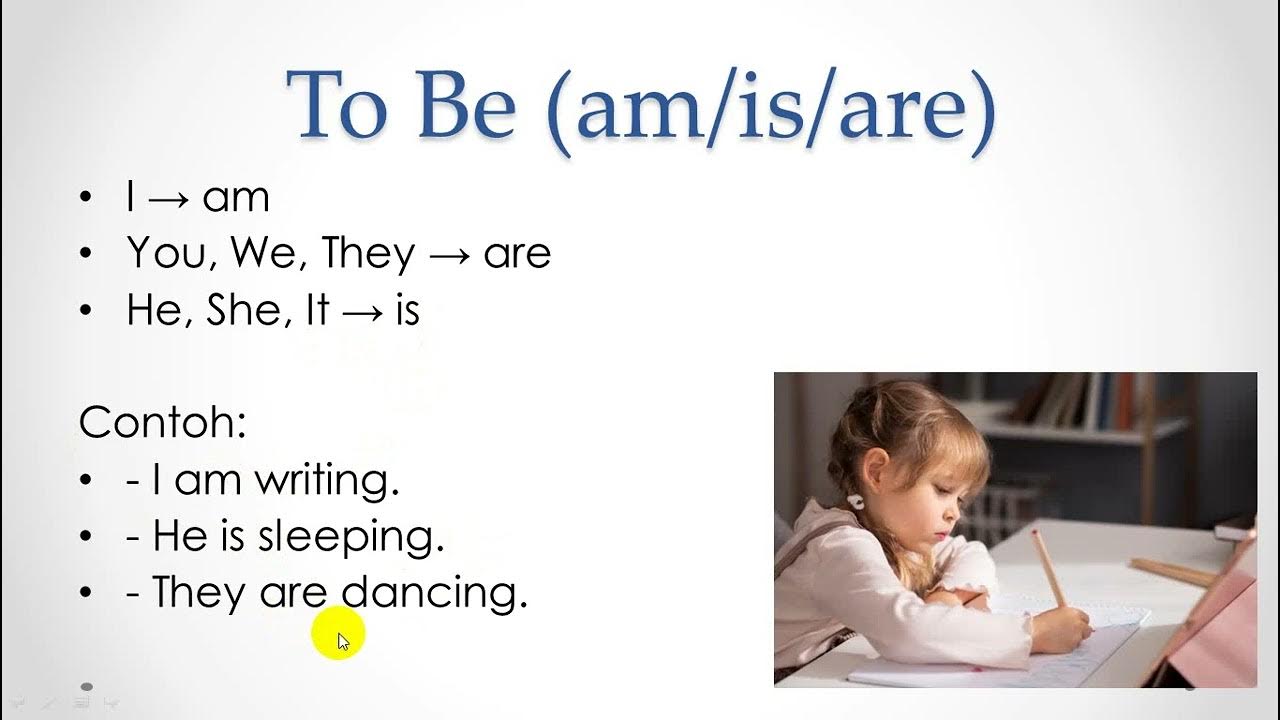
Present Continuous Tense
Present Continuous Tense | Bahasa Inggris Kelas 8 | Definition, Function, Pattern, Adverb of Time
5.0 / 5 (0 votes)

