konsep mol E2
Summary
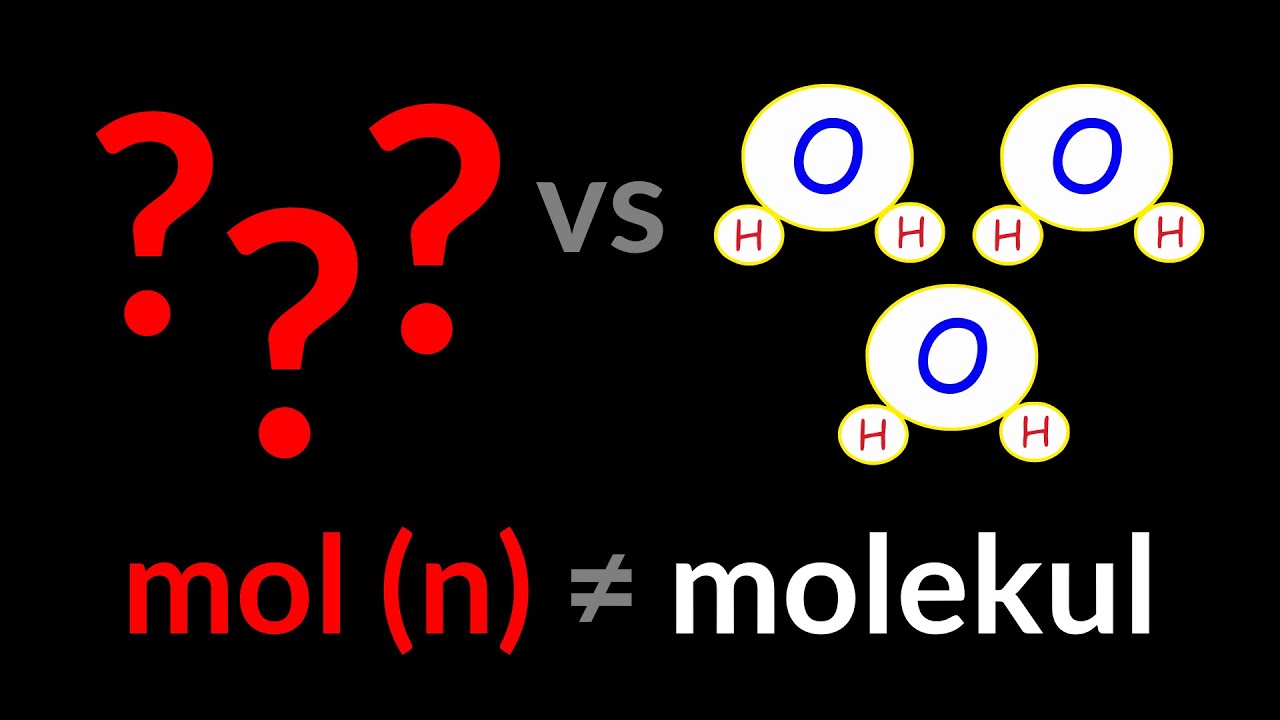
TLDRThis video unravels the fascinating concept of the mole in chemistry, showing how scientists count unimaginably tiny particles like atoms and molecules. It explains that a mole acts as a 'super dozen,' containing 6.02 × 10²³ particles, bridging the microscopic world with measurable quantities in grams and liters. The script walks through practical applications, including converting mass to moles using relative molecular mass (MR), calculating particle numbers with Avogadro's number, and determining gas volumes at STP. A case study demonstrates using moles to uncover both the empirical and molecular formulas of an unknown compound, highlighting the mole's powerful role in making the invisible world of chemistry tangible and understandable.
Takeaways
- 🧪 Chemists deal with extremely small particles like atoms and molecules in enormous quantities, making direct counting impossible.
- 📦 The concept of the mole was created as a practical solution to count vast numbers of particles efficiently.
- 🔢 One mole represents 6.02 × 10^23 particles, a value known as Avogadro’s number.
- 🌉 The mole acts as a bridge between the microscopic world (atoms and molecules) and the macroscopic world (measurable quantities like mass and volume).
- ⚖️ Molar mass (Mr) is the mass of one mole of a substance and is used to convert between mass and moles.
- 🔄 Converting between mass and moles is simple: divide by molar mass to get moles, and multiply by molar mass to get mass.
- 🧮 The mole can also be used to calculate the number of particles and the volume of gases under standard conditions (22.4 L/mol at STP).
- 🗺️ The “mole bridge” concept illustrates how moles connect mass, number of particles, and gas volume.
- 🕵️ The mole can be used as a tool to determine the empirical and molecular formulas of unknown compounds.
- 📊 Empirical formulas represent the simplest ratio of elements in a compound, derived from percentage composition data.
- 🔍 Molecular formulas reveal the actual number of atoms in a compound and are determined using molar mass comparisons.
- 🧩 By converting percentage composition into moles and simplifying ratios, chemists can deduce the empirical formula.
- 📐 Comparing empirical formula mass with actual molar mass allows determination of the molecular formula.
- ✨ The mole concept enables scientists to uncover the identity of substances from abstract data, showcasing its powerful role in chemistry.
Q & A
Why do chemists need the concept of a mole?
-Chemists deal with extremely small particles like atoms and molecules in enormous quantities, often exceeding 10^20 in just a drop of water. Counting each individually is impossible, so the mole allows them to group particles into a standard quantity for easier calculations.
What is the numerical value of Avogadro's number, and what does it represent?
-Avogadro's number is 6.02 × 10^23. It represents the number of particles (atoms, molecules, or ions) in one mole of a substance.
How is the mole concept similar to everyday counting units like a dozen or a rim?
-Just as a dozen represents 12 items and a rim represents 500 sheets of paper, a mole represents a fixed number of particles (6.02 × 10^23). It simplifies counting extremely large numbers of small entities.
What is the role of the mole as a 'bridge' in chemistry?
-The mole connects the microscopic world of atoms and molecules, which we cannot see, to the macroscopic world, where quantities can be measured in grams or liters.
How do you convert mass to moles?
-To convert mass to moles, divide the mass of a substance by its molar mass (molecular weight in grams per mole). Formula: n (mol) = mass (g) / molar mass (g/mol).
How can you convert moles back to mass?
-To find the mass from moles, multiply the number of moles by the substance's molar mass. Formula: mass (g) = moles × molar mass (g/mol).
How can the mole concept be used to determine the number of particles in a substance?
-Multiply the number of moles by Avogadro's number. Formula: Number of particles = moles × 6.02 × 10^23.
How is the volume of a gas at standard temperature and pressure (STP) related to moles?
-At STP, 1 mole of any ideal gas occupies 22.4 liters. You can convert moles to volume using: Volume (L) = moles × 22.4 L.
What is the difference between an empirical formula and a molecular formula?
-The empirical formula shows the simplest whole-number ratio of atoms in a compound, while the molecular formula shows the actual number of atoms in a molecule.
How do you determine the empirical formula from percentage composition?
-Assume percentages as grams, convert to moles for each element, divide all by the smallest number of moles to find a simple whole-number ratio, which gives the empirical formula.
How do you find the molecular formula from the empirical formula?
-Calculate the molar mass of the empirical formula, then divide the actual molar mass of the compound by the empirical formula mass. Multiply the subscripts in the empirical formula by this factor to get the molecular formula.
Can you give an example of using mole calculations to identify a compound?
-For a compound with 40% C, 6.6% H, and 53.4% O, convert to moles → ratio 1:2:1 → empirical formula CH2O. If the molar mass is 90 g/mol, divide by empirical mass 30 → factor 3 → molecular formula C3H6O3.
Outlines

此内容仅限付费用户访问。 请升级后访问。
立即升级Mindmap

此内容仅限付费用户访问。 请升级后访问。
立即升级Keywords

此内容仅限付费用户访问。 请升级后访问。
立即升级Highlights

此内容仅限付费用户访问。 请升级后访问。
立即升级Transcripts

此内容仅限付费用户访问。 请升级后访问。
立即升级浏览更多相关视频

SCIENCE 9 Quarter 2 Week 4 Mole Concept

Mole Concept | Grade 9 Science DepEd MELC Quarter 2 Module 6
Stoikiometri 1 (mol adalah jumlah)

KONSEP MOL PART 1 (JUMLAH PARTIKEL)

PART 1: Mole Concept (Mole and Molar Mass) | Science 9 - Quarter 2 (MELC 11) Week 6

How big is a mole? (Not the animal, the other one.) - Daniel Dulek
5.0 / 5 (0 votes)

