Discounted Cash Flow | DCF Model Step by Step Guide
Summary
TLDRIn this video, Kenji walks viewers through building a Discounted Cash Flow (DCF) model, covering both theory and a practical Excel example. He explains key steps: forecasting free cash flows, calculating the Weighted Average Cost of Capital (WACC), determining terminal value using perpetuity growth or exit multiples, discounting cash flows to present value, and deriving enterprise and equity value to estimate an implied share price. Kenji highlights essential assumptions, practical tips, and caveats, including mid-year adjustments and sensitivity analysis, while providing a hands-on Excel walkthrough for a complete understanding of valuing companies based on future cash flows.
Takeaways
- 😀 DCF (Discounted Cash Flow) is a valuation method used to estimate the value of an asset based on its future cash flows.
- 😀 The DCF model is intrinsic, meaning it focuses on the company's ability to generate cash flow, independent of external market conditions.
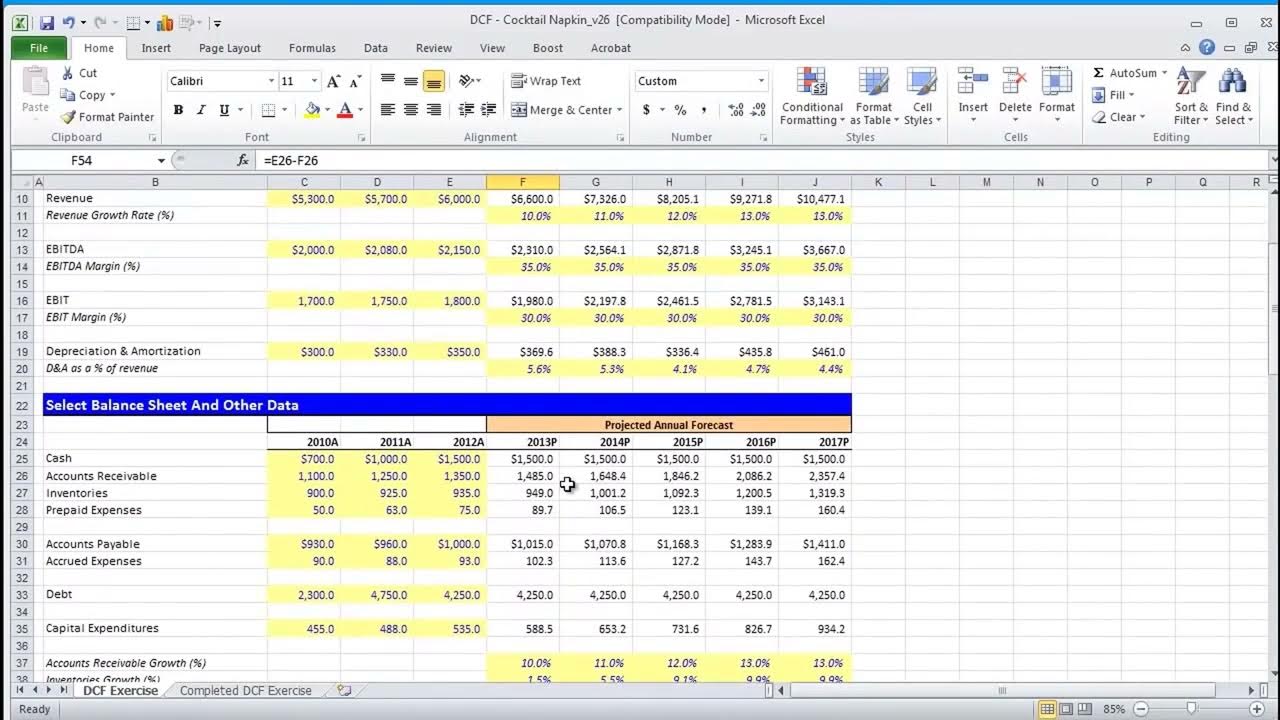
- 😀 Key steps in creating a DCF model include forecasting free cash flows, calculating WACC (Weighted Average Cost of Capital), determining the terminal value, discounting cash flows, and calculating the implied share price.
- 😀 Free Cash Flow (FCF) represents the cash available to both debt and equity holders after operating expenses and capital expenditures.
- 😀 WACC is used to discount future cash flows back to their present value and is calculated using both the cost of debt and cost of equity.
- 😀 Cost of equity is calculated using the Capital Asset Pricing Model (CAPM), which involves the risk-free rate, the company’s beta, and the market return.
- 😀 Terminal value accounts for the company's value beyond the forecast period (typically 5-10 years) and can be calculated using the perpetuity growth method or the exit multiple method.
- 😀 The perpetuity growth method assumes cash flows grow indefinitely, while the exit multiple method values the company based on an industry comparable multiple, such as EV/EBITDA.
- 😀 Discounting future cash flows and the terminal value gives the enterprise value, which includes both debt and equity.
- 😀 The equity value is derived from the enterprise value by subtracting debt and adding cash/marketable securities. Dividing by the number of shares gives the implied share price.
- 😀 The DCF model may not always be applicable for companies with negative free cash flows (e.g., startups) and may require other valuation methods like relative valuation.
Q & A
What is a discounted cash flow (DCF) model?
-A DCF model is a valuation method used to estimate the present value of an asset based on its expected future cash flows. It is an intrinsic valuation method, focusing on the company's ability to generate cash rather than market conditions.
What are the key steps in creating a DCF model?
-The key steps are: 1) Forecast free cash flows for 5-10 years, 2) Calculate the weighted average cost of capital (WACC), 3) Determine the terminal value, 4) Discount the cash flows to present value, and 5) Calculate enterprise value, equity value, and implied share price.
How is free cash flow (FCF) calculated?
-FCF is calculated as: EBIT × (1 - Tax Rate) + Depreciation & Amortization - Capital Expenditures - Change in Non-Cash Working Capital. It represents the cash available to both debt and equity holders after all operational costs.
Why are depreciation and amortization added back when calculating FCF?
-Depreciation and amortization are non-cash expenses, meaning the actual cash outflow occurred earlier when the asset was purchased. They are added back to reflect the true cash available.
What is the Weighted Average Cost of Capital (WACC) and why is it important?
-WACC represents a company's cost of financing through both debt and equity, weighted by their proportions in the company's capital structure. It is important because it serves as the discount rate for calculating the present value of future cash flows.
How do you calculate the cost of equity using CAPM?
-Cost of equity = Risk-free rate + Beta × (Market return - Risk-free rate). It reflects the expected return investors demand for taking on the risk of owning the company's equity.
What are the two methods to calculate terminal value in a DCF model?
-1) Perpetuity Growth Method: assumes cash flows grow at a steady rate forever. 2) Exit Multiple Method: assumes the company is sold using a multiple of a financial metric like EBITDA, based on comparable companies.
How do you discount future cash flows and terminal value to present value?
-Discount each cash flow using the formula PV = Cash Flow / (1 + WACC)^t, where t is the period. Apply the same formula to the terminal value, bringing it back to present value.
How is enterprise value converted to equity value and share price?
-Equity value = Enterprise Value + Cash & Marketable Securities - Debt. Implied share price = Equity Value ÷ Number of shares outstanding.
What are some limitations or considerations when using a DCF model?
-DCF is sensitive to assumptions like growth rates and WACC. Negative FCF can make valuation invalid. Mid-year adjustments and sensitivity analyses are recommended for accuracy. Forecasts should ideally be based on historical data.
Why might a mid-year adjustment be important when discounting cash flows?
-Because cash flows usually occur throughout the year, using mid-year adjustments (e.g., 0.5, 1.5 years) improves accuracy in calculating present value and reflects timing more realistically.
What is sensitivity analysis in the context of a DCF model?
-Sensitivity analysis examines how changes in key assumptions, like WACC or growth rates, impact the valuation. It helps assess the model’s robustness and understand potential risks.
Outlines

此内容仅限付费用户访问。 请升级后访问。
立即升级Mindmap

此内容仅限付费用户访问。 请升级后访问。
立即升级Keywords

此内容仅限付费用户访问。 请升级后访问。
立即升级Highlights

此内容仅限付费用户访问。 请升级后访问。
立即升级Transcripts

此内容仅限付费用户访问。 请升级后访问。
立即升级浏览更多相关视频

Build a Dynamic 3 Statement Financial Model From Scratch
Financial Modeling Quick Lessons: Building a Discounted Cash Flow (DCF) Model (Part 1) [UPDATED]

A Basic Discounted Cash Flow Model

How to Value a Company | Best Valuation Methods

Using a Python DCF Calculation to find the Intrinsic Fair Value of a Stock

The DCF Model Explained - How The Pros Value Stocks/Businesses
5.0 / 5 (0 votes)

