Posyandu Full
Summary
TLDRThis video demonstrates the process of anthropometric measurements used to monitor the growth of toddlers, including weight, height, head circumference, and upper arm circumference. It covers the appropriate tools and techniques for measuring children from 0 to 59 months, including the use of baby scales, stadiometers, and measuring tapes. Step-by-step instructions are provided for each measurement, ensuring accuracy and proper technique. The video also emphasizes the importance of tracking growth against gender and age-based growth charts, as well as the role of healthcare workers in monitoring and advising on child nutrition and health.
Takeaways
- 😀 Anthropometric measurement is a key method for monitoring the growth of toddlers and infants.
- 😀 Weight measurement for infants 0–23 months uses a baby scale, ensuring minimal clothing and no accessories.
- 😀 Infants are placed in the scale’s bowl, and the weight is recorded with precision to 10 grams or two decimal points in kilograms.
- 😀 Toddlers over 24 months or weighing more than 20 kg are measured with a digital standing scale.
- 😀 Length measurement for infants (0–23 months) is done with an infantometer, requiring two people to ensure accuracy.
- 😀 Height measurement for toddlers 24 months and older is done using a stadiometer, with precise positioning of head, back, hips, calves, and heels.
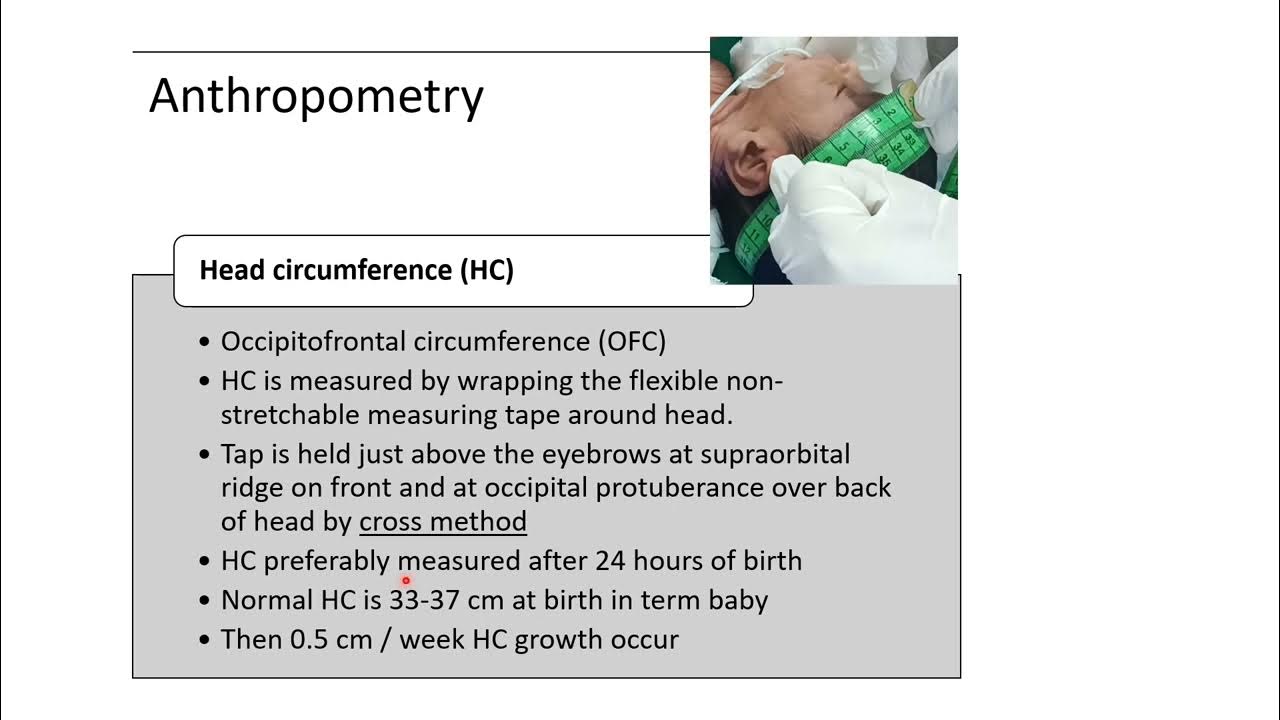
- 😀 Head circumference is measured using a measuring tape around the forehead, above the eyebrows, over the ears, and around the most prominent part of the back of the head.
- 😀 Upper arm circumference is measured for children 6–59 months as a screening tool for growth problems, marking the midpoint between shoulder and elbow.
- 😀 All measurements should be plotted on growth charts according to age and sex to monitor development accurately.
- 😀 Parents receive guidance on toddler nutrition and health, including protein-rich complementary foods and vitamin supplementation, after the measurements.
- 😀 Health workers and volunteers validate data after each measurement session to ensure accuracy and reliability of growth monitoring.
Q & A
What is the purpose of anthropometric measurements for toddlers (balita)?
-Anthropometric measurements are used to monitor the growth and development of toddlers. This includes measuring weight, height, head circumference, and upper arm circumference to assess their health and growth patterns.
What is the proper way to weigh a baby who cannot stand?
-For babies aged 0 to 23 months who cannot stand, they should be weighed using a baby scale. The baby should wear minimal clothing, no diaper, and not be holding anything. The baby is placed on the scale, and the weight is recorded when the display shows the weight, ensuring the 'hold' function is activated.
How is the weight of toddlers aged 2 years and older measured?
-For toddlers aged 2 years or older (weighing more than 20 kg), a digital or standing weight scale is used. The toddler should stand barefoot, without shoes or anything in hand, and the weight is recorded once the scale displays a stable reading.
How is the length of babies measured between 0 to 23 months?
-The length of babies aged 0 to 23 months is measured using an infantometer. The baby should be laid flat on a board with their head touching the head panel, and the feet should be positioned perpendicular to the foot piece of the instrument. Two people are required: one to hold the baby’s legs straight, and the other to adjust the foot piece.
What should be done if a baby’s feet are stiff during length measurement?
-If the baby’s feet are stiff during the length measurement, the feet should be gently massaged to loosen them. Once relaxed, the foot piece should be placed correctly on the baby’s feet to ensure accurate measurement.
What is the recommended action for measuring the height of toddlers aged 2 years or older?
-For toddlers aged 2 years or older, their height should be measured using a stadiometer. The child should stand upright, with their back against the measuring column. The head should be positioned in alignment with an imaginary line from the ear to the lower eye margin, ensuring a straight posture.
Why should measurements of height and length be adjusted in certain cases?
-When measuring height or length, adjustments are made if the child is under 2 years old. If a length measurement is taken while the child is standing, it should be increased by 0.7 cm. Similarly, when measuring a child older than 2 years lying down, the height should be reduced by 0.7 cm.
How is head circumference measured for toddlers?
-Head circumference is measured using a measuring tape, placed over the forehead above the eyebrows, around both ears, and at the back of the head. The tape should be snug but not tight. The reading should be noted in centimeters with a precision of 1 mm.
What is the purpose of measuring upper arm circumference in toddlers?
-Upper arm circumference is measured for early detection and screening of growth issues, especially in toddlers aged 6 to 59 months. It helps identify potential malnutrition or health concerns that may require medical intervention.
How are the results of anthropometric measurements used in health monitoring?
-The results of anthropometric measurements are plotted on growth charts specific to the child’s age and gender. These charts help track the child’s growth over time and identify any deviations from typical growth patterns, allowing for early intervention if necessary.
Outlines

此内容仅限付费用户访问。 请升级后访问。
立即升级Mindmap

此内容仅限付费用户访问。 请升级后访问。
立即升级Keywords

此内容仅限付费用户访问。 请升级后访问。
立即升级Highlights

此内容仅限付费用户访问。 请升级后访问。
立即升级Transcripts

此内容仅限付费用户访问。 请升级后访问。
立即升级浏览更多相关视频

Anthropometry part-II cephalometry (Physical anthropology- practical group- A)

How to Identify Malnutrition in Children
Anthropometry Measurements in Newborn | Pediatrics

7 Nutrition Screening

CARA MENGGUNAKAN GRAFIK PERTUMBUHAN ANAK WHO

⚠️⚠️⚠️SERING DIANGGAP SAMA, PAHAMI PERBEDAAN STUNTING DENGAN STUNTED❗️❗️❗️ ⚠️⚠️⚠️
5.0 / 5 (0 votes)

