Chapter 5 Part 2
Summary
TLDRThis video discusses four key growth strategies for retailers: market penetration, market expansion, retail format development, and diversification. Market penetration focuses on increasing sales to existing customers, while market expansion targets new demographics or geographic areas. Retail format development involves changing a retailer’s format to appeal to the same market, and diversification includes exploring new markets with different offerings. Real-world examples, such as Dunkin' Donuts' geographic expansion and Walmart's evolving formats, illustrate these strategies. The video prompts viewers to think about which growth strategies are most effective and challenging, using brands like The Gap to explore these concepts.
Takeaways
- 😀 Retail growth strategies focus on leveraging existing assets to expand business.
- 😀 There are four main growth strategies: market penetration, market expansion, retail format development, and diversification.
- 😀 Market penetration targets existing customers using the current retail format, aiming to increase frequency or spending.
- 😀 Techniques for market penetration include opening more stores locally, extending store hours, encouraging impulse purchases, and cross-selling.
- 😀 Market expansion uses the existing retail format to reach new customer segments, either geographically or demographically.
- 😀 Examples of market expansion include Dunkin’ Donuts expanding nationwide and Abercrombie & Fitch targeting different age groups through multiple brands.
- 😀 Retail format development introduces a new format to appeal to the existing target market, such as Walmart creating Supercenters and Neighborhood Markets.
- 😀 Diversification involves new retail formats targeting new markets and can be either related (similar operations) or unrelated (completely different business lines).
- 😀 Related diversification examples include Home Depot Supply targeting contractors, while unrelated diversification examples include GE operating in multiple industries.
- 😀 Retailers often combine strategies to maximize growth while managing risk, and discussing which strategies are easiest or most difficult can guide strategic decisions.
Q & A
What are the four types of growth strategies a retailer can use?
-The four types of growth strategies are market penetration, market expansion, retail format development, and diversification.
How does market penetration differ from the other growth strategies?
-Market penetration focuses on attracting new customers or getting existing customers to return more often, without changing the target market or the retail format. It uses the existing assets to increase sales.
What are some ways to execute a market penetration strategy?
-Some ways include opening more stores in existing areas, extending store hours, encouraging impulse purchases, and cross-selling products to increase sales per customer.
Why is keeping a store open longer an example of market penetration?
-It is an example of market penetration because it targets existing customers by offering them more opportunities to shop, without changing the customer base or the retail format.
What is the key difference between market expansion and market penetration?
-Market expansion involves using the existing retail format to target new market segments, such as new geographic regions or demographic groups, while market penetration focuses on increasing sales from the existing market and format.
Can you provide an example of market expansion in the retail world?
-An example of market expansion is Dunkin' Donuts, which expanded from the Northeast to other regions across the U.S., growing its geographic presence without changing its format.
How does retail format development help a retailer grow?
-Retail format development involves using a new retail format to target the same customer base. For example, Walmart used this strategy to introduce supercenters and neighborhood markets, targeting the same audience but offering different store formats.
What is the difference between related and unrelated diversification?
-Related diversification involves expanding into new markets or products that share some similarities with the existing business, while unrelated diversification involves branching into entirely different industries or markets with little connection to the original business.
What is an example of related diversification in the retail sector?
-An example of related diversification is Home Depot opening a new format, Home Depot Supply, which specifically targets contractors and home builders, while still operating in the DIY sector.
Why might a retailer like the Gap pursue market expansion through different demographics?
-The Gap might pursue market expansion through different demographics, such as with Baby Gap, Old Navy, and Athleta, to reach diverse customer groups while maintaining a similar product offering across its brands.
Outlines

此内容仅限付费用户访问。 请升级后访问。
立即升级Mindmap

此内容仅限付费用户访问。 请升级后访问。
立即升级Keywords

此内容仅限付费用户访问。 请升级后访问。
立即升级Highlights

此内容仅限付费用户访问。 请升级后访问。
立即升级Transcripts

此内容仅限付费用户访问。 请升级后访问。
立即升级浏览更多相关视频

Ansoff Matrix | Overview, Strategies and Practical Examples

Ansoff Matrix | McDonald's Business Strategy

Strategy Management - Diversification Strategies/ Ansoff's Matrix (Video #63)

A level Business Revision - Ansoff's Matrix
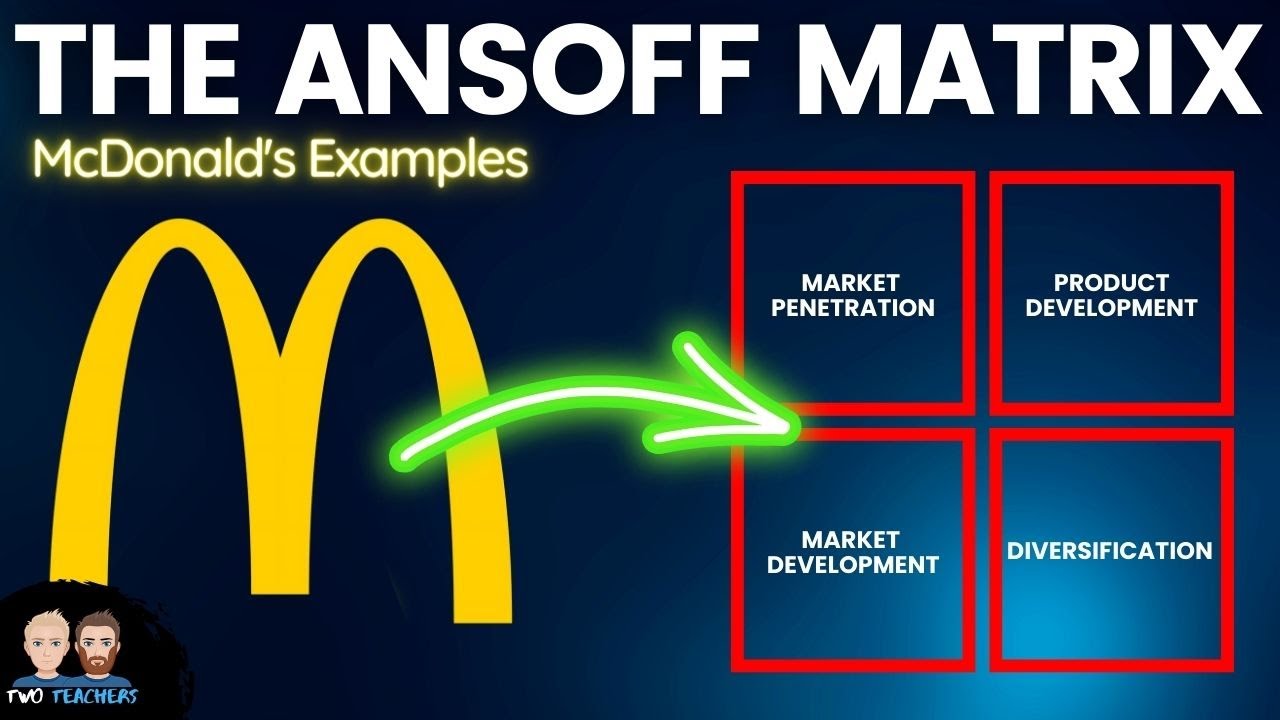
Ansoff Matrix Explained | McDonald's Examples

The 4 Business Growth Strategies
5.0 / 5 (0 votes)

