Konversi Koordinat - Kartesius ke Kutub dan Sebaliknya - Lengkap dengan Contoh Soal
Summary
TLDRThis educational video explains the conversion between Cartesian and polar coordinates. The instructor introduces Cartesian coordinates (x, y), where x is the abscissa and y is the ordinate, and compares them to polar coordinates (r, θ), where r represents the distance from the origin and θ is the angle. The video demonstrates how to convert from polar to Cartesian coordinates using formulas like x = r * cos(θ) and y = r * sin(θ), as well as vice versa. The video also includes examples and tips for handling different quadrants to ensure accurate conversions.
Takeaways
- 😀 Polar coordinates are defined by a radial distance (r) and an angle (θ), while Cartesian coordinates are defined by (x, y).
- 😀 In Cartesian coordinates, x represents the horizontal distance from the origin, and y represents the vertical distance.
- 😀 In polar coordinates, r represents the distance from the origin, and θ represents the angle with respect to the positive x-axis.
- 😀 When converting from polar to Cartesian coordinates, the formulas are: x = r * cos(θ) and y = r * sin(θ).
- 😀 When converting from Cartesian to polar coordinates, the formulas are: r = √(x² + y²) and θ = tan⁻¹(y/x).
- 😀 Always consider the quadrant when determining the angle θ during conversion between coordinate systems.
- 😀 In polar coordinates, angles can be adjusted using trigonometric identities depending on the quadrant.
- 😀 A key concept to remember is that different quadrants affect the signs of trigonometric functions (cos and sin).
- 😀 Examples of conversions from polar to Cartesian and vice versa are provided to clarify how to apply the formulas.
- 😀 Quadrants play an important role in determining the correct angle during conversion. Quadrant II, for example, will use θ = 180° - θ for adjustments.
- 😀 Trigonometric relationships such as sin(45°) = cos(45°) = 1/√2 are essential when calculating polar or Cartesian coordinates.
Q & A
What are Cartesian coordinates and how are they represented?
-Cartesian coordinates represent points in a plane using two values: x (the horizontal position, called the abscissa) and y (the vertical position, called the ordinate). A point is represented as (x, y).
What are polar coordinates and how are they different from Cartesian coordinates?
-Polar coordinates represent a point using two values: r (the radius, or distance from the origin) and θ (the angle, measured counterclockwise from the positive x-axis). Unlike Cartesian coordinates, polar coordinates use distance and angle instead of horizontal and vertical positions.
How do you convert polar coordinates to Cartesian coordinates?
-To convert from polar to Cartesian coordinates, use the formulas: x = r * cos(θ) and y = r * sin(θ). This uses the radius (r) and angle (θ) to calculate the x and y positions.
In which quadrants do the cosine and sine values change signs when converting polar coordinates to Cartesian?
-In quadrant 1, both cosine and sine are positive. In quadrant 2, cosine is negative, and sine is positive. In quadrant 3, both cosine and sine are negative. In quadrant 4, cosine is positive, and sine is negative.
What happens when converting polar coordinates to Cartesian if the angle is 135°?
-When the angle is 135°, the point lies in the second quadrant. The cosine of 135° is negative, and the sine is positive. Using these values, the Cartesian coordinates are calculated as x = -8/√2 and y = 8.
What is the formula to convert Cartesian coordinates to polar coordinates?
-To convert from Cartesian coordinates (x, y) to polar coordinates (r, θ), use the formulas: r = √(x² + y²) and θ = atan(y/x), adjusting the angle based on the quadrant.
How do you calculate the radius (r) when converting Cartesian coordinates to polar coordinates?
-The radius (r) is calculated using the formula r = √(x² + y²), which is derived from the Pythagorean theorem.
How do you determine the angle (θ) when converting from Cartesian to polar coordinates?
-The angle (θ) can be calculated using the tangent function, θ = atan(y/x). If needed, adjust the angle based on the quadrant in which the point lies, using either the sine or cosine for more precision.
What do the terms 'quadrant' and 'relasi sudut' (angle relation) refer to in the video?
-'Quadrant' refers to the four sections of the coordinate plane, while 'relasi sudut' refers to how the angle is adjusted based on the quadrant. The video explains how to use the quadrant to determine whether to use positive or negative sine and cosine values.
What does the video say about handling negative values when converting coordinates?
-The video emphasizes checking the quadrant when converting coordinates. Negative x-values and positive y-values correspond to the second quadrant, while negative x and y-values belong to the third quadrant. This determines whether to use positive or negative trigonometric values in the formulas.
Outlines

此内容仅限付费用户访问。 请升级后访问。
立即升级Mindmap

此内容仅限付费用户访问。 请升级后访问。
立即升级Keywords

此内容仅限付费用户访问。 请升级后访问。
立即升级Highlights

此内容仅限付费用户访问。 请升级后访问。
立即升级Transcripts

此内容仅限付费用户访问。 请升级后访问。
立即升级浏览更多相关视频

Konversi Koordinat Cartesius ke Koordinat Kutub/ Polar dan Sebaliknya
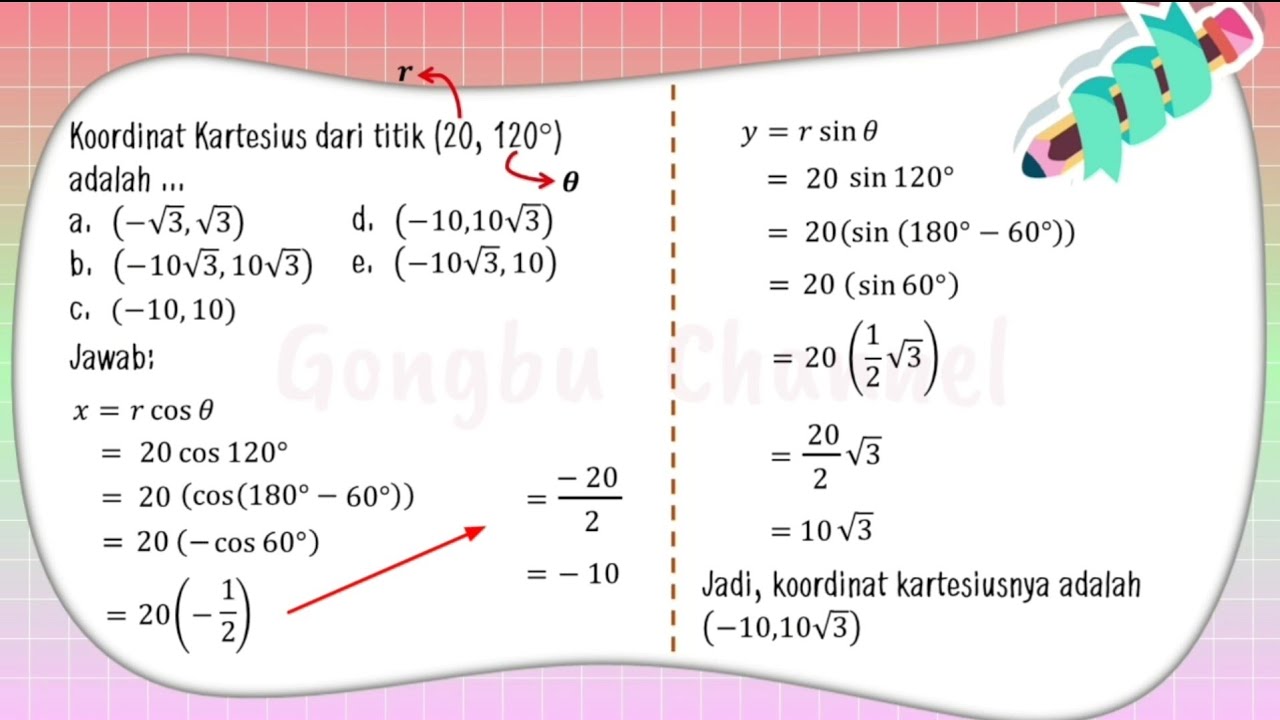
TRIGONOMETRI (Konversi Koordinat Kutub Ke Koordinat Kartesius)
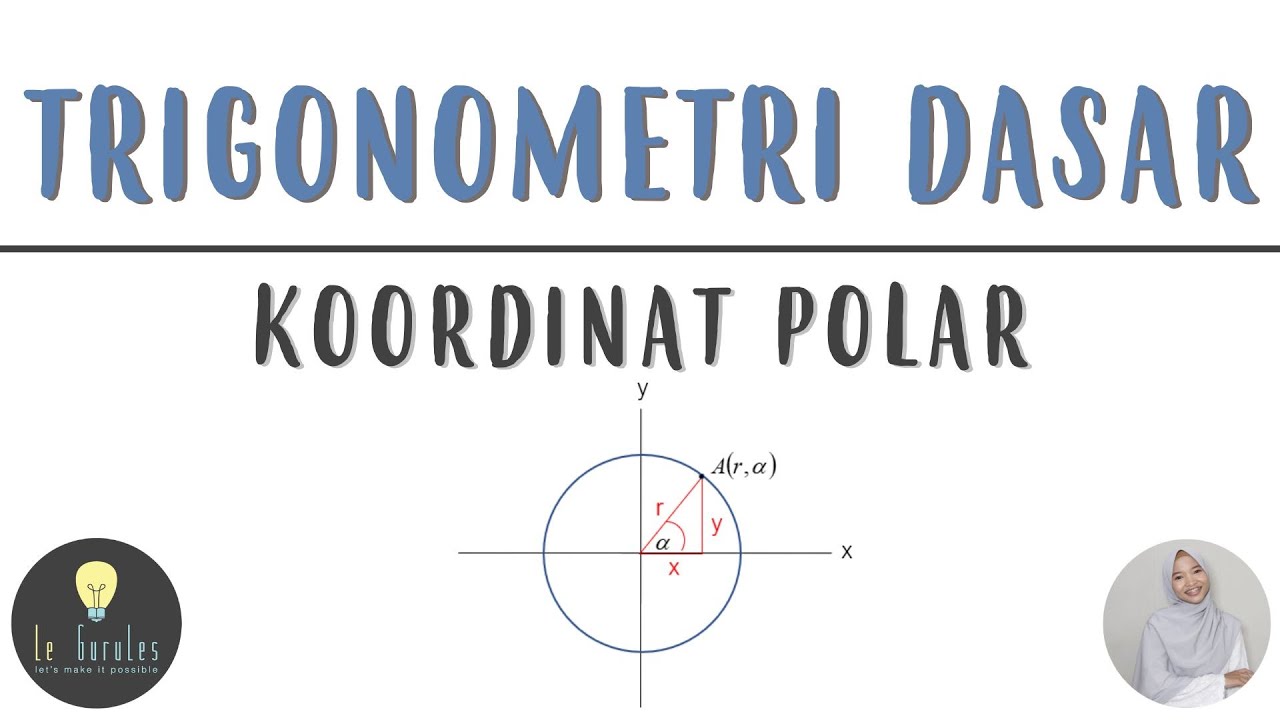
Matematika SMA - Trigonometri (6) - Koordinat Polar, Koordinat Kutub dan Kartesius (A)
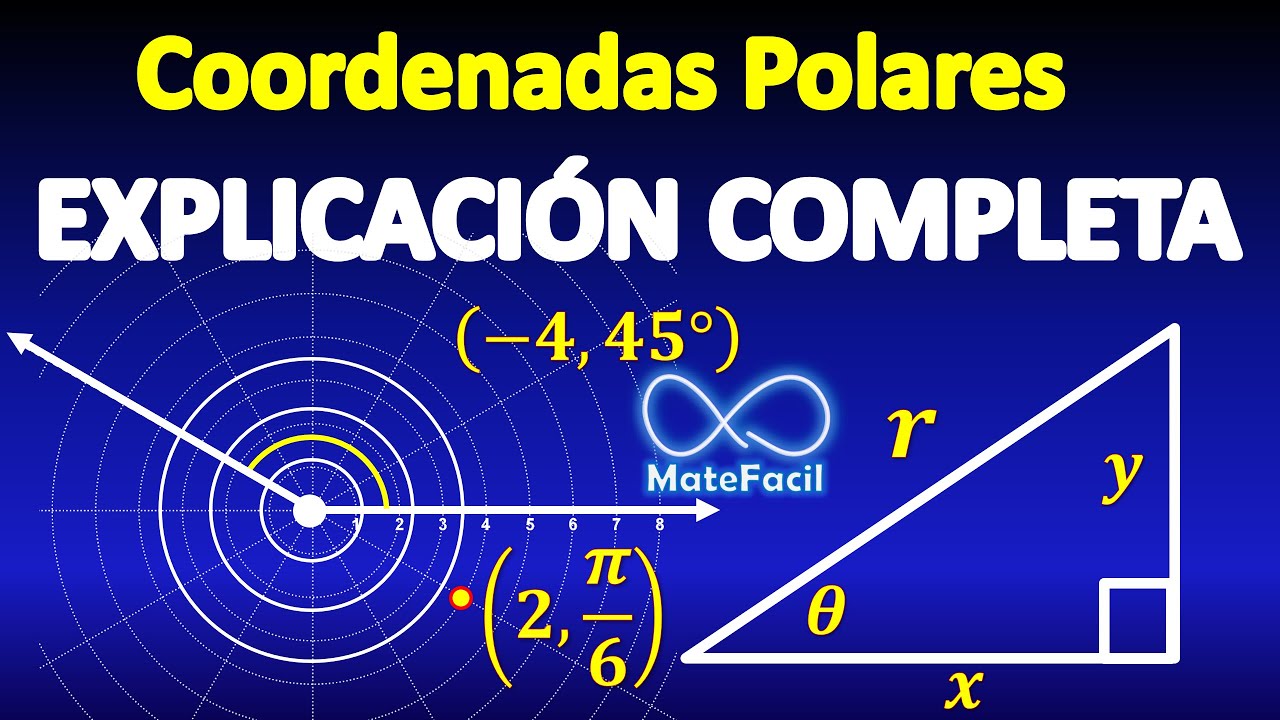
Coordenadas Polares ¿Qué son? EXPLICACIÓN COMPLETA
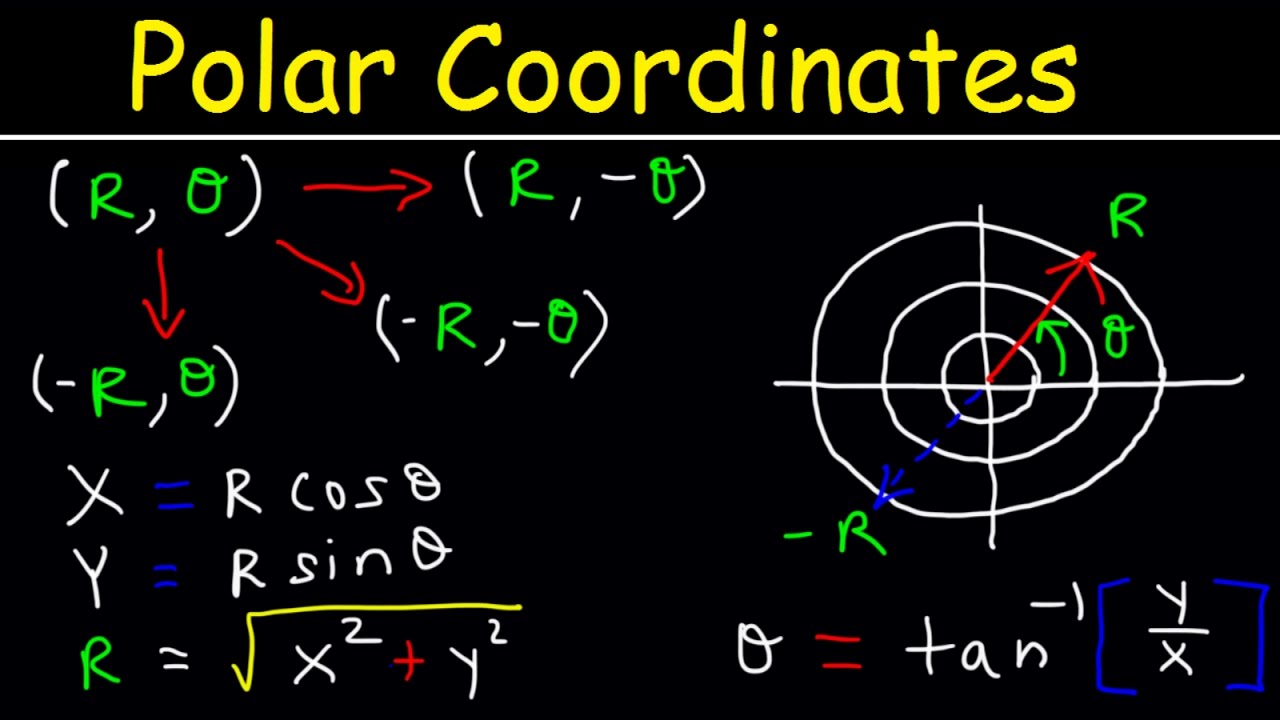
Polar Coordinates Basic Introduction, Conversion to Rectangular, How to Plot Points, Negative R Valu
Vector Algebra (LEC -33) Polar coordinate system || Polar coordinate system || in Hindi ||
5.0 / 5 (0 votes)

