Peraturan Perundang-undangan dan Tata Urutannya | Pancasila SMP
Summary
TLDRThis video script explains the importance of regulations, both in schools and at the national level in Indonesia. It illustrates how school rules ensure activities run smoothly and how Indonesia’s legal system is structured, from the Constitution to local regulations. The script highlights the principles behind creating effective laws, such as clarity, coordination, and public involvement, as well as the commitments necessary for proper enforcement. It aims to educate viewers on the hierarchy of laws and the process of lawmaking to maintain societal order and ensure fairness.
Takeaways
- 😀 The importance of rules, such as school entry times, is to ensure that activities start on time and everyone is organized.
- 😀 Indonesia, with its vast area and diverse culture, requires regulations to maintain harmony and smooth daily life.
- 😀 Regulations are essential in guiding the functioning of society, ensuring fairness and order.
- 😀 Peraturan perundang-undangan (laws and regulations) are written rules that bind society, created by authorized bodies in accordance with proper procedures.
- 😀 The highest legal reference in Indonesia is the Undang-Undang Dasar Negara Republik Indonesia (1945 Constitution), followed by other laws.
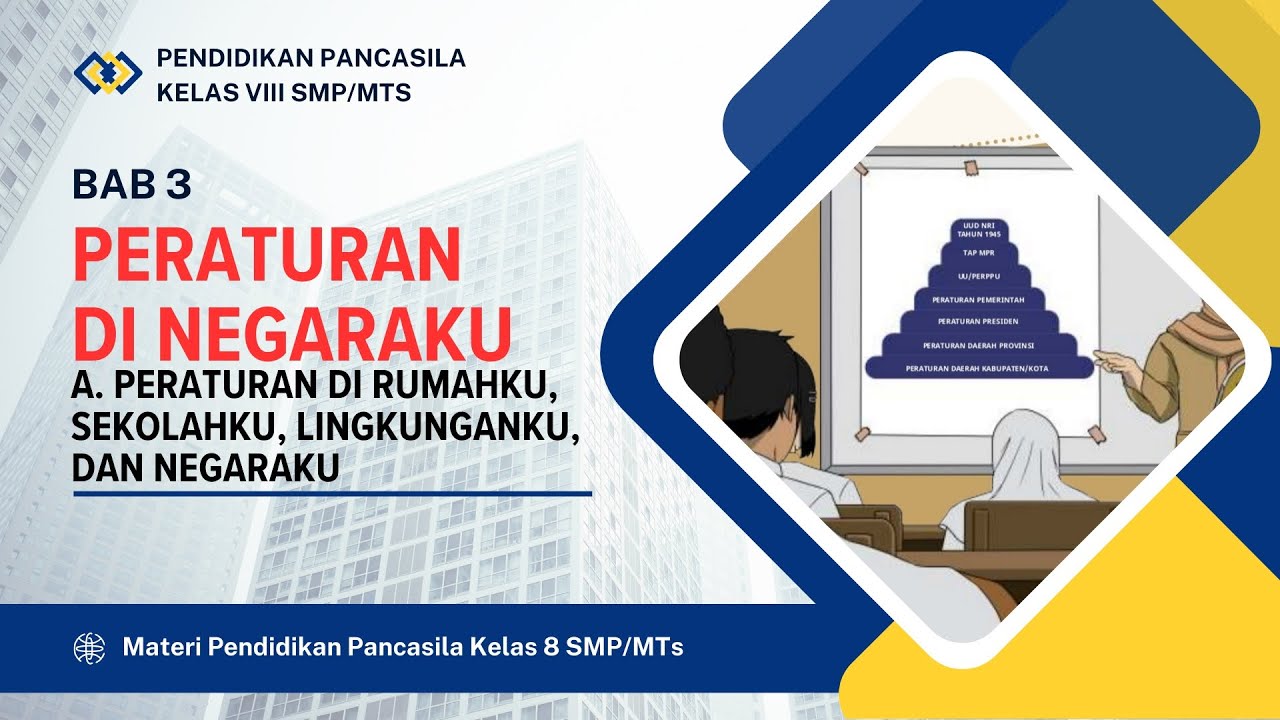
- 😀 The hierarchy of Indonesian laws starts from the highest (Constitution) down to local regulations (Perda Kabupaten/Kota).
- 😀 Local regulations must align with higher laws and cannot contradict them, ensuring national consistency.
- 😀 The 1945 Constitution of Indonesia represents the core legal values and has been amended multiple times to adapt to societal needs.
- 😀 In emergency situations, the President can issue a Peraturan Pemerintah Pengganti Undang-Undang (Perppu), which must be approved by the legislature.
- 😀 Regional laws (Perda) are created by local authorities and must still adhere to national legislation, reflecting local needs and characteristics.
- 😀 There are seven principles for creating laws in Indonesia: clear purpose, created by authorized bodies, effective implementation, usefulness, clear language, technical standards, and transparency throughout the process.
Q & A
Why is it necessary to have a school entrance time rule?
-The school entrance time rule is necessary to ensure that all students, teachers, staff, and school leaders gather at the same time so that activities can begin promptly and smoothly.
How does Indonesia's vast territory and cultural diversity affect the need for regulations?
-Due to Indonesia's wide geographic area and diverse cultures, regulations are needed to ensure that daily life functions smoothly and that all citizens follow common rules.
What is the purpose of Indonesia's written laws, or 'peraturan perundang-undangan'?
-Indonesia's 'peraturan perundang-undangan' refers to written regulations that contain binding legal norms. They are established by authorized institutions or officials through a proper procedure.
What is the highest regulation in Indonesia's legal hierarchy?
-The highest regulation in Indonesia's legal hierarchy is the Undang-Undang Dasar Negara Republik Indonesia (the 1945 Constitution), which forms the foundation for all other laws and regulations.
What are the main types of laws in Indonesia, from the highest to the lowest?
-The main types of laws in Indonesia, from highest to lowest, are: 1) the 1945 Constitution, 2) MPR Decrees, 3) Laws and Government Regulations in Lieu of Laws (UU/Perppu), 4) Government Regulations (PP), 5) Presidential Regulations (Perpres), 6) Provincial Regional Regulations (Perda), and 7) Regency/City Regional Regulations (Perda Kabupaten/Kota).
What is a Perppu and how does it become a law?
-A Perppu (Government Regulation in Lieu of Law) is issued by the president during an emergency situation. It must be submitted to the DPR (People's Representative Council) for approval. If approved, it becomes a law; if not, it is revoked.
What role do local regulations (Perda) play in Indonesia's legal system?
-Local regulations (Perda) are created by regional legislatures (DPRD) in collaboration with regional heads (governors, mayors, or regents). They are tailored to the unique needs of each region but must comply with national laws.
What are the seven principles that should be considered in creating regulations in Indonesia?
-The seven principles in creating regulations are: 1) clear objectives, 2) established by authorized institutions, 3) alignment with legal hierarchy, 4) effectiveness in society, 5) necessity and utility, 6) technical and legal clarity, and 7) transparency and openness in the process.
What are the key commitments in the implementation of regulations in Indonesia?
-Key commitments include: 1) coordinated and consistent regulation formation, 2) involving all relevant stakeholders, 3) periodic evaluation to ensure relevance, and 4) strict and fair enforcement of laws.
Can you list the seven types of regulations that make up the hierarchy of laws in Indonesia?
-The seven types of regulations are: 1) the 1945 Constitution, 2) MPR Decrees, 3) Laws (UU), 4) Government Regulations in Lieu of Laws (Perppu), 5) Government Regulations (PP), 6) Presidential Regulations (Perpres), and 7) Regional Regulations (Perda).
Outlines

此内容仅限付费用户访问。 请升级后访问。
立即升级Mindmap

此内容仅限付费用户访问。 请升级后访问。
立即升级Keywords

此内容仅限付费用户访问。 请升级后访问。
立即升级Highlights

此内容仅限付费用户访问。 请升级后访问。
立即升级Transcripts

此内容仅限付费用户访问。 请升级后访问。
立即升级浏览更多相关视频

DPR RI - PERLU PENYELARASAN ANTARA PROLEGNAS DENGAN LEGISLASI DAERAH

Struktur Kurikulum Merdeka Jenjang SMA/MA

BAB 3. Peraturan di Negaraku | Pendidikan Pancasila | Kelas 8 (Kurikulum Merdeka)

Yuk Belajar tentang Organisasi dan Multi Event Olahraga Penyandang Disabilitas

A Hierarki Peraturan Perundang Undangan Nasional
Materi Pendidikan Pancasila Kelas 8 BAB 3 || A. Peraturan di Rumahku Sekolahku Lingkungan dan Negara
5.0 / 5 (0 votes)

