Keseimbangan Benda Tegar dan Titik Berat
Summary
TLDRThis script explains the concept of the center of mass and stability in physics. It covers the importance of the center of mass in determining the balance and stability of objects, using examples such as the Leaning Tower of Pisa. The video explains three types of equilibrium—stable, unstable, and neutral—and provides step-by-step problem-solving examples for calculating the center of mass coordinates. Various physical shapes, such as beams and composite objects like a cone and cylinder, are used to demonstrate the application of these principles in real-world scenarios. It combines theoretical knowledge with practical exercises.
Takeaways
- 😀 The center of mass determines the balance and stability of an object.
- 😀 If a line drawn from the center of mass falls within the base of an object, it is considered stable.
- 😀 The Pisa Tower does not fall despite its tilt because the center of mass aligns with its base.
- 😀 Objects are designed with wider bases and lower centers of mass to make them more resistant to tipping over.
- 😀 The greater the base width, the more force is required to destabilize the object due to the larger distance needed to raise its center of mass.
- 😀 There are three types of equilibrium: stable, unstable, and neutral.
- 😀 Stable equilibrium occurs when the center of mass rises upon disturbance, but the object returns to its original position once the disturbance is removed.
- 😀 Unstable equilibrium occurs when the center of mass drops upon disturbance, and the object does not return to its original position after the disturbance is removed.
- 😀 Neutral equilibrium occurs when the center of mass does not change upon disturbance, and the object does not return to its original position.
- 😀 Examples of different types of equilibrium include objects being pushed to the right (unstable), resting at the lowest point (stable), and staying at the same position (neutral).
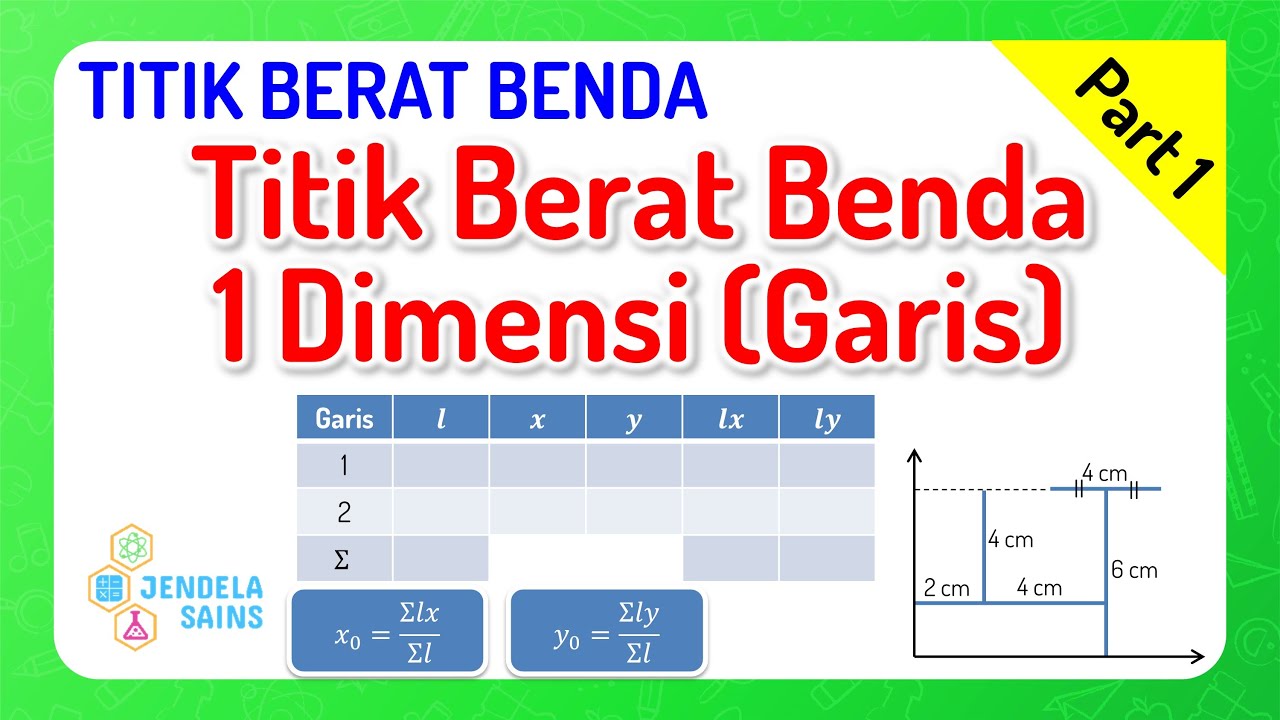
- 😀 Several examples and mathematical problems are provided to calculate the center of mass based on the coordinates and weights of different objects (lines, planes, or composite shapes).
Q & A
What is the concept of the center of mass in the context of stability?
-The center of mass is the point at which the mass of an object can be considered to be concentrated. It determines the balance and stability of the object. If a line drawn from the center of mass falls within the base, the object is considered stable.
How does the Pisa Tower remain standing despite its tilt?
-The Pisa Tower does not fall because the line from its center of mass still falls within its base. This ensures its stability despite the tilt.
Why are objects designed with wide bases and low centers of mass?
-Objects are designed this way to prevent tipping. A wider base and lower center of mass make it harder to topple the object because a greater force is needed to raise the center of mass.
What is the difference between stable, unstable, and neutral equilibrium?
-Stable equilibrium occurs when an object returns to its original position after being disturbed. Unstable equilibrium happens when the object moves away from its position after being disturbed. Neutral equilibrium is when the object's position remains unchanged after being disturbed.
Can you give an example of stable equilibrium?
-An example of stable equilibrium is a ball in a bowl. If disturbed, the ball rolls back to the lowest point in the bowl.
What is an example of unstable equilibrium?
-An example of unstable equilibrium is a pencil balancing on its tip. A small disturbance causes the pencil to fall.
What is the process for calculating the center of mass for an object with multiple components?
-To calculate the center of mass, multiply the position of each component by its mass, sum the results, and then divide by the total mass of the object.
How is the center of mass calculated for a structure with four lines of known length and coordinates?
-The center of mass is calculated by taking the weighted average of the coordinates (x and y) of each line, using the lengths of the lines as weights. The formula involves multiplying each coordinate by the length, summing the products, and dividing by the total length.
What is the formula for calculating the center of mass on the x-axis?
-The formula for the x-coordinate of the center of mass is: X0 = (X1 * L1 + X2 * L2 + X3 * L3 + X4 * L4) / (L1 + L2 + L3 + L4), where X1, X2, X3, and X4 are the x-coordinates, and L1, L2, L3, and L4 are the lengths of the respective components.
What does the center of mass of a 3D object depend on?
-The center of mass of a 3D object depends on the shape, mass distribution, and volume of each component. For example, in a combination of a cone and a cylinder, the coordinates of the center of mass would be calculated based on their individual volumes and the positions of their centers of mass.
Outlines

此内容仅限付费用户访问。 请升级后访问。
立即升级Mindmap

此内容仅限付费用户访问。 请升级后访问。
立即升级Keywords

此内容仅限付费用户访问。 请升级后访问。
立即升级Highlights

此内容仅限付费用户访问。 请升级后访问。
立即升级Transcripts

此内容仅限付费用户访问。 请升级后访问。
立即升级



5.0 / 5 (0 votes)

