BE3002 Transport Phenomena in Biosystem Module 2_Segment 3
Summary
TLDRIn this segment of the transport phenomena in biosystems module, Yusuf from ITB discusses fluid statics and static equilibrium. The focus is on how pressure and gravity are the only forces acting on a fluid element in a static condition. Using equations and force balance, the pressure forces on submerged objects are explored, introducing concepts like buoyant force. The session concludes by setting up the next discussion on constitutive relations in fluid dynamics, bridging the understanding of static forces to more complex bioengineering applications.
Takeaways
- 😀 Fluid statics and static equilibrium are important in bioengineering, even though most transport problems involve moving fluids.
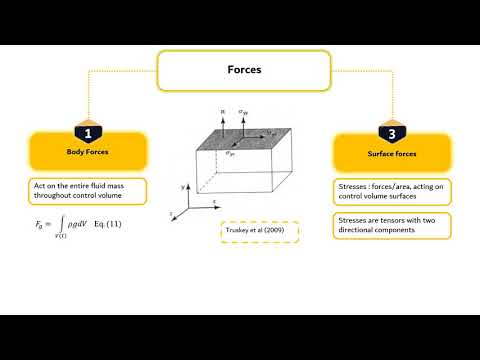
- 😀 In static conditions, the only forces acting on a fluid element are pressure and gravity.
- 😀 The balance of forces in a static fluid can be expressed by an equation that accounts for pressure and gravitational forces.
- 😀 By applying force balance to a cubic control volume, differential balances can be derived using calculus.
- 😀 The fluid forces in static equilibrium can be described using vector notation for more complex situations.
- 😀 The pressure acting on a submerged object creates a surface force that is normal to the object's surface at every point.
- 😀 The pressure force on an object submerged in a fluid can be calculated using an integral of the stress over the surface.
- 😀 The divergence theorem helps to relate surface integrals to volume integrals, making force calculations easier.
- 😀 The pressure force on an object submerged in a liquid is also known as the buoyant force and acts opposite to gravity.
- 😀 The pressure acting on a submerged object can be calculated by considering the object’s equivalent volume in the fluid.
- 😀 The next segment of the lecture will cover constitutive relations, building on the static equilibrium and force calculations discussed.
Q & A
What is the main topic of the segment in the transcript?
-The segment discusses fluid statics and static equilibrium, particularly in the context of bioengineering, focusing on the forces acting on fluid elements in equilibrium, such as pressure and gravity.
Why is fluid statics important in bioengineering?
-Fluid statics is important in bioengineering because even though most transport problems involve moving fluids, understanding static conditions is crucial for calculating forces, such as buoyant forces, that act on submerged objects.
What forces act on a fluid element in static conditions?
-In static conditions, the only forces acting on a fluid element are pressure and gravity.
How is the force balance expressed in the transcript?
-The force balance is expressed by an equation (Equation 11) and is applied to a cubic control volume, leading to a series of differential equations (Equations 13a to 13c).
What does the differential balance in fluid statics represent?
-The differential balance represents the distribution of forces within a fluid, calculated as the limit of the force balance as the volume shrinks to zero.
What is the significance of the pressure force in fluid statics?
-The pressure force acts normally to the surface of a submerged object and is essential for calculating the buoyant force acting on the object. This force is directed opposite to gravity.
What is the role of the Divergence Theorem in fluid statics?
-The Divergence Theorem relates surface and volume integrals, allowing the pressure force to be calculated through a volume integral over the fluid.
What is the buoyant force in fluid statics?
-The buoyant force is the upward force exerted by the fluid on a submerged object. It acts in the opposite direction of gravity and is calculated based on the pressure distribution in the fluid.
How is the pressure force on an object calculated in fluid statics?
-The pressure force is calculated as the integral of the pressure stress over the surface of the object. This can be simplified using the Divergence Theorem and the relationship between the object and the surrounding fluid.
What is the purpose of the next segment mentioned in the transcript?
-The next segment will discuss constitutive relations, which are important for understanding the material properties and behaviors that affect fluid flow in bioengineering contexts.
Outlines

此内容仅限付费用户访问。 请升级后访问。
立即升级Mindmap

此内容仅限付费用户访问。 请升级后访问。
立即升级Keywords

此内容仅限付费用户访问。 请升级后访问。
立即升级Highlights

此内容仅限付费用户访问。 请升级后访问。
立即升级Transcripts

此内容仅限付费用户访问。 请升级后访问。
立即升级浏览更多相关视频
BE3002 Transport Phenomena in Biosystem Module 2_Segment 2

BE3002 Transport Phenomena in Biosystem_Module 3 Segment 1
BE2103 Thermodynamics in Biosystem_Module 3 Segment 2

BE3002 Transport Phenomena in Biosystem_Module 3 Segment 4

FISIKA KELAS XI || Kesetimbangan || DINAMIKA ROTASI & KESETIMBANGAN BENDA TEGAR
BE3002 Transport Phenomena in Biosystem Module 2_Segment 1
5.0 / 5 (0 votes)

