1.3 Manajemen Strategik - Memahami Proses Manajemen Strategi
Summary
TLDRThis video explores the importance of understanding strategic management through historical lessons. It highlights insights from ancient strategies like Sun Tzu's *The Art of War* and compares them to modern business practices, such as Apple’s unique approach to the computer and smartphone markets. The video traces the evolution of strategic management, from early scientific management principles by Frederick Taylor to the rise of business strategy as a formal field of study. Key concepts like SWOT analysis, understanding internal and external factors, and the critical role of innovation in business success are also discussed.
Takeaways
- 📜 Strategic management is deeply rooted in history, and ignoring historical lessons can lead to serious strategic mistakes that could otherwise be avoided.
- 🧠 Ancient thinkers like Sun Tzu emphasized strategy as a creative art, highlighting ideas such as winning without direct confrontation, which remain highly relevant in modern business.
- 🍎 Apple exemplifies Sun Tzu’s philosophy by avoiding price wars and instead creating unique products and loyal customers through differentiation and innovation.
- 🐴 The Trojan Horse story illustrates strategy as deception and indirect tactics, showing how clever planning can overcome stronger defenses.
- ⚔️ King Arthur’s Round Table represents a collaborative and egalitarian approach to strategy, where all members have equal voices in decision-making.
- 🔬 Strategic management evolved into a scientific discipline in the early 20th century, influenced by Frederick W. Taylor’s principles of scientific management focused on efficiency and standardization.
- 🏭 Henry Ford applied strategic thinking and efficiency to mass production, making automobiles affordable, while also demonstrating the risks of inflexibility in strategy.
- 🎓 Strategic management became formalized in academia through business policy courses, beginning at Harvard University and later spreading globally.
- 📘 Alfred Chandler’s work emphasized the alignment between organizational strategy and structure as a key driver of long-term performance.
- 📊 Michael Porter’s competitive strategy framework in the 1980s marked the recognition of strategic management as a distinct field of study.
- 🌍 Strategic management requires continuous analysis of both external environments and internal resources to adapt effectively to change.
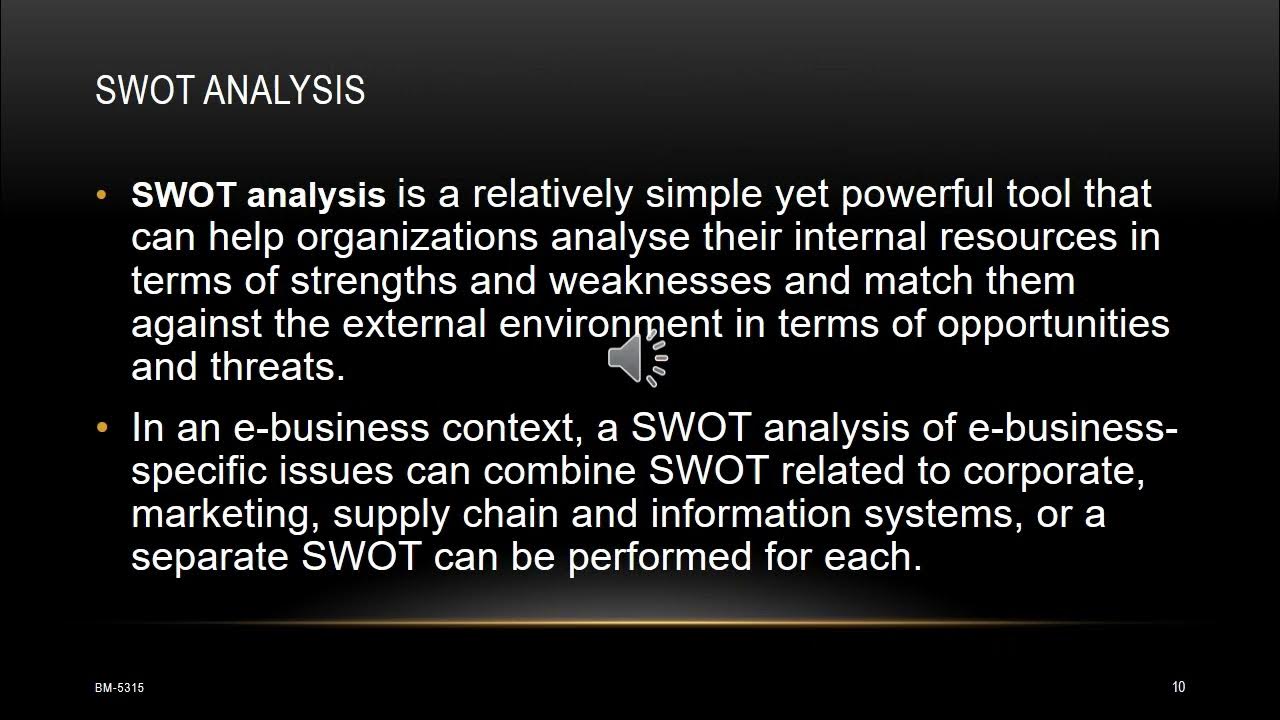
- 🧩 SWOT analysis integrates internal strengths and weaknesses with external opportunities and threats, aligning closely with classical military strategy principles.
- 🚀 Successful strategy implementation depends on effective organizational structure, culture, innovation, and ongoing monitoring to ensure long-term survival and growth.
Q & A
What is the core concept of strategic management discussed in the video?
-Strategic management is described as both an art and a science, focusing on the careful planning and execution of strategies that help companies navigate changes in their external and internal environments. It involves understanding historical lessons, analyzing trends, and making informed decisions to ensure business success.
How does history influence strategic decision-making?
-The video emphasizes that overlooking history can lead to critical strategic mistakes. By studying past strategies, businesses can learn from the successes and failures of others, especially in ancient examples like the strategies of Sun Tzu in China and the tactical deception of the Trojan Horse.
What is Sun Tzu's famous strategic concept applied in business?
-One of Sun Tzu’s key ideas, applied in modern business, is that sometimes winning a battle without actually fighting is the best strategy. Apple, for instance, avoided a price war in the computer industry by creating unique features and a loyal customer base, rather than competing directly on price.
What role did Frederick W. Taylor play in the evolution of strategic management?
-Frederick W. Taylor is credited with applying scientific methods to management. His 1911 book 'The Principles of Scientific Management' emphasized efficiency through research-based approaches, and his ideas helped save companies, including railroads, significant amounts of money.
How did Henry Ford's approach to strategy differ from his competitors?
-Henry Ford revolutionized the car industry by introducing an efficient assembly line and aiming to make cars affordable for middle-class families. This strategy, based on Taylor’s principles of efficiency, contrasted with the luxury focus of other car manufacturers of the time.
What mistake did Henry Ford make with the Model T?
-Ford’s mistake with the Model T was his rigid stance on offering only one color (black). When competitors began offering more color choices, Ford had no option but to adapt and introduce color options for his cars in 1912.
What was the significance of Harvard University’s 1912 business policy course?
-Harvard University’s 1912 course on business policy was significant because it marked the first time a higher education institution focused on teaching executives how to lead businesses toward greater success, emphasizing the importance of strategic planning in management.
What milestone in strategic management occurred in the 1980s?
-In the 1980s, the publication of Michael Porter’s book 'Competitive Strategy: Techniques for Analyzing Industries and Competitors' marked a key milestone in the formalization of strategic management as an academic discipline. It helped shape the way companies analyze their competitive environment.
What is SWOT analysis, and how does it relate to Sun Tzu’s principles?
-SWOT analysis is a tool that evaluates a company’s Strengths, Weaknesses, Opportunities, and Threats. It aligns with Sun Tzu’s principles of knowing oneself and one’s enemy—by understanding internal resources (strengths/weaknesses) and external factors (opportunities/threats), companies can better strategize.
What is the role of feedback in strategic management?
-Feedback plays a crucial role in strategic management by helping executives monitor changes and adjust strategies as needed. This continuous loop of feedback allows businesses to stay adaptive and responsive to both internal and external changes, ensuring long-term success.
Outlines

此内容仅限付费用户访问。 请升级后访问。
立即升级Mindmap

此内容仅限付费用户访问。 请升级后访问。
立即升级Keywords

此内容仅限付费用户访问。 请升级后访问。
立即升级Highlights

此内容仅限付费用户访问。 请升级后访问。
立即升级Transcripts

此内容仅限付费用户访问。 请升级后访问。
立即升级


5.0 / 5 (0 votes)

