Ecuaciones exponenciales usando cambio de variable | Ejemplo 4
Summary
TLDRIn this educational video, the instructor explains how to solve exponential equations using the method of variable substitution. He highlights how recognizing certain patterns, like terms with exponents that are powers of each other, can guide students to use this method. The tutorial walks through an example where powers of 2 and 4 are involved, demonstrating step-by-step how to transform the equation into a quadratic form. The video concludes with a detailed explanation of solving the quadratic equation, providing key insights for handling similar problems in the future.
Takeaways
- 😀 Recognizing when to use the change of variable method is key for solving exponential equations, especially when there are terms with exponents of the same base (e.g., 4^x and 2^x).
- 😀 The change of variable method involves rewriting an equation with different bases, like converting 4^x to 2^(2x), to simplify the process of solving.
- 😀 After simplifying the equation, a substitution is made to replace exponential terms with a variable (e.g., 2^x becomes 'm'), transforming the equation into a quadratic form.
- 😀 The quadratic equation obtained through substitution can be solved using methods like factoring or the quadratic formula. In this case, factoring is recommended as it’s simpler.
- 😀 Solving the quadratic equation yields the values for the new variable (e.g., m = 8 and m = -4).
- 😀 Once the new variable values are found, substitute them back to find the solution for the original variable (x).
- 😀 In cases where negative exponents are found (e.g., 2^x = -4), it’s concluded that there is no real solution.
- 😀 Factorization of quadratic equations is the preferred method when the quadratic term has no coefficient (e.g., m^2 - 4m - 32 = 0).
- 😀 The process also includes a verification step, where the solution for x is substituted back into the original equation to confirm the correctness of the result.
- 😀 The change of variable method helps solve more complex exponential equations by simplifying them into a quadratic form, making them easier to solve.
- 😀 The teacher encourages practice, noting that with experience, recognizing when to use the change of variable method becomes second nature, streamlining the solution process.
Q & A
What is the main focus of the video?
-The video focuses on explaining how to solve exponential equations using the method of change of variable.
How can one identify when to use the change of variable method for solving an equation?
-You can identify the need for the change of variable method when you encounter equations involving terms like 4^x and 2^x, or similar pairs of numbers where one is the square of the other, such as 3^x and 9^x.
Why is it important to recognize the presence of squared terms in an equation?
-Recognizing squared terms is crucial because it signals that the equation can be simplified by rewriting terms in a more manageable form, such as converting 4^x into 2^(2x). This makes the equation solvable through the change of variable method.
What is the first step to solving an equation using the change of variable method?
-The first step is to rewrite any exponential terms that are powers of a number into a form where the base is the same, making it easier to apply the method of substitution.
How does the instructor demonstrate the change of variable for 4^x?
-The instructor demonstrates the change of variable by converting 4^x into (2^2)^x, which simplifies to 2^(2x), effectively substituting the base 2 for 4 and simplifying the equation.
What happens after performing the change of variable substitution?
-After substitution, the equation becomes quadratic, and you proceed by simplifying it, moving all terms to one side, and then solving for the new variable.
Why does the instructor prefer factoring over using the quadratic formula?
-The instructor prefers factoring because the equation is simple, and factoring is a quicker method when the quadratic term does not involve complicated coefficients.
What are the two possible solutions to the quadratic equation after factoring?
-The two possible solutions are derived from setting each factor equal to zero, which gives the values for the substituted variable, denoted as 'm'. These solutions are then substituted back to find the value of 'x'.
Why does the equation 2^x = -4 have no solution?
-The equation 2^x = -4 has no solution because the base of the exponential function is positive, and raising a positive number to any power will never yield a negative result.
What is the final solution to the equation presented in the video?
-The final solution is x = 3, as this is the only valid solution obtained after performing the substitution and solving the quadratic equation.
Outlines

此内容仅限付费用户访问。 请升级后访问。
立即升级Mindmap

此内容仅限付费用户访问。 请升级后访问。
立即升级Keywords

此内容仅限付费用户访问。 请升级后访问。
立即升级Highlights

此内容仅限付费用户访问。 请升级后访问。
立即升级Transcripts

此内容仅限付费用户访问。 请升级后访问。
立即升级浏览更多相关视频
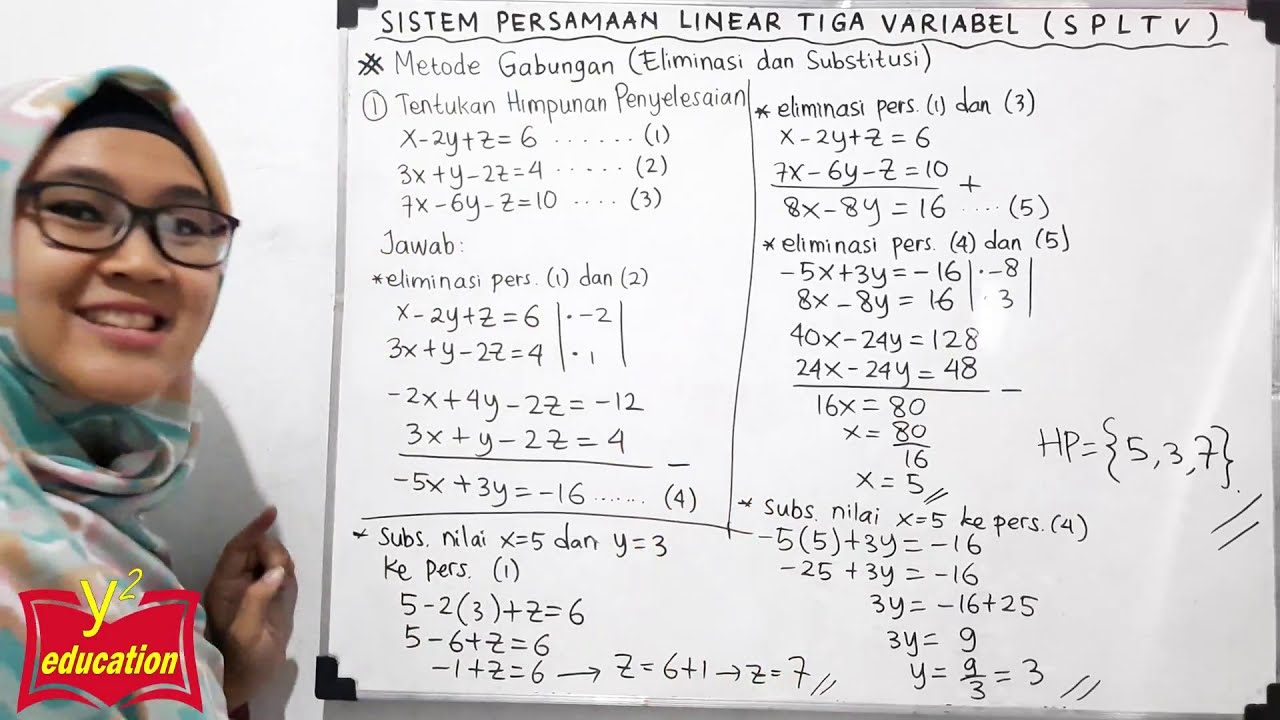
SPLTV #Part 4 // Metode Gabungan // Sistem Persamaan Linear Tiga Variabel

Kurikulum Merdeka Matematika Kelas 9 Bab 1 Sistem Persamaan Linear Dua Variabel

SPLDV - Metode Eliminasi

5 MTK EKO PENCARIAN AKAR AKAR PERS LINEAR
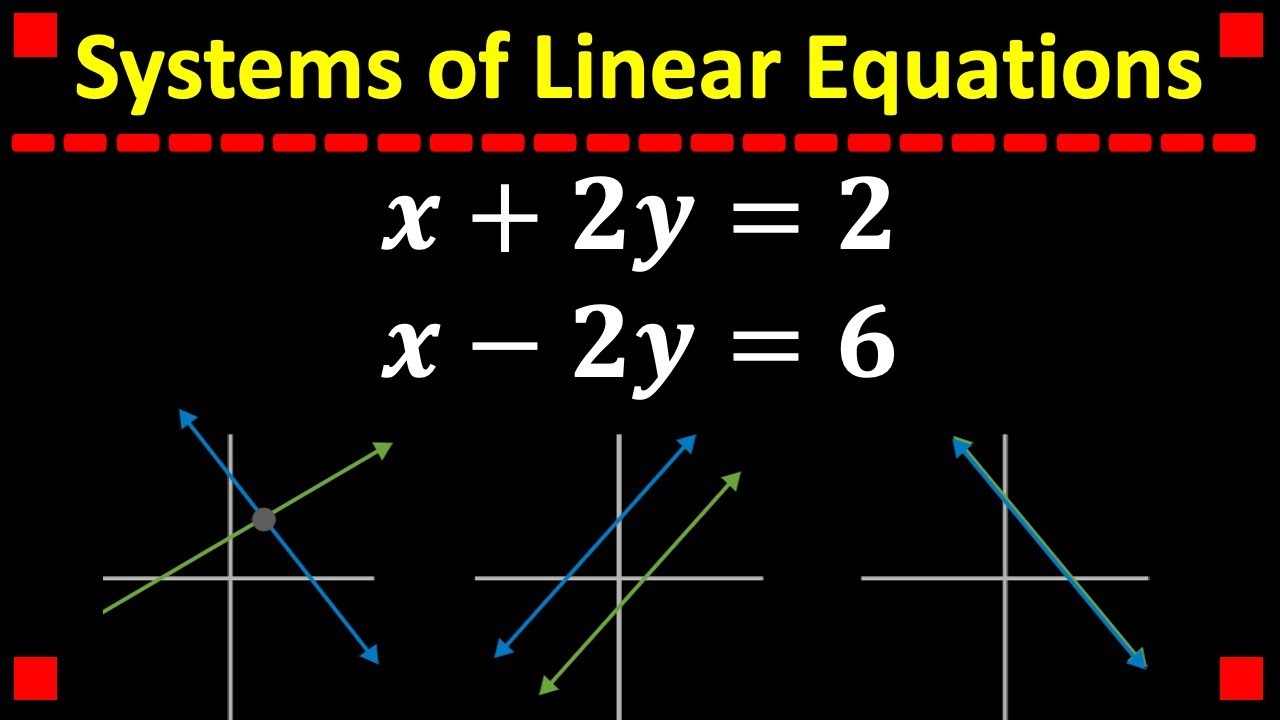
Solving Systems of Equations in Two Variables
SOLVING SYSYEM OF NONLINEAR EQUATIONS || PRECALCULUS
5.0 / 5 (0 votes)

