Apa itu ADVERB ? - Part of Speech (Part 1) dilengkapi contoh #englishgrammar #learnenglish
Summary
TLDRThis video explains the concept of adverbs in a clear and engaging way, highlighting their role in modifying verbs, adjectives, and other adverbs. It covers various types of adverbs including time, place, frequency, degree, purpose, and manner, with examples to demonstrate their usage. The video also emphasizes the distinction between adverbs and adjectives, helping viewers understand their functions in sentences. Practical tips for using adverbs correctly in both formal and informal contexts are provided, making the learning process interactive and accessible.
Takeaways
- 😀 Adverbs modify verbs, adjectives, or other adverbs to provide additional details about actions, qualities, or intensities.
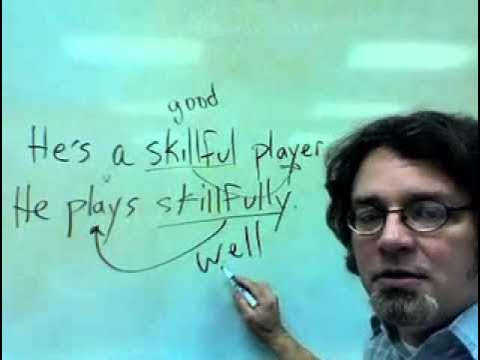
- 😀 An adverb can describe how an action is performed, as in 'She drives slowly' (modifying the verb 'drives').
- 😀 Adverbs can also modify adjectives to explain the extent or intensity of a quality, such as 'The room is good enough for me' (modifying the adjective 'good').
- 😀 Adverbs can describe other adverbs, for example, 'She runs very quickly' (modifying the adverb 'quickly').
- 😀 Adverbs are often formed by adding '-ly' to adjectives (e.g., 'careful' becomes 'carefully'). However, some adjectives like 'friendly' do not change.
- 😀 Not all adverbs are formed by adding '-ly' to adjectives, and some adverbs look the same as adjectives, such as 'fast' and 'hard'. These are known as flat adverbs.
- 😀 Adverbs can be classified into different types, such as adverbs of time, place, degree, frequency, manner, and purpose.
- 😀 Adverbs of time answer the question 'When?' and describe when an action or event happens. They often appear at the beginning or end of a sentence.
- 😀 Adverbs of place answer 'Where?' and describe the location or direction of an action. They are usually placed at the end of a sentence.
- 😀 Adverbs of frequency describe how often an event occurs and can be placed either at the beginning, middle, or end of a sentence, depending on the verb type.
- 😀 Adverbs of purpose explain the reason for an action and answer the question 'Why?'. They are usually placed at the end of a sentence or at the beginning with a comma.
Q & A
What is an adverb?
-An adverb is a word that describes or modifies a verb, an adjective, or another adverb, providing additional information about how, when, where, or to what degree something happens.
How does an adverb modify a verb? Provide an example.
-An adverb modifies a verb by explaining how the action is performed. For example, in 'She drives slowly,' 'slowly' modifies the verb 'drives' and tells us the manner of driving.
Can adverbs modify adjectives? How?
-Yes, adverbs can modify adjectives by indicating the degree or extent of the adjective. For example, in 'good enough,' the adverb 'enough' modifies the adjective 'good' to show sufficiency.
What are flat adverbs?
-Flat adverbs are adverbs that have the same form as their corresponding adjectives, often used in informal speech or short imperative sentences, e.g., 'fast,' 'hard,' or 'early.'
What types of questions do adverbs of time answer?
-Adverbs of time answer the questions 'when?' and 'how long?' They indicate the timing or duration of an action, for example, 'today,' 'last week,' or 'before going to bed.'
Where are adverbs of place usually positioned in a sentence?
-Adverbs of place are usually positioned at the end of a sentence. They indicate location, direction, or distance, for example, 'We must go away' or 'She is looking around this area.'
What is the function of adverbs of degree?
-Adverbs of degree indicate the intensity or extent of an action, adjective, or another adverb. Examples include 'absolutely,' 'completely,' 'really,' or 'hardly.'
How are adverbs of frequency categorized?
-Adverbs of frequency are categorized as definite or indefinite. Definite adverbs indicate specific frequencies like 'once' or 'daily,' usually placed at the end, while indefinite adverbs like 'always' or 'sometimes' are placed in the middle of a sentence.
What do adverbs of purpose explain?
-Adverbs of purpose explain the reason or intention behind an action, answering the question 'why?' Examples include 'to,' 'for,' 'because,' 'so that,' and 'therefore.'
Which adverbs typically end with '-ly' and what do they indicate?
-Adverbs of manner often end with '-ly' and indicate how an action is performed. Examples include 'carefully,' 'completely,' and 'broadly.' They can appear at the beginning, middle, or end of a sentence.
How can you distinguish between an adjective and a flat adverb?
-You can distinguish them by their function in a sentence: an adjective modifies a noun, whereas a flat adverb modifies a verb, adjective, or another adverb. Context and position in the sentence help determine the correct form.
Outlines

This section is available to paid users only. Please upgrade to access this part.
Upgrade NowMindmap

This section is available to paid users only. Please upgrade to access this part.
Upgrade NowKeywords

This section is available to paid users only. Please upgrade to access this part.
Upgrade NowHighlights

This section is available to paid users only. Please upgrade to access this part.
Upgrade NowTranscripts

This section is available to paid users only. Please upgrade to access this part.
Upgrade Now



5.0 / 5 (0 votes)
