MEMAHAMI PENGERTIAN GARIS
Summary
TLDRIn this educational video, the presenter introduces basic geometric concepts, focusing on lines, segments, and rays. Viewers are taught the differences between points, lines, and planes, with clear illustrations showing how lines can extend infinitely, unlike segments and rays, which are limited in length. The video explains the properties of lines, such as their lack of endpoints and ability to be extended, and dives into the concept of rays and segments with examples. It also covers the notation used for these geometric shapes. The video concludes with practical exercises to reinforce learning.
Takeaways
- 😀 The lesson introduces a new chapter on lines and angles, focusing first on understanding lines.
- 😀 A point is defined as having no size and is usually represented by a dot, e.g., point A.
- 😀 A line is depicted as a straight path with arrows at both ends, indicating it can extend infinitely.
- 😀 A plane is a flat surface, like a table or wall, that can be extended infinitely in all directions.
- 😀 Lines are one-dimensional figures made up of a collection of points and are the simplest shapes in geometry.
- 😀 Lines have no starting or ending points, can be extended infinitely, and are typically labeled with lowercase letters.
- 😀 A line segment is a part of a line with definite endpoints, marked with small circles, and has a limited length.
- 😀 A ray has a fixed starting point (marked with a small circle) and extends infinitely in one direction (marked with an arrow).
- 😀 Lines, line segments, and rays can be distinguished visually: line segments have two endpoints, rays have one, and lines have none.
- 😀 The video provides examples and exercises to identify line segments, rays, and lines using labeled points for clarity.
Q & A
What is a point in geometry?
-A point is an element that has no size and is typically represented by a dot, often labeled with a letter, such as point A.
How is a line represented in geometry?
-A line is represented by a straight line with two arrowheads at both ends, indicating that it extends infinitely in both directions.
What defines a plane in geometry?
-A plane is a flat surface that can be extended infinitely in all directions, like a tabletop or a wall. It contains points and lines within it.
What is the definition of a line according to the video?
-A line is a one-dimensional geometric figure composed of a collection of points, making it the simplest form in geometry.
What are the main properties of a line?
-Lines have no endpoints, can be extended infinitely on both sides, and are usually denoted by a lowercase letter, though capital letters are used for parts of a line.
What is a line segment (ruas garis)?
-A line segment is a part of a line that has a definite starting and ending point, marked by small circles at both ends, and has a fixed length.
What is a ray (sinar garis)?
-A ray is a line with a fixed starting point but no endpoint. It is represented with a small circle at the starting point and an arrow at the other end to indicate it extends infinitely.
How is a straight line different from a line segment or ray?
-A straight line has no endpoints and extends infinitely in both directions, marked with arrowheads at both ends, unlike a line segment or ray which have at least one endpoint.
How do you determine the line segments in a set of points?
-Line segments are determined by identifying points connected with definite start and endpoints. For example, in the script, PQ, QR, and PR are line segments.
How do you determine rays from a set of points?
-Rays are determined by identifying a starting point and direction of extension. For example, PQ and QP are rays with different directions depending on their starting points.
How do you determine straight lines from a set of points?
-Straight lines are lines that pass through two points and extend infinitely in both directions. Examples from the script are lines PQ, QR, and PR.
Why is it important to understand the difference between line segments, rays, and lines?
-Understanding the differences helps in geometric reasoning, problem-solving, and accurately representing shapes and figures in geometry, as each type has distinct properties and notation.
Outlines

This section is available to paid users only. Please upgrade to access this part.
Upgrade NowMindmap

This section is available to paid users only. Please upgrade to access this part.
Upgrade NowKeywords

This section is available to paid users only. Please upgrade to access this part.
Upgrade NowHighlights

This section is available to paid users only. Please upgrade to access this part.
Upgrade NowTranscripts

This section is available to paid users only. Please upgrade to access this part.
Upgrade NowBrowse More Related Video
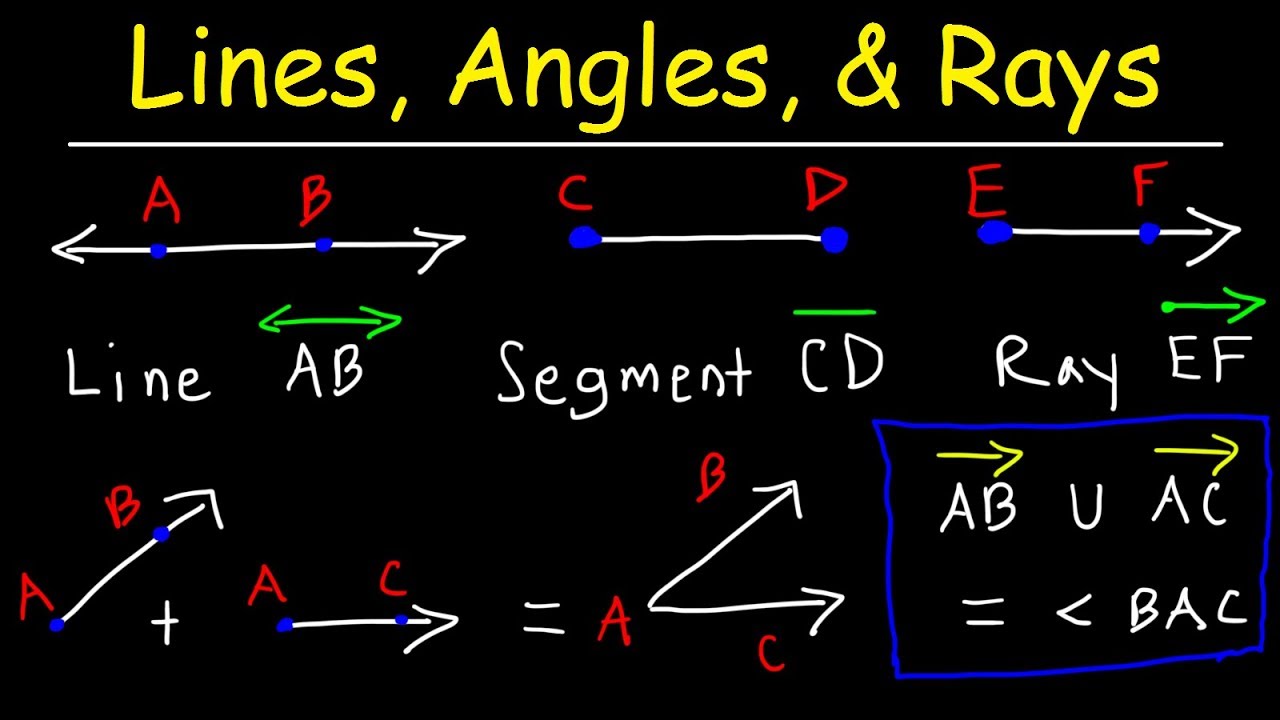
Lines, Rays, Line Segments, Points, Angles, Union & Intersection - Geometry Basic Introduction

Basic Terms: Lines
2nd Quarter Grade 10 Math -( Lesson 5) Illustrating Secant, Tangent, Sector and Segment of a Circle

Bangun Datar [Part 1] - Garis dan Sudut

Garis dan Sudut Kelas 7 SMP Semester 2
🔥Aula de Matemática PM-AL e CBM-AL | Ângulo, Segmento de reta e Reta
5.0 / 5 (0 votes)
