Fisika Kelas 11 | Ringkasan Materi Gelombang Bunyi [LENGKAP!!!]
Summary
TLDRIn this educational video, Pak Agung explains the concept of sound waves, focusing on their classification (infrasonic, audible, and ultrasonic), speed in different media, resonance, and the Doppler effect. He covers formulas for calculating sound velocity in solids, liquids, and gases, and explores sound intensity and its calculation. The video also discusses the behavior of sound from vibrating strings and organ pipes, providing real-world examples such as musical instruments. Finally, Pak Agung clarifies the Doppler effect with practical examples, making complex physics concepts accessible for high school students.
Takeaways
- 😀 Sound waves are vibrations that travel through different mediums, such as solids, liquids, or gases, and can be heard by the human ear.
- 😀 Sound waves are classified into three categories based on their frequency: Infrasonic (below 20 Hz), Audiosonic (20 Hz to 20,000 Hz), and Ultrasonic (above 20,000 Hz).
- 😀 The speed of sound varies in different mediums and is calculated using specific formulas based on the type of medium (solid, liquid, or gas).
- 😀 According to Melde's formula, the speed of sound can be determined by the relationship involving frequency and the medium's properties.
- 😀 The source of sound can either be a vibrating string (e.g., guitar strings) or a pipe organ, which can be open or closed at the ends.
- 😀 In an open pipe organ, the frequency ratios of the harmonics are 1:2:3, while in a closed pipe organ, the frequency ratio is 1:3:5.
- 😀 The intensity of sound refers to the amount of sound energy passing through a unit area per second, with units in decibels (dB).
- 😀 When multiple sound sources are present, their combined intensity can be calculated using logarithmic formulas, considering the number of sources.
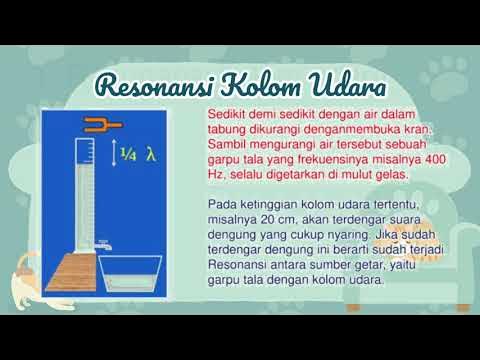
- 😀 Resonance occurs when an object vibrates due to the vibration of another object with the same frequency, resulting in amplifying the sound.
- 😀 The Doppler effect explains the change in frequency or wavelength of a sound due to the relative motion between the source and observer, with different formulas used depending on the direction of movement.
Please replace the link and try again.
Outlines

This section is available to paid users only. Please upgrade to access this part.
Upgrade NowMindmap

This section is available to paid users only. Please upgrade to access this part.
Upgrade NowKeywords

This section is available to paid users only. Please upgrade to access this part.
Upgrade NowHighlights

This section is available to paid users only. Please upgrade to access this part.
Upgrade NowTranscripts

This section is available to paid users only. Please upgrade to access this part.
Upgrade NowBrowse More Related Video

IPA Kelas 8 - Getaran & Gelombang 3 (Bunyi)

Getaran dan Gelombang (Part 3) II Bunyi

Gelombang Bunyi • Part 1: Sifat, Klasifikasi, dan Cepat Rambat Gelombang Bunyi
GELOMBANG & BUNYI Materi IPA SMP kelas 8

Bab 4 GELOMBANG | getaran, gelombang dan cahaya IPA KELAS 8 Kurikulum Merdeka #ipakelas8 #gelombang

GETARAN DAN GELOMBANG || BUNYI || Materi IPA Kelas 8
5.0 / 5 (0 votes)
