Hubungan Antara Koefisien dan Diskriminan dengan Fungsi Kuadrat
Summary
TLDRIn this educational video, the relationship between the coefficients (a, b, c) and the discriminant (D) with quadratic functions is explored. The video covers how the coefficient 'a' determines whether the parabola opens upward or downward, and how the constant 'c' affects the intersection with the y-axis. It also explains how the discriminant (D) reveals the number and nature of the intersections with the x-axis. Through clear examples, viewers learn to analyze quadratic functions, identify graph behaviors, and apply the concepts to solve mathematical problems. The video concludes with a reminder to engage with the channel for more educational content.
Takeaways
- 😀 The relationship between the coefficients (a, b, and c) of a quadratic function and its graph is crucial for understanding the shape and orientation of the graph.
- 😀 If the coefficient 'a' is positive (a > 0), the parabola opens upwards, and if 'a' is negative (a < 0), the parabola opens downwards.
- 😀 The value of 'c' determines the y-intercept of the parabola. If 'c' is positive, the parabola intersects the positive side of the y-axis, and if 'c' is negative, it intersects the negative side.
- 😀 When 'c' equals zero, the parabola passes through the origin (0,0), and the graph's orientation still depends on the sign of 'a'.
- 😀 The discriminant (D) of a quadratic function determines how the graph interacts with the x-axis: two distinct real roots if D > 0, one real root (a tangent) if D = 0, and no real roots if D < 0.
- 😀 If D > 0, the parabola intersects the x-axis at two distinct points, with the orientation of the parabola determined by the sign of 'a'.
- 😀 If D = 0, the graph touches the x-axis at exactly one point, also known as a tangent. The direction of the parabola is still determined by 'a'.
- 😀 If D < 0, the parabola does not intersect the x-axis at all, and the graph remains above or below the x-axis depending on the sign of 'a'.
- 😀 The coefficient 'a' in a quadratic function controls the direction of the parabola, whether it opens upwards (a > 0) or downwards (a < 0).
- 😀 The video provides worked examples to help visualize how the coefficients and discriminant affect the quadratic function's graph and solutions.
Q & A
What is the relationship between the coefficient 'a' and the graph of a quadratic function?
-The coefficient 'a' determines the direction of the graph. If 'a' is positive (a > 0), the graph opens upward. If 'a' is negative (a < 0), the graph opens downward.
How does the coefficient 'c' affect the graph of a quadratic function?
-The coefficient 'c' affects the y-intercept of the graph. If 'c' is positive, the graph intersects the positive y-axis. If 'c' is negative, the graph intersects the negative y-axis. If 'c' equals 0, the graph passes through the origin (0,0).
What does the discriminant 'D' tell us about the graph of a quadratic function?
-The discriminant 'D' helps determine the number of x-intercepts and the graph's shape. If D > 0, the graph intersects the x-axis at two points. If D = 0, the graph touches the x-axis at one point. If D < 0, the graph does not intersect the x-axis.
What happens when the discriminant 'D' is greater than zero?
-When D > 0, the graph intersects the x-axis at two distinct points. If 'a' is positive, the graph opens upward, and if 'a' is negative, the graph opens downward.
What is the significance of the discriminant being equal to zero (D = 0)?
-If D = 0, the graph touches the x-axis at exactly one point, which is the vertex of the parabola. If 'a' is positive, the graph opens upward, and if 'a' is negative, the graph opens downward.
What happens when the discriminant 'D' is less than zero?
-When D < 0, the graph does not intersect the x-axis. If 'a' is positive, the graph opens upward, and if 'a' is negative, the graph opens downward.
How can we find the discriminant of a quadratic function?
-The discriminant 'D' is calculated using the formula D = b^2 - 4ac, where 'a', 'b', and 'c' are the coefficients of the quadratic function.
What can we infer about the graph of the function y = x^2 + 3x + 2 based on the discriminant?
-For the function y = x^2 + 3x + 2, the discriminant is D = 1 (positive), so the graph opens upward and intersects the x-axis at two points.
What happens to the graph of the function y = 2x^2 - 6x + 3?
-For the function y = 2x^2 - 6x + 3, the discriminant is D = 12 (positive), so the graph opens upward and intersects the x-axis at two points.
How would you describe the graph of the function y = -3x^2 - 5x + 2?
-For the function y = -3x^2 - 5x + 2, the discriminant is D = 49 (positive), and since 'a' is negative, the graph opens downward and intersects the x-axis at two points.
What can we conclude about the graph of the function y = 4x^2 - 6x + 8?
-For the function y = 4x^2 - 6x + 8, the discriminant is D = -92 (negative), so the graph opens upward and does not intersect the x-axis.
Outlines

This section is available to paid users only. Please upgrade to access this part.
Upgrade NowMindmap

This section is available to paid users only. Please upgrade to access this part.
Upgrade NowKeywords

This section is available to paid users only. Please upgrade to access this part.
Upgrade NowHighlights

This section is available to paid users only. Please upgrade to access this part.
Upgrade NowTranscripts

This section is available to paid users only. Please upgrade to access this part.
Upgrade NowBrowse More Related Video

Matematika SMA - Fungsi Kuadrat (3) - Pengaruh Diskriminan Pada Fungsi Kuadrat
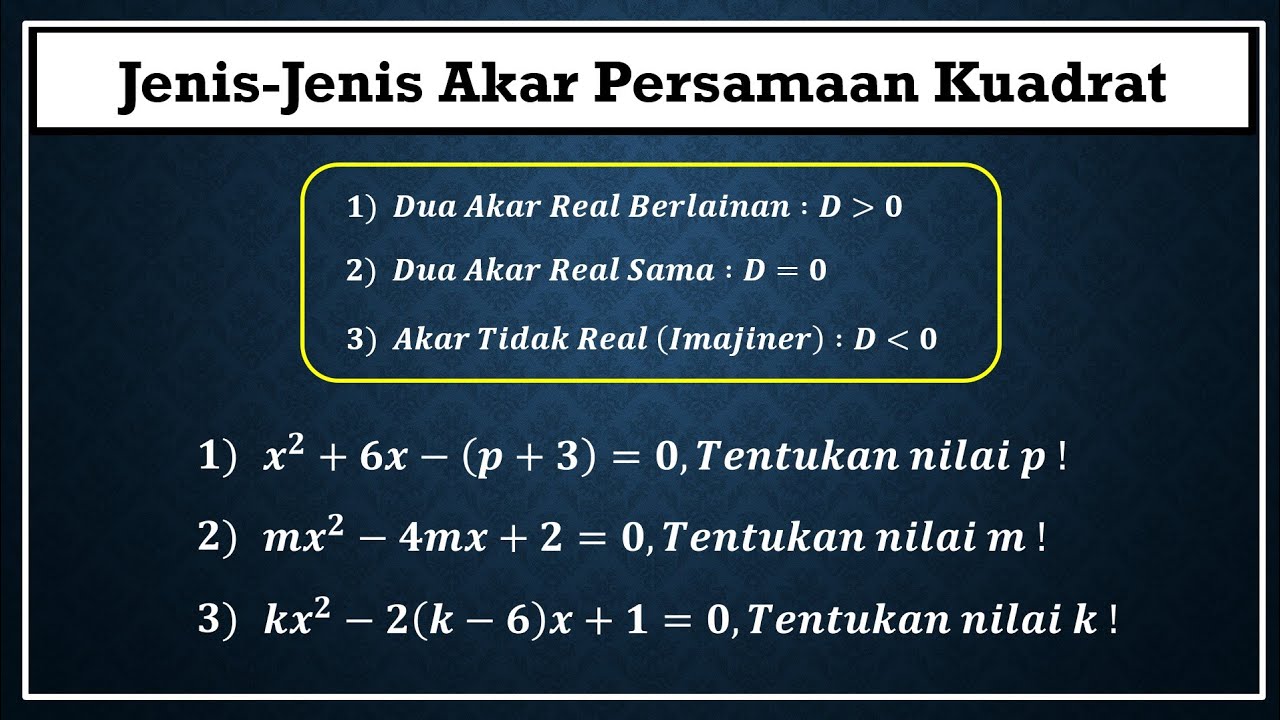
Jenis-jenis akar persamaan kuadrat || akar real berbeda, akar real sama, akar tidal real (IMAJINER)
Matematika Kelas 9 : Fungsi Kuadrat (Part 1 : Bentuk umum dan grafik fungsi kuadrat)
THE NATURE OF THE ROOTS OF A QUADRATIC EQUATION USING THE DISCRIMINANT || GRADE 9 MATHEMATICS Q1

Fungsi Kuadrat Kelas 10 Kurikulum Merdeka

Fungsi Kuadrat [Part 7] - Grafik Fungsi Kuadrat
5.0 / 5 (0 votes)
