Ship Rolling Period: Determine the Metacentric Height (GM) Easily Using Rolling Period
Summary
TLDRThis video explains how to determine a ship's metacentric height (GM) using the rolling period method, a practical approach for assessing ship stability, especially at sea. It covers the definition of GM, its importance for ship stability, and how to calculate it using the ship's rolling period, beam, and rolling coefficient. The video also provides a step-by-step example for a loaded ship, showing how different rolling coefficients affect GM. The method is emphasized as both quick and useful, particularly for onboard assessments during operations.
Takeaways
- ⚓ Understanding ship stability is essential for safe operations at sea.
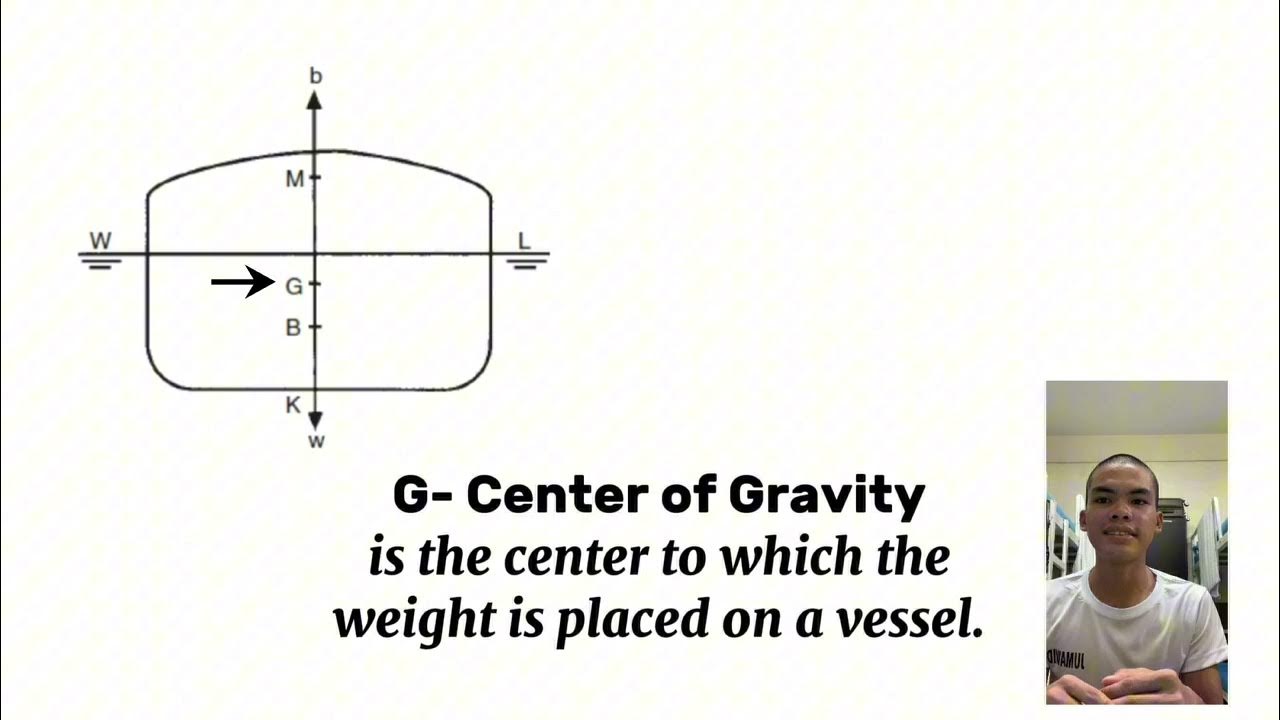
- 📏 The metacentric height (GM) is the vertical distance from the ship's center of gravity to the metacenter, crucial for stability.
- 🛳️ Initial GM for cargo ships should not be less than 0.15 m, corrected for free surface effect.
- ⏱️ The rolling period method is a practical way to determine a ship's GM while at sea.
- 🔄 Rolling period is the time for a ship to complete one full oscillation from one side to the other and back.
- 📊 GM can be approximated using the formula: GM = K × B / T², where K is a constant or rolling coefficient, B is the ship's beam, and T is the rolling period in seconds.
- 📚 The rolling coefficient varies with ship type and loading condition: 0.88 for empty ships, 0.78 for 20% load, 0.75 for 10% load, 0.73 for 5% load.
- 📐 For loaded ships, the rolling coefficient should be checked in the ship’s stability manual or consulted with the shipbuilder if unknown.
- -
- 🖩 Pre-calculated GM tables prepared by the chief officer can be used on board for quick reference.
- -
- 📌 Example: A loaded ship with a beam of 23.25 m and rolling period of 12 seconds has an approximate GM of 2.28 m using a rolling coefficient of 0.78.
- -
- 🎯 Rolling period directly affects GM: a longer rolling period indicates a smaller GM, reflecting lower initial stability.
Q & A
What is the role of metacentric height (GM) in ship stability?
-Metacentric height (GM) is the vertical distance between the ship's center of gravity and its metacenter. It plays a crucial role in determining the ship's stability, as it influences the ship's ability to return to an upright position after being tilted by external forces like wind or waves.
How is metacentric height (GM) typically calculated?
-GM is typically calculated before the ship's departure, with the initial value for cargo ships not being less than 0.15 meters, corrected for free surface effects. It involves the measurement of the ship's center of gravity and the metacenter.
What is the rolling period of a ship?
-The rolling period of a ship refers to the time it takes to complete one full oscillation, or roll, from one extreme position (e.g., maximum port tilt) to the other extreme (e.g., maximum starboard tilt) and back to its starting position.
How is the rolling period used to calculate GM?
-To calculate GM using the rolling period, we use the formula where GM is determined based on the ship's rolling period, beam, and a constant (K) that varies depending on the measurement system (English or metric). The rolling period is measured in seconds, and the result is used to estimate GM.
What constants are used in the formula for calculating GM?
-The constant used in the formula depends on the measurement system: 0.44 for the English system and 0.797 for the metric system.
What is the rolling coefficient, and why is it important?
-The rolling coefficient is a value that replaces the constant K in the formula when calculating GM. It is used to adjust the calculation based on the ship's specific condition (e.g., empty, loaded, or with liquid tanks). This coefficient helps provide more accurate results during practical applications on board.
What rolling coefficient values are typically used for different ship conditions?
-Typical rolling coefficient values are as follows: 0.88 for empty ships with ballast, 0.78 for loaded ships with 20% of total load, 0.75 for ships with 10% of total load, and 0.73 for ships with 5% of total load. These values can vary depending on the ship's type and specific condition.
What would be the GM for a loaded ship with a beam of 23.25 meters and a rolling period of 12 seconds?
-For a loaded ship with a beam of 23.25 meters and a rolling period of 12 seconds, using a rolling coefficient of 0.78, the approximate GM would be 2.28 meters.
How does the rolling period affect the GM value?
-The rolling period directly impacts the GM value. A longer rolling period results in a lower GM, while a shorter rolling period typically leads to a higher GM. For example, with a rolling period of 15 seconds, the GM would be 1.46 meters, which is lower than the GM for a rolling period of 12 seconds (2.28 meters).
Why is it important to check the ship's rolling coefficient table or consult the shipbuilder?
-It is important to check the rolling coefficient table or consult the shipbuilder because the rolling coefficient can vary depending on the ship's type, load condition, and specific characteristics. Using the correct coefficient ensures accurate calculations and reliable stability assessments.
Outlines

This section is available to paid users only. Please upgrade to access this part.
Upgrade NowMindmap

This section is available to paid users only. Please upgrade to access this part.
Upgrade NowKeywords

This section is available to paid users only. Please upgrade to access this part.
Upgrade NowHighlights

This section is available to paid users only. Please upgrade to access this part.
Upgrade NowTranscripts

This section is available to paid users only. Please upgrade to access this part.
Upgrade NowBrowse More Related Video

Shift of Ship's Center of Gravity (Part2) when Adding Weight ll Calculate Final KG
Stability Nomenclature| Importance of Ship’s Stability

Calculate Fluid GM l Multiple Weight I Initial Metacentric height l Final KG l Stability Calculation

How ship's Center of Gravity (G) moves?
Naval Arch 04 - Effects of Loading on Stability
Naval Arch 03 - Intact Stability
5.0 / 5 (0 votes)
