KBM daring 8 april
Summary
TLDRIn this chemistry class, the teacher introduces the concept of 'mol,' a fundamental unit used to measure the amount of substance. The lesson covers important topics such as atomic mass, isotopes, atomic mass averages, relative atomic mass (AR), and molecular weight (MR). The teacher explains the relationship between these concepts and demonstrates how to calculate MR and mols using examples. Additionally, students are guided on stoichiometry, focusing on using formulas to convert between mass, mols, and particle numbers. The class ends with a reminder to stay engaged in the group for further learning and assignments.
Takeaways
- 😀 The lesson introduces the concept of the mole as a unit for the amount of substance, similar to how liters measure volume.
- 😀 Prerequisite knowledge includes understanding Relative Molecular Mass (MR) and Atomic Mass (AR).
- 😀 Atomic mass is calculated as an average of isotopes, weighted by their natural abundance.
- 😀 Relative atomic mass (AR) compares the average atomic mass of an element to one carbon-12 atom.
- 😀 MR is calculated by summing the relative atomic masses of all atoms in a molecule, including cases with parentheses and coefficients.
- 😀 Avogadro's number (6.02 × 10^23) is used to convert between the number of particles and moles.
- 😀 The formula for calculating moles from particles is: moles = number of particles ÷ Avogadro's number.
- 😀 The formula for calculating moles from mass is: moles = mass ÷ MR, and can be rearranged to find mass or MR.
- 😀 The lesson emphasizes understanding and practicing formula rearrangements for stoichiometry calculations.
- 😀 The instructor encourages using these concepts for future chemistry and science-related studies and provides follow-up exercises via class groups.
Q & A
What is the concept of mol in chemistry?
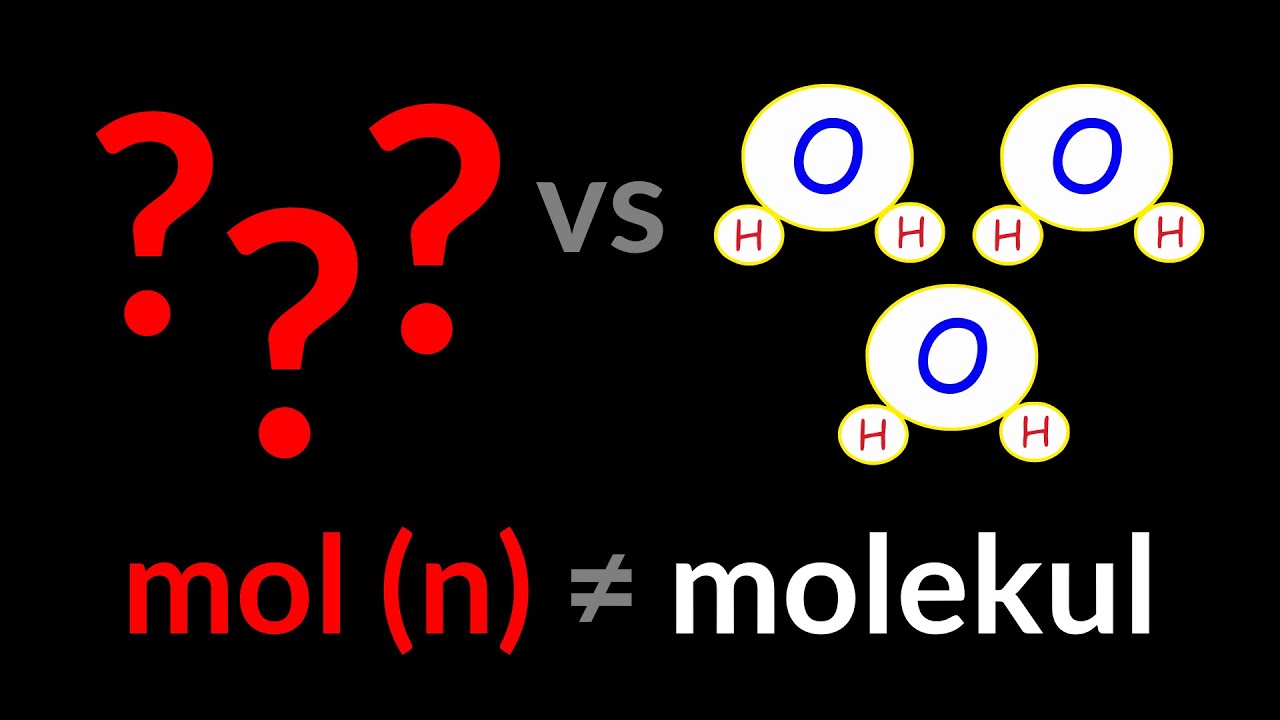
-Mol is a unit used to measure the amount of a substance. It represents the number of particles (atoms, molecules, etc.) in a sample and is equivalent to 6.02 × 10^23 particles, known as Avogadro's number.
How is mol different from other units of measurement like liters?
-Mol measures the quantity of particles in a substance, whereas liters measure volume. For example, liters are used for liquids, but mol is used for counting the number of molecules or atoms in a given amount of substance.
What does MR (Molar Mass) represent in chemistry?
-Molar Mass (MR) is the sum of the atomic masses of all atoms in a molecule. It is calculated by adding the atomic masses (AR) of each element in the compound, which helps determine the mass of one mole of a substance.
What is the importance of MR in chemical calculations?
-MR is crucial for stoichiometric calculations in chemistry. It allows the calculation of how much of a substance is involved in a chemical reaction, as it helps relate the mass of a substance to the number of moles present.
What is an isotope, and how does it affect the calculation of atomic mass?
-An isotope is an atom of the same element that has the same number of protons but a different number of neutrons, leading to a different atomic mass. The average atomic mass of an element is calculated by considering the percentages of each isotope and their respective masses.
Can you explain the calculation for the average atomic mass?
-The average atomic mass is calculated by multiplying the mass of each isotope by its relative abundance (percentage), summing these values, and then dividing by 100. This gives the weighted average atomic mass of an element.
What is the role of Carbon-12 in determining relative atomic mass?
-Carbon-12 is used as the standard for atomic mass measurements. The atomic mass of other elements is compared to the mass of one atom of Carbon-12, which is assigned a value of 12 atomic mass units (amu).
How do you calculate the molar mass of a compound like H2SO4?
-To calculate the molar mass of a compound, add the atomic masses of each element in the compound multiplied by the number of atoms present. For H2SO4, the molar mass is calculated as (2 × 1) + (1 × 32) + (4 × 16) = 98 g/mol.
What is the relationship between mol and the number of particles in a substance?
-The number of moles of a substance is directly related to the number of particles by Avogadro's number. One mole of any substance contains exactly 6.02 × 10^23 particles (atoms, molecules, etc.).
How do you convert between grams and moles for a substance like glucose (C6H12O6)?
-To convert between grams and moles, divide the mass of the substance by its molar mass. For glucose, first calculate the molar mass (C6H12O6 = (6×12) + (12×1) + (6×16) = 180 g/mol), then use the formula: moles = mass (g) / molar mass (g/mol).
Outlines

This section is available to paid users only. Please upgrade to access this part.
Upgrade NowMindmap

This section is available to paid users only. Please upgrade to access this part.
Upgrade NowKeywords

This section is available to paid users only. Please upgrade to access this part.
Upgrade NowHighlights

This section is available to paid users only. Please upgrade to access this part.
Upgrade NowTranscripts

This section is available to paid users only. Please upgrade to access this part.
Upgrade Now




5.0 / 5 (0 votes)
