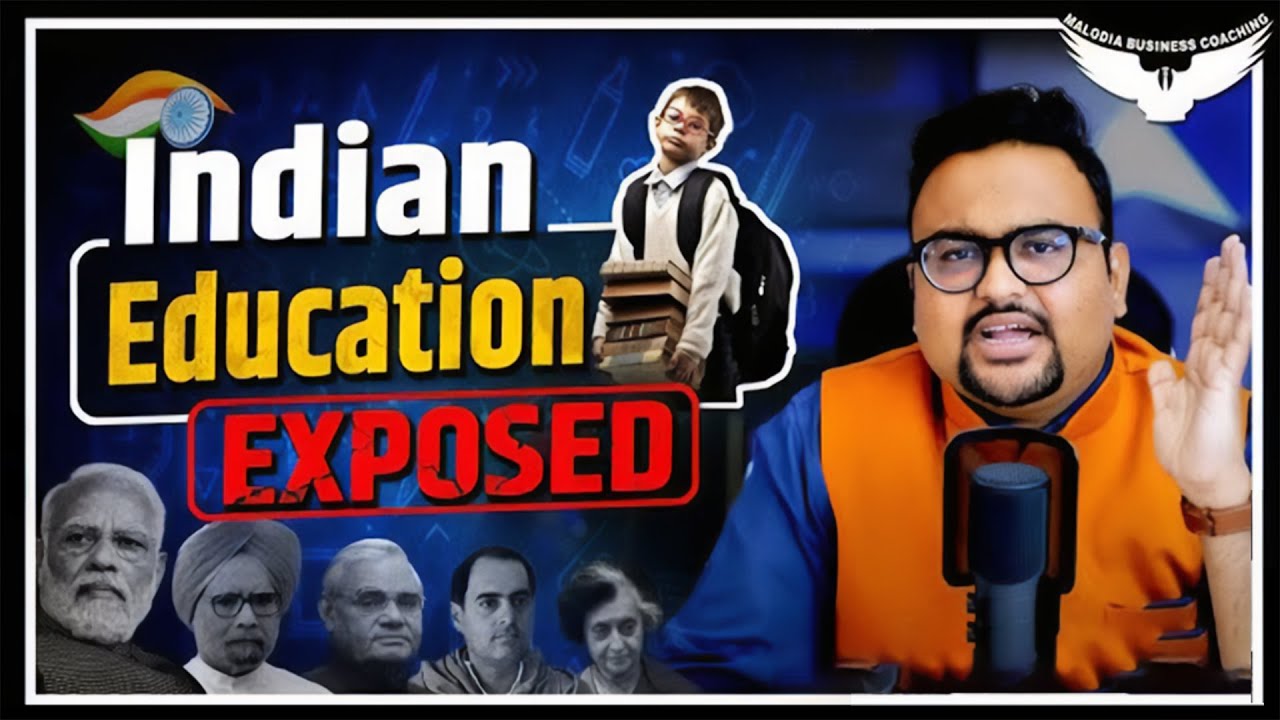
Indian Education System Exposed | Full Documentary🔥
Summary
TLDRThe video critically examines the Indian education system, tracing its roots to British colonial policies that prioritized obedience over creativity. It highlights systemic flaws, including rote learning, fear-based discipline, and outdated curricula that fail to equip students with real-world skills. Through personal anecdotes, the speaker contrasts government and private schools, exposing both the commercial motives and the gaps in teaching quality. Emphasizing self-education, leadership, and parental support, the video encourages students to pursue their passions and develop practical skills beyond traditional academics. The key message is that true success requires bypassing systemic limitations and creating one’s own path.
Takeaways
- 😀 The Indian education system has deep historical roots, shaped by British colonialism, aiming to create employees who serve colonial interests.
- 😀 The education system focuses on conformity, memorization, and following rules, rather than fostering creativity and critical thinking.
- 😀 English was prioritized over Indian languages during colonial rule, leading to the gradual decline of native languages like Sanskrit.
- 😀 Lord Macaulay's education policy in 1835 laid the foundation for the system, which was designed to create a workforce loyal to British rulers.
- 😀 The current school system still mimics factory-like conditions, preparing students for a lifetime of obedience and repetitive tasks in the corporate world.
- 😀 The education system values rote learning over practical knowledge, discouraging students from thinking outside the box or applying concepts in real-world scenarios.
- 😀 Students are often forced to conform to societal expectations, like becoming doctors or engineers, which leads to mental stress, burnout, and even tragic consequences like suicides.
- 😀 The focus on grades and standardized testing does not encourage understanding, leaving students unprepared for real-world challenges and job market requirements.
- 😀 The traditional education system limits the development of leadership skills and independent thinking, instead of nurturing a creative, entrepreneurial mindset.
- 😀 To bring real change, the education system needs to shift towards a more holistic approach that encourages students to explore their passions and think critically, beyond societal pressures.
Q & A
What is the main criticism of the Indian education system presented in the script?
-The script argues that the Indian education system is outdated and designed to produce obedient employees rather than creative thinkers, focusing heavily on rote learning and theoretical knowledge instead of practical skills and innovation.
How did the British influence the Indian education system?
-According to the script, the British introduced an education system aimed at creating workers who could follow orders, communicate in English, and serve colonial administration, rather than fostering independent thinking or leadership.
What role did Lord Macaulay play in shaping the education system?
-Lord Macaulay is portrayed as a key figure who helped design an education policy that prioritized English language learning and structured schooling to create disciplined workers aligned with British interests.
Why does the script criticize the use of strict schedules and bells in schools?
-The script claims that structured schedules and bells were introduced to condition students to follow fixed routines, similar to factory workers, limiting their freedom and independent thinking.
What is the script's view on creativity in the education system?
-The script suggests that creativity is suppressed because students are trained to memorize fixed answers (like 'A for Apple') instead of thinking freely or exploring alternative ideas.
How does the script describe the impact of fear in education?
-It argues that fear of punishment, low marks, or authority discourages students from thinking independently and pushes them to blindly follow instructions.
What issue does the script highlight regarding collaboration among students?
-The script points out that students are discouraged from helping each other, especially during exams, which fosters competition over collaboration and limits collective growth.
Why does the script claim there is a gap between education and real-world skills?
-It states that schools teach theoretical concepts that are rarely used in real life, while practical skills like financial management, communication, and entrepreneurship are largely ignored.
What problems does the script identify with teachers and schools?
-The script mentions issues such as underpaid teachers, lack of passion among some educators, poor infrastructure in government schools, and private schools focusing more on business and appearance than quality education.
How does the script view the pressure placed on students by parents and society?
-It criticizes societal pressure to pursue conventional careers like engineering or government jobs, which can suppress a child's true interests and even lead to mental health issues or extreme outcomes.
What alternative approach to education does the script suggest?
-The script encourages self-education, skill development, independent thinking, and pursuing one's passions instead of blindly following the traditional education system.
How does the script define success outside the traditional system?
-Success is described as achieving financial independence, personal satisfaction, and growth through skills, creativity, and entrepreneurship rather than relying solely on degrees and jobs.
What is meant by the 'matrix' in the script?
-The 'matrix' refers to the structured system of education and societal expectations that restrict individuals' thinking and potential, keeping them confined to conventional paths.
Why does the script emphasize early decision-making in life?
-It suggests that making bold decisions early can help individuals avoid regret later in life and pursue opportunities aligned with their passions and goals.
What final message does the script convey to students and viewers?
-The script encourages viewers to take control of their lives, question the system, pursue what they truly enjoy, and not be afraid to step outside traditional paths to achieve success.
Outlines

This section is available to paid users only. Please upgrade to access this part.
Upgrade NowMindmap

This section is available to paid users only. Please upgrade to access this part.
Upgrade NowKeywords

This section is available to paid users only. Please upgrade to access this part.
Upgrade NowHighlights

This section is available to paid users only. Please upgrade to access this part.
Upgrade NowTranscripts

This section is available to paid users only. Please upgrade to access this part.
Upgrade NowBrowse More Related Video

School of Law Mitali Srivastava 2023 24 Historical background of CAG
Indian Education System Exposed By Rahul Malodia

The interesting story of our educational system | Adhitya Iyer | TEDxCRCE

Why Ancient Indian Women are Always shown TOPLESS?

The 3 Myths of the Indian Education System | Vinay Menon | TEDxThiruvananthapuram

Civilising the Native Educating the Nation Class 8 History | CBSE | NCERT | Class 8 History
5.0 / 5 (0 votes)
