Kimia Kelas 11: Teori Tumbukan dan Laju Reaksi | Portal Sekolah
Summary
TLDRThis educational script explains the collision theory of chemical reactions, highlighting the factors that influence reaction rates such as temperature, concentration, surface area, and catalysts. It introduces the concept of activation energy—the minimum energy required for reactions to occur—and explores how increasing temperature or altering the concentration of reactants can accelerate reactions. Through relatable examples like the combustion of paper and the use of catalysts, the script emphasizes the importance of effective collisions and the energy required for them to lead to the formation of products. The engaging format includes music and audience interaction to keep the lesson dynamic.
Takeaways
- 😀 Reactions occur when particles collide with sufficient energy and correct orientation, according to the collision theory.
- 😀 Effective collisions produce products, while ineffective ones do not result in a reaction.
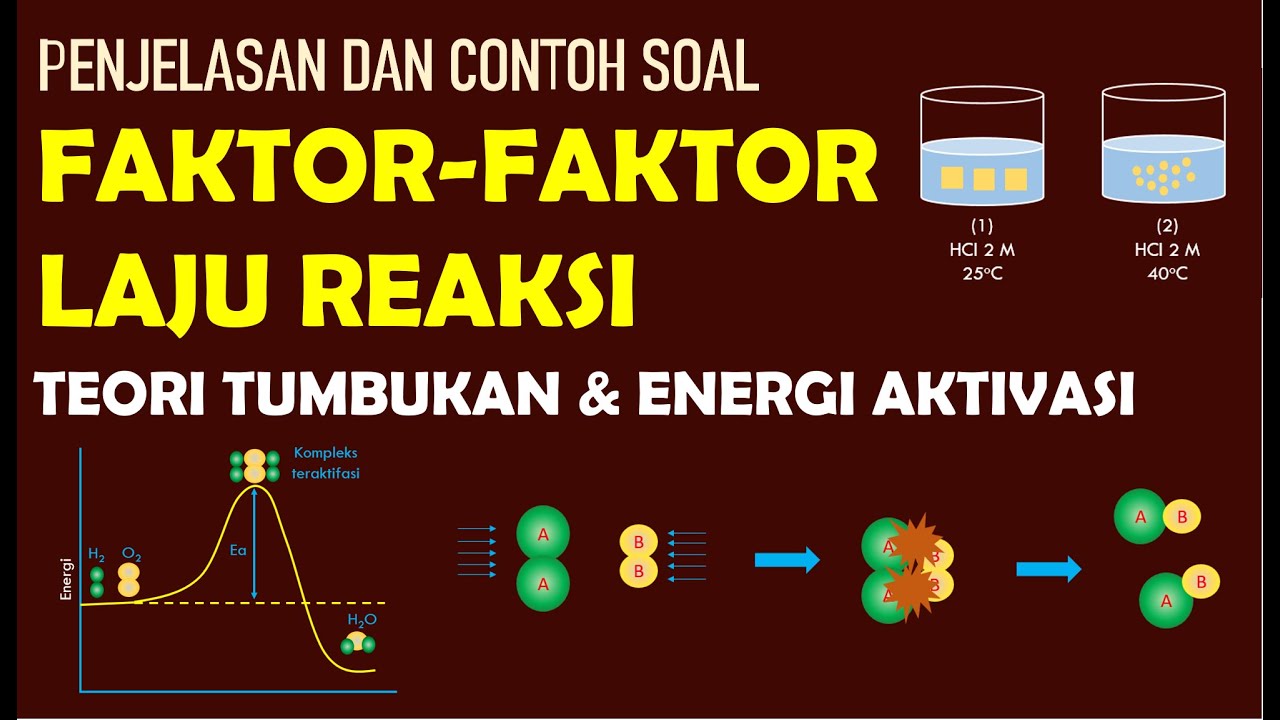
- 😀 The activation energy is the minimum energy required for a reaction to occur, and particles must possess enough energy to reach this threshold.
- 😀 Temperature plays a significant role in increasing the kinetic energy of particles, which in turn increases the frequency of collisions and the chances of effective collisions.
- 😀 Increasing the concentration of reactants increases the likelihood of collisions, leading to a faster reaction rate.
- 😀 The surface area of reactants affects reaction speed; smaller particles provide a larger surface area, facilitating more frequent collisions.
- 😀 A catalyst lowers the activation energy required for a reaction, speeding up the process without being consumed in the reaction.
- 😀 Not all chemical reactions require high temperatures; reactions with low activation energy can occur at lower temperatures.
- 😀 The example of burning paper demonstrates how external energy (heat) is necessary to overcome the activation energy barrier.
- 😀 The reaction rate for processes like rusting is faster in humid conditions due to higher concentrations of water vapor in the air.
- 😀 In practical applications, increasing temperature or surface area (such as using small sugar crystals in hot tea) speeds up reactions significantly.
Q & A
What is the relationship between temperature and reaction rate in chemical reactions?
-Increasing the temperature of a solution accelerates the reaction rate. This is because higher temperatures increase the kinetic energy of the particles involved in the reaction, leading to more frequent and effective collisions between reactant particles.
What is meant by 'effective collision' in a chemical reaction?
-An effective collision occurs when reactant particles collide with sufficient energy and proper orientation to break bonds and form new bonds, resulting in the production of products.
What is 'activation energy' and why is it important for chemical reactions?
-Activation energy is the minimum energy required for reactant particles to collide effectively and initiate a chemical reaction. It is important because a reaction will only occur if the particles have enough energy to overcome this energy barrier.
How does adding heat help in a combustion reaction, such as burning paper?
-Heat provides the necessary activation energy for the reaction. In the case of burning paper, applying heat causes the reactant particles (paper and oxygen) to acquire enough energy for an effective collision, resulting in combustion.
Why do some chemical reactions occur at lower temperatures while others require higher temperatures?
-Reactions that occur at lower temperatures typically have low activation energy, while reactions requiring higher temperatures have high activation energy. The activation energy dictates how easily the reaction can proceed at a given temperature.
What is the difference between an exothermic and an endothermic reaction in terms of activation energy?
-Both exothermic and endothermic reactions require activation energy to start. However, exothermic reactions release more energy than they consume, while endothermic reactions absorb energy from their surroundings during the reaction process.
How does the frequency of particle collisions affect the reaction rate?
-The more frequent the collisions between reactant particles, the higher the chance of effective collisions. A higher collision frequency increases the likelihood of a reaction occurring, speeding up the reaction rate.
What role does the orientation of reactant particles play in a chemical reaction?
-The orientation of reactant particles during collision is crucial for a reaction to occur. If the particles collide in the wrong orientation, the collision will be ineffective, and no product will form.
How does increasing the concentration of reactants affect the reaction rate?
-Increasing the concentration of reactants increases the number of particles in a given volume, leading to more frequent collisions. This raises the likelihood of effective collisions, thus accelerating the reaction rate.
What is the function of a catalyst in a chemical reaction?
-A catalyst is a substance that speeds up a chemical reaction by lowering the activation energy. It facilitates the reaction without being consumed in the process, allowing the reaction to proceed more quickly.
Outlines

This section is available to paid users only. Please upgrade to access this part.
Upgrade NowMindmap

This section is available to paid users only. Please upgrade to access this part.
Upgrade NowKeywords

This section is available to paid users only. Please upgrade to access this part.
Upgrade NowHighlights

This section is available to paid users only. Please upgrade to access this part.
Upgrade NowTranscripts

This section is available to paid users only. Please upgrade to access this part.
Upgrade NowBrowse More Related Video
FAKTOR LAJU REAKSI, TEORI TUMBUKAN DAN ENERGI AKTIVASI | KIMIA SMA KELAS 11

Laju Reaksi (3) | Faktor Yang mempengaruhi Laju Reaksi | Teori Laju Reaksi

6. Chemical Reactions (Part 2) (2/5) (Cambridge IGCSE Chemistry 0620 for 2023, 2024 & 2025)

Faktor-faktor Yang Mempengaruhi Laju Reaksi

[MDQ] - Cinética Química - Teoria das colisões

FAKTOR FAKTOR YANG MEMPENGARUHI LAJU REAKSI
5.0 / 5 (0 votes)
