3 01 Knapsack Recursive
Summary
TLDRThis video teaches how to solve the 0/1 Knapsack Problem using recursion and dynamic programming. It explains the core concepts, including how to identify recursive problems, build choice diagrams, and implement a recursive function for the problem. The process involves creating base conditions and reducing the problem size step by step. Through a hands-on approach, the video demonstrates the importance of decision-making at each step, whether to include or exclude an item based on the knapsack's capacity. The final solution is a recursive code that returns the maximum profit. The next video will cover optimizing this solution with memoization.
Takeaways
- 😀 Understand that the 0/1 knapsack problem involves maximizing the total value of items in the knapsack, given a weight constraint.
- 😀 Recursive approach is the first step in solving the 0/1 knapsack problem, where we have choices to include or exclude each item.
- 😀 The base condition for recursion is when there are no items or the knapsack has no capacity left, in which case the profit is zero.
- 😀 Creating a choice diagram helps visualize the recursive problem-solving process, making the code easier to write and understand.
- 😀 The two main choices for each item are: either include it in the knapsack (if it fits) or exclude it.
- 😀 For the base case, if there are no items (n == 0) or the knapsack capacity is zero (W == 0), the profit should be zero.
- 😀 Recursive calls reduce the problem size by considering the next item and either including or excluding it based on its weight and the remaining knapsack capacity.
- 😀 If an item’s weight exceeds the remaining knapsack capacity, it cannot be included, and the recursion proceeds to the next item.
- 😀 When implementing the recursive function, you need to calculate the maximum profit by comparing the results of including or excluding the item.
- 😀 After completing the recursive implementation, the next step would be to optimize the solution using memoization or dynamic programming (top-down approach).
Q & A
What is the 0/1 knapsack problem?
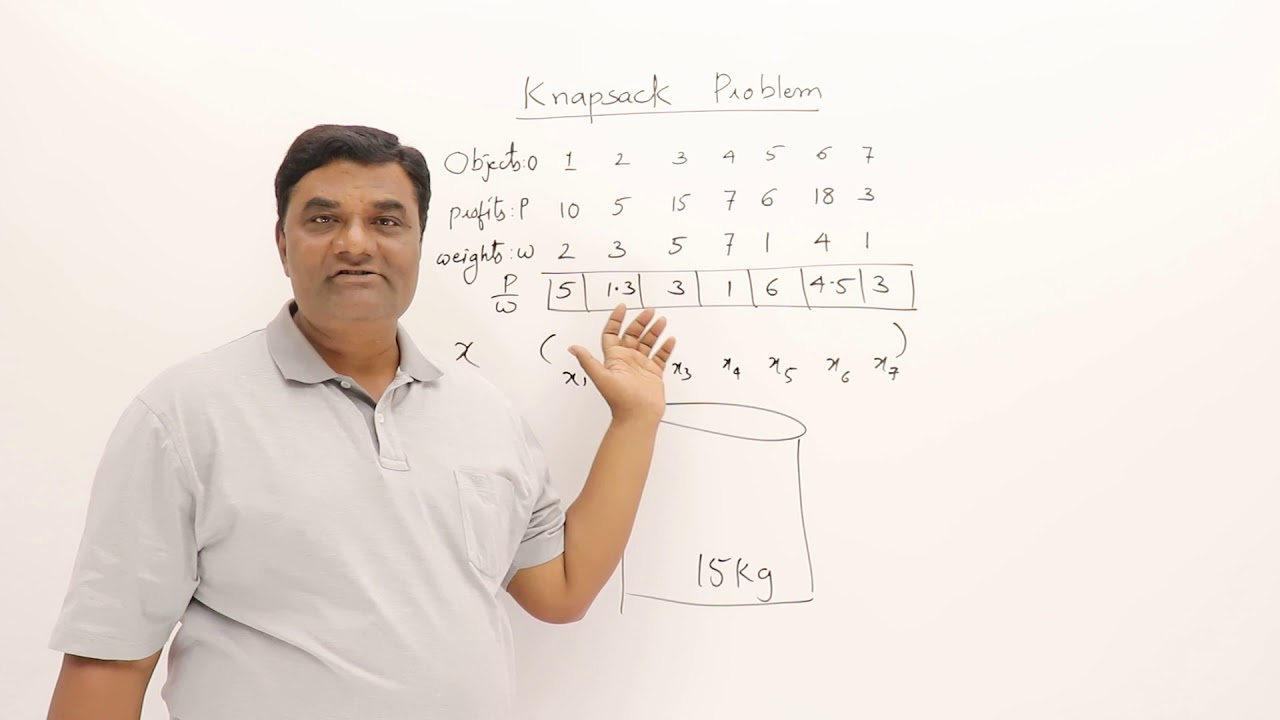
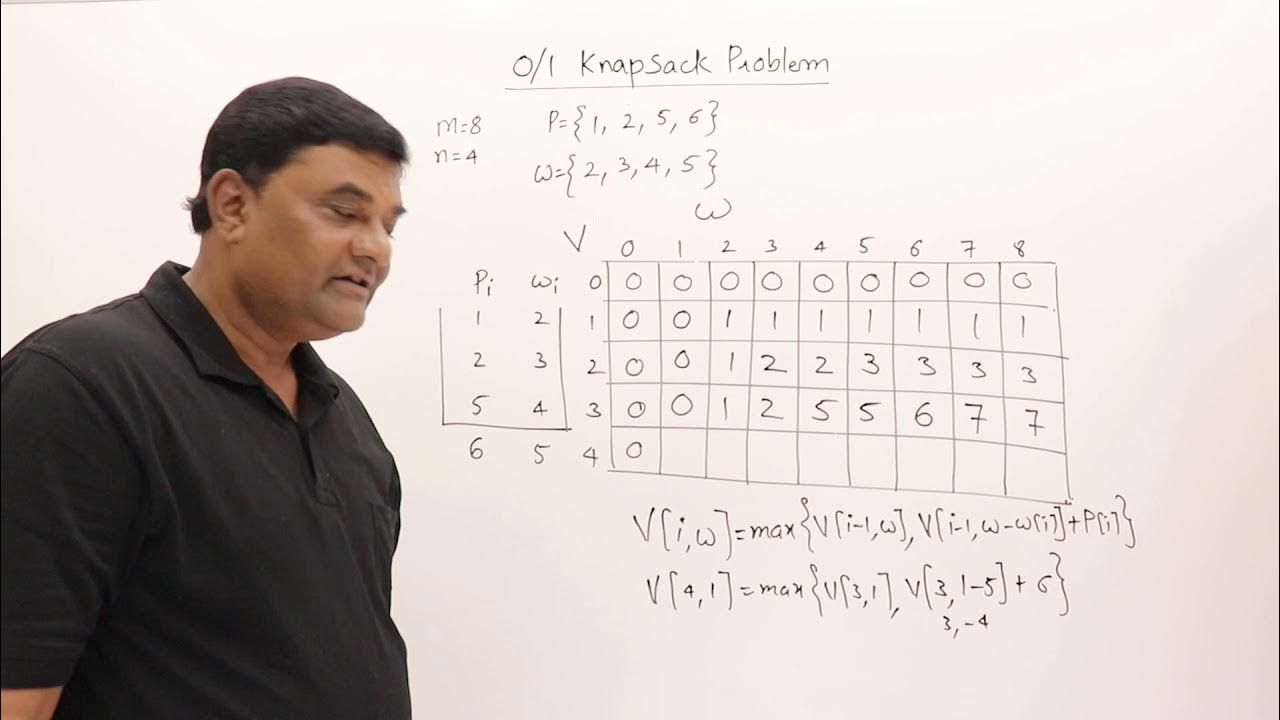
-The 0/1 knapsack problem involves selecting items with specific weights and values to maximize the total value without exceeding the capacity of the knapsack. Each item can either be included or excluded (hence 0/1).
Why is recursion used to solve the 0/1 knapsack problem?
-Recursion is effective for the 0/1 knapsack problem because it allows us to break down the problem into smaller subproblems. Each subproblem corresponds to deciding whether to include or exclude a particular item, which makes it a natural fit for recursion.
What is the base case in the recursive solution of the knapsack problem?
-The base case occurs when there are no items left (`n == 0`) or when the knapsack is full (`W == 0`). In either case, the maximum profit is zero, as there are no items to consider or no capacity to fill.
How do we decide whether to include an item in the knapsack or not?
-To decide whether to include an item, we check if its weight is less than or equal to the remaining capacity of the knapsack. If it fits, we have two choices: include it, or exclude it. If it doesn't fit, we must exclude it.
What is the recursive approach for solving the knapsack problem?
-The recursive approach involves calling the function twice for each item: once including the item (and reducing the capacity), and once excluding the item (keeping the same capacity). We return the maximum of the two recursive calls.
What happens when an item’s weight exceeds the knapsack’s remaining capacity?
-When an item's weight exceeds the knapsack's remaining capacity, it cannot be included in the knapsack. In this case, the recursive function simply skips this item and proceeds with the next.
What is the time complexity of the recursive knapsack solution?
-The time complexity of the recursive solution is exponential, specifically O(2^n), where `n` is the number of items. This is due to the fact that for each item, we are making two recursive calls (include or exclude), leading to a large number of redundant computations.
Why is a choice diagram useful in understanding the recursive approach?
-A choice diagram visually represents the decision process at each step of the recursion. It clarifies the two options for each item (include or exclude) and helps organize the flow of the recursive function, making it easier to write and debug the code.
What is the role of the 'n' parameter in the knapsack function?
-The 'n' parameter represents the number of items left to consider in the knapsack. As recursion proceeds, 'n' decreases by 1, representing the decision to include or exclude the current item.
What are the next steps after writing the recursive knapsack function?
-After writing the recursive function, the next step is to optimize it using memoization or dynamic programming to avoid redundant calculations. This will significantly improve the performance of the solution, especially for large input sizes.
Outlines

This section is available to paid users only. Please upgrade to access this part.
Upgrade NowMindmap

This section is available to paid users only. Please upgrade to access this part.
Upgrade NowKeywords

This section is available to paid users only. Please upgrade to access this part.
Upgrade NowHighlights

This section is available to paid users only. Please upgrade to access this part.
Upgrade NowTranscripts

This section is available to paid users only. Please upgrade to access this part.
Upgrade NowBrowse More Related Video

5.0 / 5 (0 votes)
