PENYEDERHANAAN HUKUM EKIVALEN IDENSPORENT, KOMUTATIF, ASOSIATI, DE MORGAN, IMPLIKASI
Summary
TLDRThis video script explains the simplification of logical expressions using various logical equivalences, such as commutative, associative, De Morgan's laws, and implications. The speaker provides examples for each law, demonstrating how to simplify complex logical formulas through the application of these rules. The content focuses on the process of transforming logical expressions by moving variables, negations, and constants, along with providing practical examples for each case. It emphasizes the importance of understanding the rules to effectively simplify logical problems in mathematics and computer science.
Takeaways
- 😀 The equivalence law simplifies logical expressions by removing redundancies in logical operations like conjunction and negation.
- 😀 The identity law states that the conjunction of a variable with itself (e.g., A AND A) simplifies to just A.
- 😀 A logical expression can be simplified if all variables or constants in the expression are the same, such as using 1 for TRUE and 0 for FALSE.
- 😀 The commutative law allows you to swap the order of conjunction (AND) and disjunction (OR) without changing the result.
- 😀 In commutative law, moving a variable or constant does not affect the logical outcome, e.g., A AND B is equivalent to B AND A.
- 😀 The associative law allows changing the grouping of operations within an expression as long as the same type of operation (AND, OR) is used throughout.
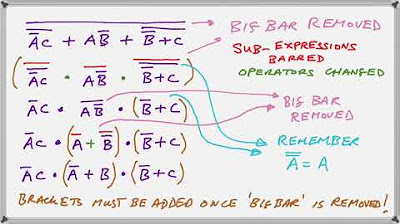
- 😀 The De Morgan's law is used for negations in logical expressions, where negation of a conjunction becomes the disjunction of negations and vice versa.
- 😀 For De Morgan's law to apply, the negation must be outside parentheses, and it only applies to conjunctions and disjunctions, not implications.
- 😀 Implication simplification involves converting an implication (A → B) into a logical expression using negation and disjunction (¬A OR B).
- 😀 Logical simplifications such as De Morgan’s and implications must preserve the structure of the expression and not alter variable groupings, ensuring the result stays consistent.
Q & A
What is the purpose of the video script provided?
-The video aims to explain how to simplify logical expressions using equivalence laws such as identity, sporen, commutative, associative, De Morgan, and implication laws.
What is the identity law in logical expressions?
-The identity law states that a variable ANDed with itself equals the variable (A ∧ A = A) and a negated variable ORed with itself equals the negation (¬A ∨ ¬A = ¬A). It is used to simplify expressions where variables or constants are repeated in the same form.
What are the main conditions for using the sporen law?
-Sporen law can be applied when all variables or constants in an expression are identical and have the same form (negated or not). It does not apply to different variables or constants and requires consistent operator usage (AND or OR).
How does the commutative law work in logical expressions?
-The commutative law allows you to swap the positions of variables or constants in an expression without changing the result. For example, A ∧ B = B ∧ A and A ∨ B = B ∨ A, as long as the operators used in the expression are consistent.
What is the associative law and how is it applied?
-The associative law permits changing the grouping of variables with parentheses in an expression without altering the outcome. For example, (A ∧ B) ∧ C = A ∧ (B ∧ C) and (A ∨ B) ∨ C = A ∨ (B ∨ C), allowing simplification of nested expressions.
Under what conditions can De Morgan's law be applied?
-De Morgan's law applies when there is a negation outside a group of variables connected by AND or OR, and the variables inside the parentheses are different. It converts negated conjunctions into disjunctions and negated disjunctions into conjunctions.
Can De Morgan's law be used with implications or constants?
-No, De Morgan's law is only valid for conjunctions (AND) and disjunctions (OR) of different variables. It does not apply to implications, bi-implications, or constants like 0 or 1.
What is the implication law in logical expressions?
-The implication law states that A → B can be rewritten as ¬A ∨ B. The simplification requires that the expression involves variables and not constants, and it does not allow repeated variables within the same implication.
How should double negations be handled in simplification?
-Double negations (¬¬A) should first be removed before applying other laws. Removing double negation simplifies the expression to its original variable or constant, which can then be further simplified using the appropriate equivalence laws.
Why is it important to maintain operator consistency when applying these laws?
-Maintaining operator consistency ensures that the result of the simplified expression remains equivalent to the original. Using mixed operators or altering the grouping improperly can change the logical value of the expression, leading to incorrect simplifications.
What is the key takeaway from using these logical equivalence laws?
-The key takeaway is that logical equivalence laws allow systematic simplification of complex logical expressions, reducing them to simpler forms involving only variables, constants, or their negations, which helps in problem-solving in digital logic and mathematical logic.
Outlines

This section is available to paid users only. Please upgrade to access this part.
Upgrade NowMindmap

This section is available to paid users only. Please upgrade to access this part.
Upgrade NowKeywords

This section is available to paid users only. Please upgrade to access this part.
Upgrade NowHighlights

This section is available to paid users only. Please upgrade to access this part.
Upgrade NowTranscripts

This section is available to paid users only. Please upgrade to access this part.
Upgrade NowBrowse More Related Video



5.0 / 5 (0 votes)
