Il Dialogo sopra i due massimi sistemi
Summary
TLDRIn this final video lesson, the focus is on Galileo Galilei's 'Dialogue Concerning the Two Chief World Systems'. The video explores the historical context of the work, its publication in 1632, and Galileo's challenge to the Catholic Church's views on the heliocentric theory. The dialogue, written in vernacular for accessibility, presents Galileo's arguments through three fictional characters: Salviati, Simplicio, and Sagredo. It critically examines Aristotle’s theories, the motion of the Earth, and the tides, while emphasizing the importance of scientific inquiry over theological authority. The video also reflects on Galileo’s influence on modern scientific thinking and his efforts to separate science from religious doctrine.
Takeaways
- 😀 Galileo Galilei's 'Dialogo sopra i due massimi sistemi' was published in 1632, presenting the Copernican theory as a hypothesis.
- 😀 The work contrasts two main cosmological systems: the geocentric (Aristotelian) and heliocentric (Copernican).
- 😀 Galileo's original title for the work was 'Dialogo sopra il flusso e il reflusso del mare' but was changed to avoid church censorship.
- 😀 The book received condemnation from the church, as the Copernican theory was deemed heretical and philosophically absurd.
- 😀 Galileo was forced to retract his views in front of the church after the work was banned and confiscated.
- 😀 The 'Dialogo' is written in Italian (vulgar language) to ensure wider accessibility, aiming to be clear, precise, and understandable.
- 😀 The work presents Copernican theory as a mathematical hypothesis, but avoids presenting it as absolute truth.
- 😀 There are three main interlocutors in the dialogue: Salviati (Galileo's spokesperson), Simplicio (defender of Aristotelian ideas), and Sagredo (a noble Venetian, Galileo's ally).
- 😀 The dialogue is divided into four days: discussing the Copernican vs. Ptolemaic systems, Earth's daily rotation, the causes of tides, and the theory of tides themselves.
- 😀 Galileo critiques Aristotelian physics, especially challenging the Aristotelian view of anatomy and the science of the time with the famous dissection scene.
- 😀 The primary goal of the 'Dialogo' was to assert the independence of science from theology and challenge the reliance on authority, urging scientific inquiry and skepticism.
Q & A
What is the primary focus of this video lesson on Galileo Galilei?
-The video focuses on Galileo's work *Dialogo sopra i due massimi sistemi*, his presentation of the Copernican model, and the conflicts he faced with the Church regarding his ideas.
Why did Galileo choose the title *Dialogo sopra i due massimi sistemi* for his work?
-Galileo chose this title to avoid censorship from the Church, which would have targeted a more provocative title, *Dialogo sopra il flusso e il reflusso del mare*, which he initially considered.
What was the significance of the title *Dialogo sopra i due massimi sistemi*?
-The title refers to the two competing world systems—the geocentric (Earth-centered) and the heliocentric (Sun-centered) models—and serves as a framework for discussing and comparing these models.
When was *Dialogo sopra i due massimi sistemi* published, and why was it controversial?
-*Dialogo* was published in 1632, and it was controversial because it supported the Copernican heliocentric model, which contradicted the Church’s teachings, leading to its condemnation and Galileo’s trial.
How did Galileo try to avoid the consequences of publishing the Copernican theory?
-Galileo presented the Copernican model as an *hypothesis* rather than a confirmed fact, which was a strategy to protect himself from direct censure and accusations of heresy.
What were the four days of dialogue in *Dialogo* about?
-The four days of dialogue in *Dialogo* cover a range of topics: the comparison between the Copernican and Ptolemaic systems, the daily rotation of the Earth, tidal movements, and the flow and reflux of the sea as evidence for heliocentrism.
Who are the three key interlocutors in the *Dialogo*, and what roles do they play?
-The three interlocutors are Filippo Salviati (Galileo’s spokesperson), Simplicio (who defends Aristotelian views), and Sagredo (a neutral Venetian noble who hosts the discussions). These characters debate the validity of various scientific theories.
What is the importance of the ‘discreet reader’ mentioned in the prologue of *Dialogo*?
-The 'discreet reader' refers to someone who can discern between truth and falsehood, highlighting the importance of critical thinking and skepticism in scientific inquiry.
What key scientific concept does *Dialogo* promote regarding knowledge and methods?
-The work promotes the idea that knowledge should be based on empirical evidence, mathematical reasoning, and observation, encouraging a method of questioning and testing, rather than accepting established dogmas.
How does *Dialogo* challenge Aristotelian physics and anatomy?
-Through a discussion of anatomical observations, *Dialogo* challenges Aristotelian beliefs, such as the incorrect understanding of nerves, showing how reliance on observation and evidence refutes older, unverified theories.
What is Galileo's stance on the relationship between science and theology in *Dialogo*?
-Galileo argues for the autonomy of science from theology, suggesting that scientific reasoning and discoveries should not be bound by theological doctrines or authorities.
Outlines

This section is available to paid users only. Please upgrade to access this part.
Upgrade NowMindmap

This section is available to paid users only. Please upgrade to access this part.
Upgrade NowKeywords

This section is available to paid users only. Please upgrade to access this part.
Upgrade NowHighlights

This section is available to paid users only. Please upgrade to access this part.
Upgrade NowTranscripts

This section is available to paid users only. Please upgrade to access this part.
Upgrade NowBrowse More Related Video
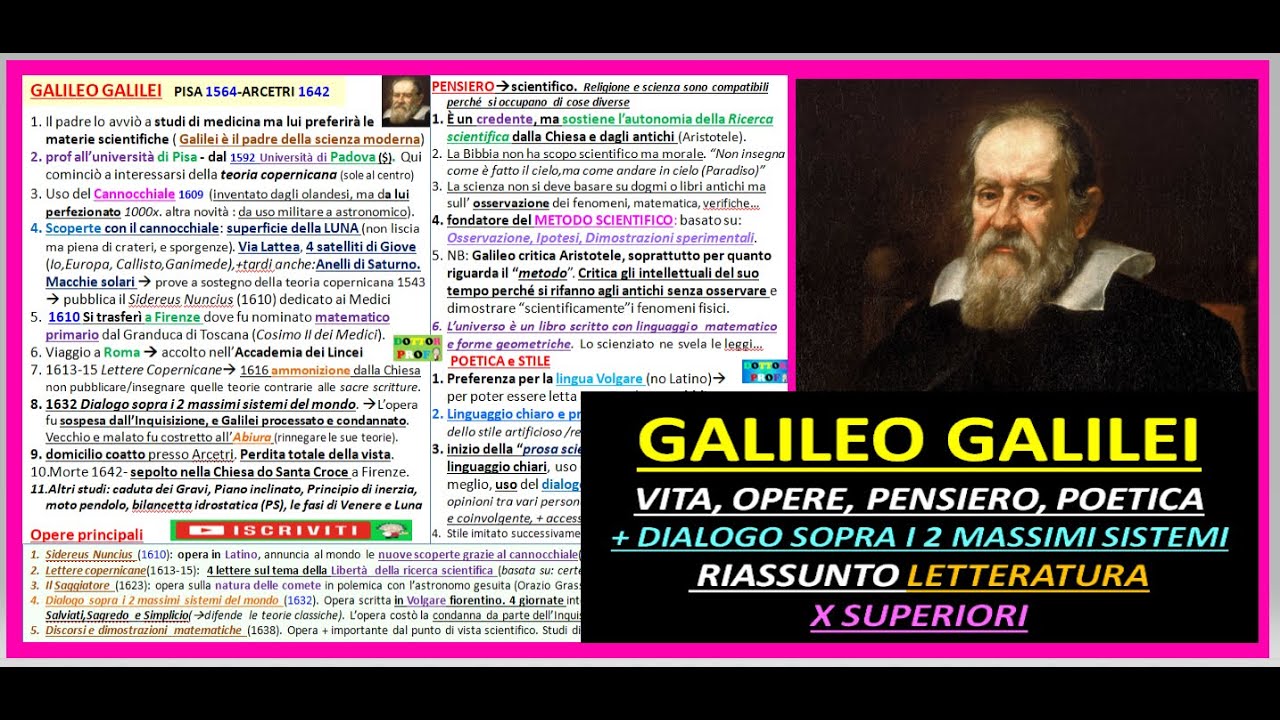
GALILEO GALILEI riassunto Vita,opere,scoperte, pensiero e poetica- letteratura x superiori
#9 Biografías científicas - Galileo Galilei, un hombre polémico

01 - O mundo da Física - Física - Ens. Médio - Telecurso

1. Galileo Galilei: la critica al principio di autorità e agli aristotelici.
History and Philosophy of Science - The origins of the Modern Science

Top 10 Innovators Who Changed The World
5.0 / 5 (0 votes)
