How you can master Economics for UPSC | Booklist and Sources | One of the highest scoring subjects
Summary
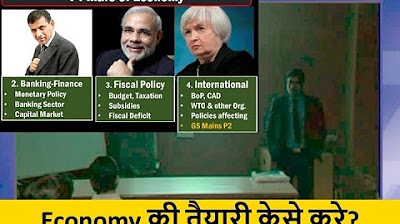
TLDRIn this video, the speaker outlines a strategic approach to studying Economics for the UPSC exam, emphasizing its importance for both Prelims and Mains. The speaker offers a structured study framework, including recommended books, YouTube channels, and resources for mastering key topics such as macroeconomics, national income, fiscal policies, and current affairs. The video highlights the significance of understanding theory while staying updated on current events, along with methods to practice and improve time management. The speaker shares personal insights into the exam’s patterns, offering guidance on how to efficiently tackle the Economics section and excel in the UPSC.
Takeaways
- 😀 Focus on understanding the framework for studying UPSC economics, which includes identifying what to study, how to study, and when to study.
- 😀 Choose the right sources for economics preparation: Nitin Singhania's book, YouTube channels like Khan Academy and Murunal's, and previous year question papers.
- 😀 Economics is a key subject for UPSC, with 10-15 questions typically asked in the prelims. A thorough understanding can significantly boost your score.
- 😀 Break down large topics into smaller, manageable portions, focusing on the most frequently asked topics from previous years' papers.
- 😀 For effective preparation, blend book study with YouTube resources, especially for difficult topics, and prioritize topics that have appeared in previous exams.
- 😀 Always go back to previous year questions (PYQs) to identify trends and focus on high-yield topics while minimizing time spent on less relevant content.
- 😀 Use a strategic approach to studying economics by structuring your study schedule around key topics such as macroeconomics, capital markets, and fiscal/monetary policies.
- 😀 Economics preparation should ideally start 1-2 months into your UPSC preparation to build a strong foundation before diving into other subjects.
- 😀 Focus on current affairs related to economics, using reliable sources like newspapers (Indian Express) and monthly current affairs magazines to stay updated.
- 😀 Don't waste time on overly detailed notes. Instead, make concise notes highlighting key concepts and important examples for quick revision.
Q & A
Why is Economics considered an important subject for the UPSC Prelims?
-Economics contributes around 10–15 questions in the UPSC Prelims, making it one of the highest-weightage subjects. With proper preparation, candidates can score 9–10 correct answers, giving them a significant edge over others.
What is the core framework suggested for studying Economics for UPSC?
-The framework consists of four main elements: what to study (sources), how to study (topic-wise structuring), when to study (timing in preparation), and how to integrate current affairs, practice tests, and previous year questions.
Which book is recommended as the primary source for Economics and why?
-Nitin Singhania’s Indian Economy book is recommended because it is easy to understand, well-structured, and covers key UPSC-relevant topics such as Indian economy, money and banking, inflation, and financial institutions.
What YouTube resources are suggested for Economics preparation?
-The recommended YouTube resources are Khan Academy (American version) for economic fundamentals, Mrunal’sUPSC Economics Preparation videos for Indian economy and finance, and Anuj Jindal’s UPSC economy lectures for conceptual clarity.
Why are Previous Year Questions (PYQs) critical in Economics preparation?
-PYQs help aspirants identify recurring and important topics, understand UPSC’s question pattern, avoid wasting time on irrelevant theory, and prioritize high-yield areas such as inflation, GDP, fiscal policy, and monetary policy.
How should large Economics topics be broken down for effective study?
-Candidates should first identify broad areas like national income, macroeconomics, banking, capital markets, economic development, and planning, and then divide them into smaller subtopics based on book chapters and PYQ trends.
Which topics in Economics require more focus based on UPSC trends?
-High-priority topics include GDP (real vs nominal), inflation, interest rates, fiscal and monetary policy, banking system, capital markets, HDI and development indices, MSP, Finance Commission, and current-affairs-linked issues.
How should current affairs be integrated with Economics preparation?
-Current affairs should be studied alongside basic theory. When an economic issue appears in news, aspirants should revisit the related concept in books or videos to understand the linkage between theory and real-world application.
What role do newspapers and monthly magazines play in Economics preparation?
-Newspapers like The Indian Express help in daily conceptual exposure, while monthly current affairs magazines consolidate economic issues. Candidates should rely on one newspaper and one monthly magazine rather than multiple sources.
Why is note-making discouraged in detail for Economics?
-Detailed notes consume excessive time and are often redundant. Instead, aspirants should make very short notes containing key definitions, concepts, and examples for quick revision, as conceptual understanding matters more than memorization.
How should aspirants practice Economics questions effectively?
-Aspirants should solve PYQs repeatedly, take subject-specific mock tests after completing the syllabus, and focus on improving time management and decision-making during MCQs.
How do UPSC Economics questions combine theory and current affairs?
-UPSC often links theoretical concepts like inflation and monetary policy with real-world events such as post-pandemic interest rate hikes by central banks, making questions predictable if concepts are clear.
What is the importance of understanding capital markets versus money markets?
-UPSC frequently tests the distinction between capital markets and money markets. Understanding instruments like government bonds, treasury bills, stock markets, and call money markets is essential to answer such questions accurately.
How should aspirants approach unfamiliar factual questions like Niger seed MSP?
-In such cases, candidates should use logical elimination, partial knowledge, and educated guessing based on known facts, as UPSC sometimes includes applied reasoning rather than direct recall.
When should Economics ideally be studied during UPSC preparation?
-Economics should ideally be completed early in preparation, within the first few weeks, and finished in about 1.5 to 2 months, as it is a high-weightage subject that builds conceptual strength for other areas.
Outlines

This section is available to paid users only. Please upgrade to access this part.
Upgrade NowMindmap

This section is available to paid users only. Please upgrade to access this part.
Upgrade NowKeywords

This section is available to paid users only. Please upgrade to access this part.
Upgrade NowHighlights

This section is available to paid users only. Please upgrade to access this part.
Upgrade NowTranscripts

This section is available to paid users only. Please upgrade to access this part.
Upgrade NowBrowse More Related Video

कौन से Subject से UPSC में First Attempt में Selection होता है? By Sachin Jain Sir IRS 2016

Strategy for UPSC 2025 | 12 months Plan for UPSC CSE 2025 with Daily targets

IBPS PO 2025 Complete Information | Best Books Kit to Prepare for the Exams

Non Negotiable Plan for PRELIMS 2025 (Only for Serious Aspirants)

SEIZE THE MAINS | Day - 144 | Counter Terrorism | UPSC CSE |
L1/P1: Economy Overview, How to prepare it for UPSC
5.0 / 5 (0 votes)
