Learn Japanese Lessons in Tagalog | How to Tell the Date and Days in Japanese EV | JFT, JLPT Review
Summary
TLDRIn this lesson from Wireless Online of Oyster, viewers learn how to express dates and days of the week in Japanese. The video covers key topics such as how to say the year, months, and specific days of the month, with special attention given to exceptions for certain dates like the 1st, 4th, 14th, 20th, and 24th. The lesson also teaches the days of the week, connecting each day with its corresponding element in Japanese. The video concludes by providing practical examples, encouraging viewers to practice by writing down the date and day they watched the lesson.
Takeaways
- 😀 In Japanese, the year is stated by adding 'nen' (年) after the number, such as 2021 being 'nisen nijūichi-nen' (二千二十一年).
- 😀 Japanese months are similar to English, with each month numbered, e.g., January is 'ichigatsu' (一月), February is 'nigatsu' (二月), and so on.
- 😀 Some months have unique names, such as July ('shichigatsu' 七月) instead of 'nanagatsu' (七月) and September ('kugatsu' 九月) instead of 'kyūgatsu' (九月).
- 😀 The day of the month is expressed using 'nichi' (日) after the number, but special names are used for the first 10 days, including the 4th, 14th, and 24th.
- 😀 The 1st day of the month is 'tsuitachi' (一日), the 2nd is 'futsuka' (二日), and the 4th day is 'yokka' (四日), with unique readings for these days.
- 😀 For the 20th day of the month, the term 'hatsuka' (二十日) is used, which is a unique exception.
- 😀 Days of the week in Japanese are named after celestial bodies, with Monday as 'getsuyōbi' (月曜日), Tuesday as 'kayōbi' (火曜日), and so on.
- 😀 Wednesday is 'suiyōbi' (水曜日), which literally means 'water day', and Thursday is 'mokuyōbi' (木曜日), meaning 'wood day'.
- 😀 Friday is 'kin'yōbi' (金曜日), which means 'gold day', while Saturday is 'doyōbi' (土曜日), meaning 'earth/soil day'.
- 😀 To express a specific date, such as January 4th on a Saturday, the format is 'Ichigatsu yokka doyoubi' (一月四日土曜日).
- 😀 The video encourages viewers to write down the date and day they watched the video to practice their learning.
Q & A
How do you say the year 2021 in Japanese?
-In Japanese, 2021 is said as 'Nissen ni-juu-ichi' (にせんにじゅういち), where 'Nissen' represents 2000, and 'ni-juu-ichi' represents 21.
What is the Japanese word for January?
-The Japanese word for January is 'Ichigatsu' (いちがつ), where 'ichi' means one and 'gatsu' means month.
What are the exceptions in naming the days of the month in Japanese?
-The exceptions are the 4th, 14th, and 24th days of the month, which are pronounced with unique forms: 'yoka' (よっか) for the 4th, 'juuyokka' (じゅうよっか) for the 14th, and 'nijuuyokka' (にじゅうよっか) for the 24th.
How do you say the 20th day of the month in Japanese?
-The 20th day of the month is said as 'Hatsuka' (はつか), which is different from the normal pattern of using 'nichi' (にち) after the number.
How do you say 'March 1st' in Japanese?
-'March 1st' in Japanese is 'Sangatsu tsuitachi' (さんがつついたち), where 'Sangatsu' means March and 'tsuitachi' means the first day of the month.
What is the Japanese word for Tuesday and its origin?
-The Japanese word for Tuesday is 'Kayoubi' (かようび), which originates from the word for 'fire' ('hi' or 'ka') because Tuesday is associated with fire in the traditional Japanese system.
How do you say 'Saturday' in Japanese?
-Saturday in Japanese is 'Doyoubi' (どようび), which means 'day of the soil' ('tsuchi'), representing the Earth or soil in the traditional Japanese weekday naming system.
How are months and days of the month generally said in Japanese?
-In Japanese, months are named using the number followed by 'gatsu' (month). Days of the month are said using the number followed by 'nichi' (day), except for specific days like the 1st, 2nd, 3rd, and certain other exceptions.
What is the pattern for saying the days of the month after the 10th?
-After the 10th, the days are formed by saying the number followed by 'juu' (for 10), and then adding the unit. For example, 'juuichinichi' (じゅういちにち) for the 11th, 'juuninichi' (じゅうににち) for the 12th, and so on.
How would you say 'March 30th, 2021, Tuesday' in Japanese?
-'March 30th, 2021, Tuesday' in Japanese would be 'Nissen ni-juu-ichi nen, sangatsu sanjuu-nichi, kayoubi' (にせんにじゅういちねん、さんがつさんじゅうにち、かようび). This includes the year 'Nissen ni-juu-ichi' (2021), month 'Sangatsu' (March), day 'Sanjuu-nichi' (30th), and day of the week 'Kayoubi' (Tuesday).
Outlines

This section is available to paid users only. Please upgrade to access this part.
Upgrade NowMindmap

This section is available to paid users only. Please upgrade to access this part.
Upgrade NowKeywords

This section is available to paid users only. Please upgrade to access this part.
Upgrade NowHighlights

This section is available to paid users only. Please upgrade to access this part.
Upgrade NowTranscripts

This section is available to paid users only. Please upgrade to access this part.
Upgrade NowBrowse More Related Video

Belajar Bahasa Jepang – Bab 4 Minna no Nihongo – Part 1

BULAN, TANGGAL & ULANG TAHUN | BELAJAR BAHASA JEPANG
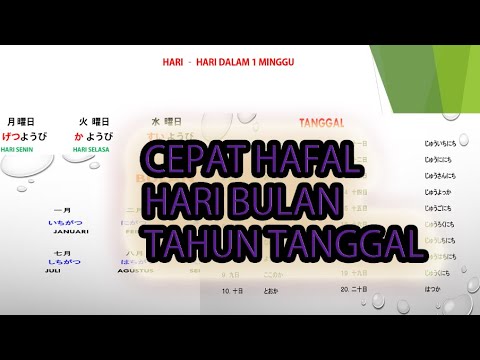
BELAJAR BAHASA JEPANG HARI TANGGAL BULAN TAHUN

Hobi (Shumi) & Frekuensi Melakukannya Dalam Bahasa Jepang

Learn Spanish: Days of the Week Made Easy!

STOP SALAH! BEGINI CARA SEBUT TANGGAL YANG BENAR DALAM BAHASA INGGRIS | TEATU - Kampung Inggris LC
5.0 / 5 (0 votes)
