The Compilation of the Quran - Essence of the Quran
Summary
TLDRThis video script provides a historical overview of the compilation of the Quran after the Prophet's (S.A.W.) passing. It covers key moments, including the leadership of Abu Bakr, Umar, Usman, and Ali in preserving and standardizing the Quranic text. It explores the initial compilation during Abu Bakr's time, the challenges with varying recitations, and the eventual creation of a unified script by Usman to resolve disputes. The script also highlights the introduction of vowel marks and dots to the Quranic text over time, culminating in its current structure.
Takeaways
- 😀 The Prophet Muhammad (saw) passed away at the age of 63, and after his demise, the caliphates of Abu Bakr, Umar, Uthman, and Ali followed in succession.
- 😀 The compilation of the Quran began during the time of Caliph Abu Bakr, triggered by the deaths of many Quran memorizers in the Battle of Yarmouk, where a large number of the companions perished.
- 😀 Under the guidance of Umar, the task of compiling the Quran was entrusted to Zayd ibn Thabit, a scribe of the Prophet, and the Quran was arranged in the order it was recited by the Prophet.
- 😀 The compilation of the Quran during Abu Bakr’s caliphate was crucial to ensure that the Quran was preserved and not lost as many companions who had memorized it were dying in battles.
- 😀 During the era of Uthman, a major dispute arose over the different regional dialects used in Quranic recitations. This led to Uthman standardizing the Quran’s script to prevent confusion and division.
- 😀 Uthman’s solution was to create a unified version of the Quran in a fixed script that allowed for different regional pronunciations while maintaining consistency.
- 😀 The Quran was initially written without diacritical marks (dots or vowels), leading to confusion in pronunciation. This issue was later resolved through the addition of diacritical marks in the time of Ali and subsequent generations.
- 😀 In the period following Uthman, the Quran was further refined, including the development of diacritical marks and vowel symbols, which helped clarify pronunciation and ensure accurate recitation.
- 😀 The Quran was divided into 30 parts (Juz), 7 manzils (sections), and 60 hizbs to facilitate recitation and memorization, especially for those reciting it over the course of a month or in shorter intervals.
- 😀 Uthman’s version of the Quran, often referred to as the 'Mushaf Uthmani', became the standard copy of the Quran, distributed across the Islamic empire, and was recognized by the Muslim community.
- 😀 The symbols and notations introduced in later years helped people recite the Quran correctly without altering its meaning, ensuring that the Quran was accessible to a broader audience for both memorization and recitation.
Q & A
What was the duration of Abu Bakr’s caliphate after the Prophet Muhammad’s (ﷺ) demise?
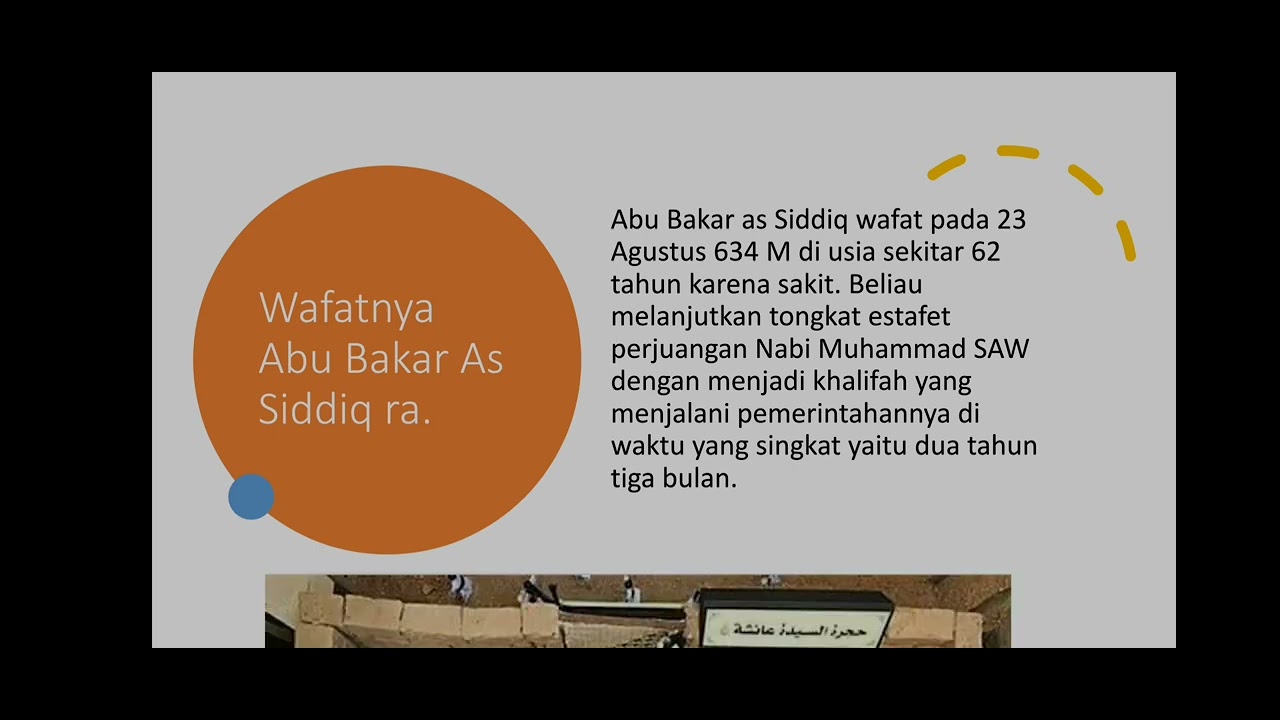
-Abu Bakr’s caliphate lasted for approximately two years after the Prophet Muhammad (ﷺ) passed away.
How long did the caliphates of Umar, Uthman, and Ali last respectively?
-Umar’s caliphate lasted about 10–11 years, Uthman’s about 12–13 years, and Ali’s around 4–5 years.
What major event during Umar’s caliphate led to the first compilation of the Qur’an?
-The Battle of Yarmouk, during which many companions who had memorized the Qur’an were martyred, prompted Umar to urge Abu Bakr to compile the Qur’an to prevent its loss.
Who was chosen to lead the first compilation of the Qur’an and why?
-Zayd ibn Thabit, one of the Prophet’s scribes, was chosen to lead the compilation because of his trustworthiness, knowledge, and expertise in Qur’anic writing.
What method was used to ensure accuracy in the first compilation of the Qur’an?
-The process was meticulous — verses were verified through both written records and the memories of multiple companions to ensure correctness and authenticity.
What issue arose during Uthman’s time that led to a new standardization of the Qur’an?
-Disputes arose among Muslims in different regions over variations in Qur’anic recitation and pronunciation, leading Uthman to standardize the written form to prevent division.
What was distinctive about the script (font) of Uthman’s standardized Qur’an?
-The script was written in a way that allowed multiple legitimate recitations to be read from it, but it initially lacked dots and vowel markings.
What does the term 'Mushaf Uthmani' refer to?
-It refers to the standardized copy of the Qur’an produced and distributed under Caliph Uthman’s supervision, not a new version but the unified text accepted by all Muslims.
When were dots and vowel markings added to the Qur’anic script?
-Dots and vowel markings were introduced approximately 50–60 years after the time of Ali’s caliphate to help non-Arab readers correctly pronounce and distinguish letters.
How and why was the Qur’an later divided into 30 parts (Juz’) and 7 sections (Manzil)?
-The Qur’an was divided into 30 Juz’ to facilitate monthly recitation and into 7 Manzil to allow completion within a week, matching the recitation habits of some companions.
What are 'Ruku' signs in the Qur’an and what is their purpose?
-Ruku signs mark suitable places to pause during recitation, often where a thematic or topical section ends, assisting readers in reciting the Qur’an coherently during prayer.
How did later scholars contribute to the development of Qur’anic symbols and notation?
-Over time, scholars added additional symbols and rules, such as stop signs and pronunciation aids, to guide correct recitation and understanding for readers of all levels.
Outlines

This section is available to paid users only. Please upgrade to access this part.
Upgrade NowMindmap

This section is available to paid users only. Please upgrade to access this part.
Upgrade NowKeywords

This section is available to paid users only. Please upgrade to access this part.
Upgrade NowHighlights

This section is available to paid users only. Please upgrade to access this part.
Upgrade NowTranscripts

This section is available to paid users only. Please upgrade to access this part.
Upgrade NowBrowse More Related Video

Pembukuan al Qur'an pasca masa Nabi Part 1

Overconfident Visitor's Ignorance About The Quran Is Exposed | Mansur | Speakers Corner

MATERI KULIAH: KODIFIKASI AL QUR'AN

Sejarah Pengumpulan dan Penulisan Al Qur'an || Qur'an Series Part 2

Sejarah Perkembangan Hadits
Sejarah Perkembangan Islam pada masa Khulafaurrasyidin
5.0 / 5 (0 votes)
